
Pluto
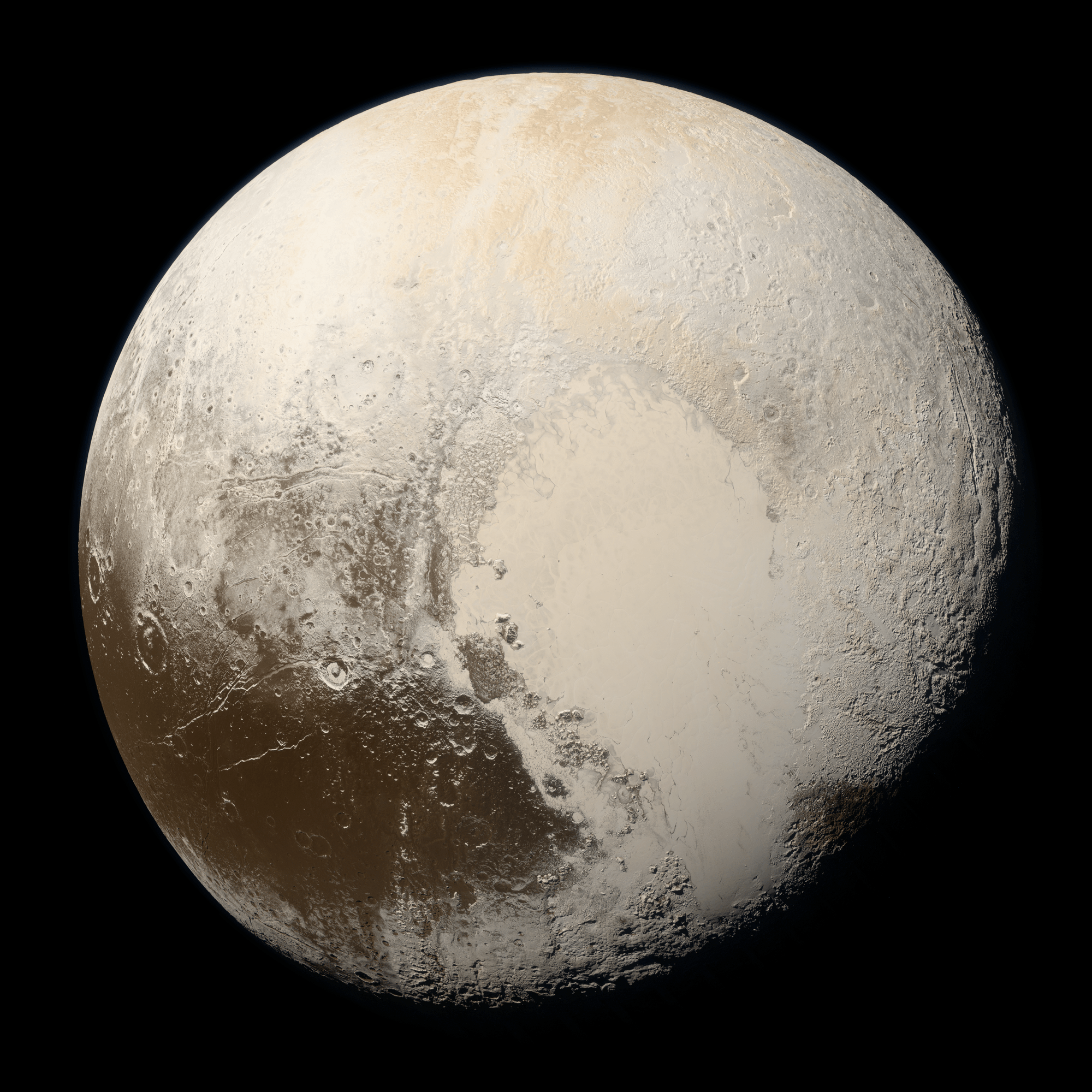
Credit: NASA/Johns Hopkins University Applied Physics Laboratory/Southwest Research Institute/Alex Parker · Public domain
Pluto is a small, icy world that orbits the Sun far beyond Neptune. Scientists call it a "dwarf planet" — a world that orbits the Sun and is round, but is not big enough to be called a planet. Pluto is only about two-thirds the size of Earth's Moon. It was discovered in 1930 by an American astronomer named Clyde Tombaugh.
For 76 years, Pluto was called the ninth planet of the solar system. In 2006, a group called the International Astronomical Union voted to change Pluto from a planet to a dwarf planet. Many people — including many scientists — are still mad about the change.
The reason for the change was that astronomers had found other icy worlds out past Neptune. One of them, called Eris, is almost the same size as Pluto. Scientists had a choice. They could keep adding new planets as they found them, or they could make the rules for what counts as a planet stricter. They made the rules stricter. Under the new rules, a planet has to orbit the Sun, be round, and have cleared the area around its orbit of other objects. Pluto passed the first two tests. But it shares its orbit with many other icy objects, so it did not pass the third test. So it was demoted.
Pluto lives in a part of the solar system called the Kuiper Belt, a zone of icy bodies beyond Neptune. Its surface is covered in frozen nitrogen and methane, with mountains made of water ice. The temperature there is colder than negative 380 degrees Fahrenheit. A year on Pluto — one full trip around the Sun — takes 248 Earth years.
For most of history, Pluto was just a tiny dot in telescopes. That changed in 2015, when NASA's New Horizons spacecraft flew past Pluto after a nine-year trip through space. The photos it sent back amazed everyone. Pluto had mountains of water ice, glaciers of frozen nitrogen, and a huge, heart-shaped plain. Scientists nicknamed the heart Sputnik Planitia.
Pluto has five moons. The biggest, Charon, is more than half the size of Pluto itself. That is very big for a moon. The two worlds actually orbit each other around a point in the empty space between them. Some astronomers think of Pluto and Charon as a double dwarf planet.
Not everyone accepts the 2006 demotion. Alan Stern, the scientist who led the New Horizons mission, still thinks Pluto should be a planet. He says the "cleared its neighborhood" rule is a bad one. By that rule, he says, Earth would not count as a planet either if you moved it out to where Pluto orbits. The argument continues, and new discoveries in the outer solar system keep shaping it.
Last updated 2026-04-20