
Comet
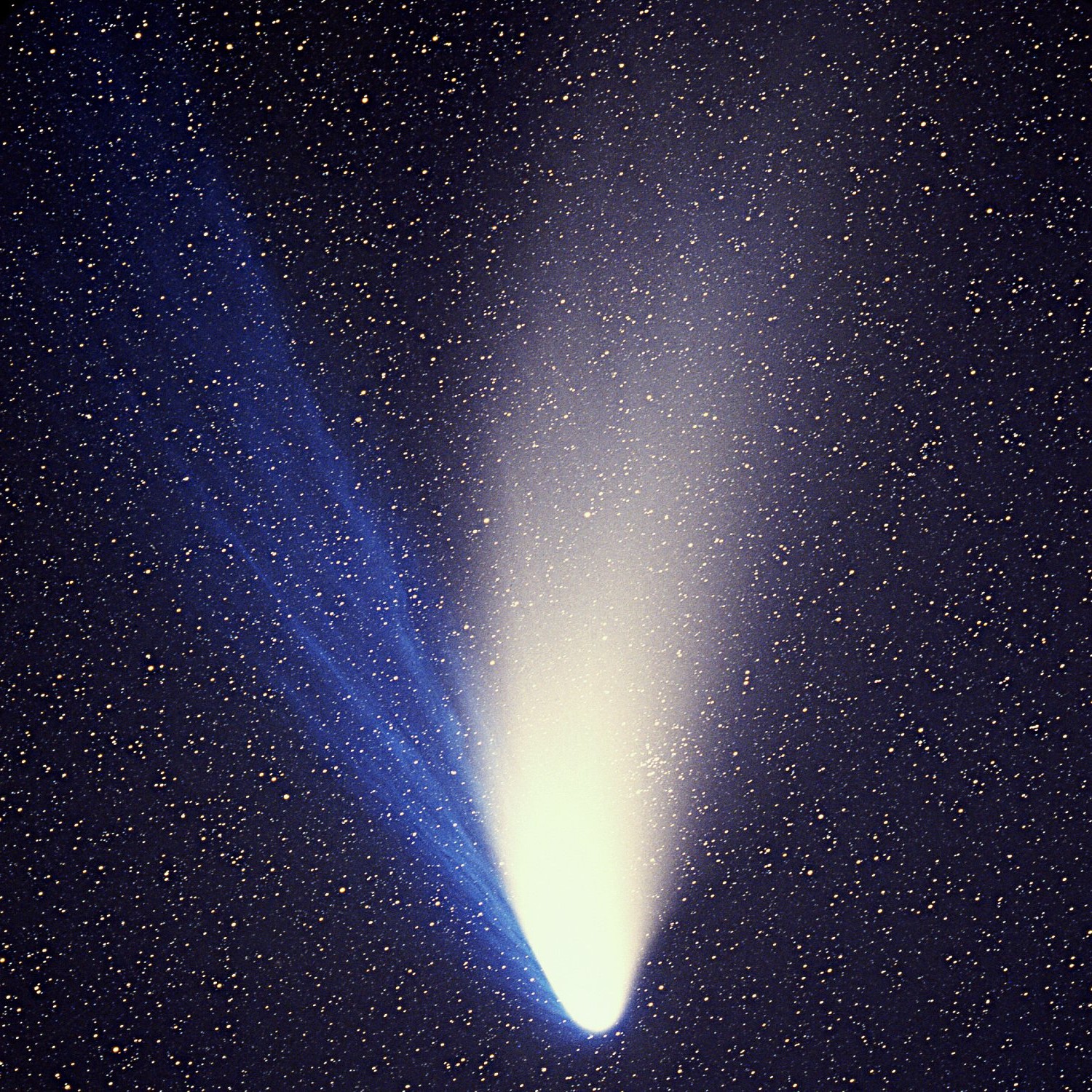
Credit: E. Kolmhofer, H. Raab; Johannes-Kepler-Observatory, Linz, Austria (https://sternwarte.at) · CC BY-SA 3.0
A comet is a small, icy object that orbits the Sun. Comets are made of frozen gases, water ice, dust, and rocky bits. Scientists sometimes call them "dirty snowballs" because of this mix. Most comets are only a few miles wide. But when a comet gets close to the Sun, it can grow a glowing tail that stretches for millions of miles.
The solid center of a comet is called the nucleus. For most of a comet's life, the nucleus is a dark, frozen lump traveling through the cold outer parts of the solar system. When a comet swings close to the Sun, heat turns the ice into gas. The gas and dust stream off into space and form two tails. One tail is made of gas and glows blue. The other is made of dust and glows white or yellow. Both tails always point away from the Sun, pushed by sunlight and by a stream of particles called the solar wind.
Comets come from two cold regions far from the Sun. Short-period comets, which return every 200 years or less, come from the Kuiper Belt beyond Neptune. Long-period comets come from the Oort Cloud, a giant shell of icy objects that may stretch a trillion miles out from the Sun. That is so far away it takes light more than a year to get there. Some long-period comets take tens of thousands of years to complete one orbit.
The most famous comet is Halley's Comet. It passes Earth about every 76 years. Ancient people spotted it as far back as 240 BCE. The next time it will be visible is in 2061. People alive today will be the first in history to know it was coming.
Comets have crashed into planets, and scientists think those crashes matter. Many researchers believe comets delivered a lot of the water in Earth's oceans billions of years ago. They may even have brought some of the chemicals that life is built from. This idea is still debated. Other scientists think most of Earth's water came from asteroids instead.
In 2014, a European spacecraft called Rosetta did something no mission had done before. It flew all the way to a comet, went into orbit around it, and dropped a small lander on its surface. The lander took pictures from the ground of an icy world only a few miles wide, drifting between the planets.
Last updated 2026-04-22