
Neptune
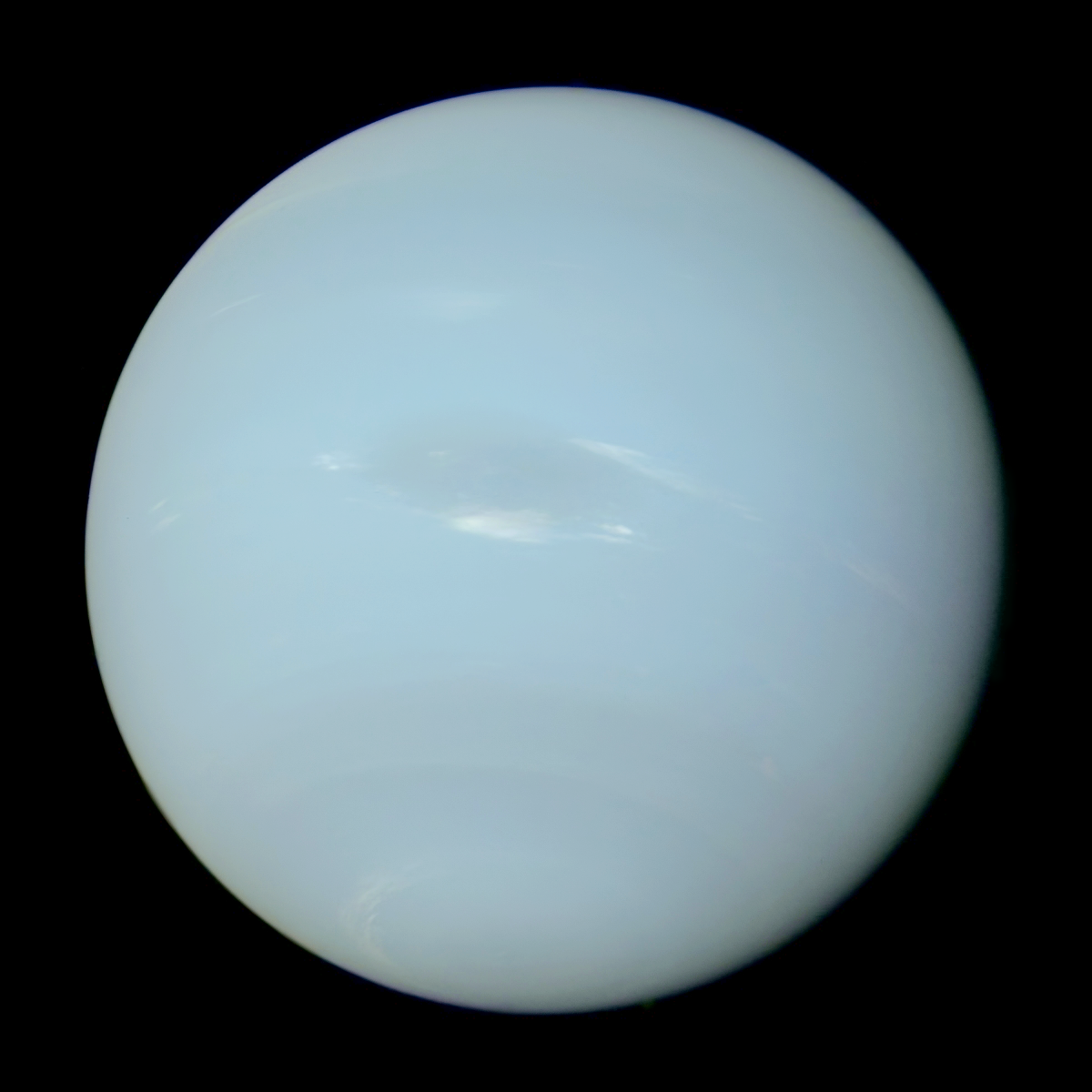
Credit: NASA / Voyager 2 / PDS / OPUS / Ardenau4 · CC0
Neptune is the eighth and farthest planet from the Sun in our solar system. It is a giant ball of gas and ice, about four times wider than Earth. Neptune sits about 2.8 billion miles from the Sun, roughly 30 times farther than Earth. Sunlight that reaches Earth in eight minutes takes more than four hours to get to Neptune.
Neptune is called an "ice giant." It is not made of solid ice like an ice cube. Most of the planet is a thick, slushy mix of water, ammonia, and methane deep under its atmosphere. The outer layers are mostly hydrogen and helium gas. Methane in the air soaks up red light and bounces blue light back into space. That is why Neptune looks such a deep, clear blue.
Neptune is the windiest planet in the solar system. Storms there can blow at more than 1,200 miles per hour, faster than the speed of sound on Earth. In 1989, the Voyager 2 spacecraft spotted a huge dark storm on Neptune about the size of Earth. Scientists named it the Great Dark Spot. When the Hubble Space Telescope looked a few years later, the storm was gone. Neptune's storms come and go, unlike Jupiter's Great Red Spot, which has lasted for centuries.
Neptune was the first planet found by math instead of by eye. In the 1840s, astronomers noticed that Uranus was not moving the way it should. They guessed another planet's gravity must be tugging on it. A French mathematician named Urbain Le Verrier calculated where that planet should be. In 1846, a German astronomer pointed his telescope at the spot Le Verrier named and found Neptune right there.
Neptune has 14 known moons. The biggest is Triton. Triton is strange because it orbits Neptune backward, the opposite way the planet spins. Most big moons travel the same direction as their planet. Scientists think Triton was not born with Neptune. It was probably a dwarf planet from the Kuiper Belt that wandered too close and got captured by Neptune's gravity.
Only one spacecraft has ever visited Neptune. Voyager 2 flew past in August 1989 and took the photos we still use today. Since then, no mission has returned. Almost everything we know about the farthest planet comes from that one brief flyby and from telescopes here on Earth.
Last updated 2026-04-22