
Asteroid
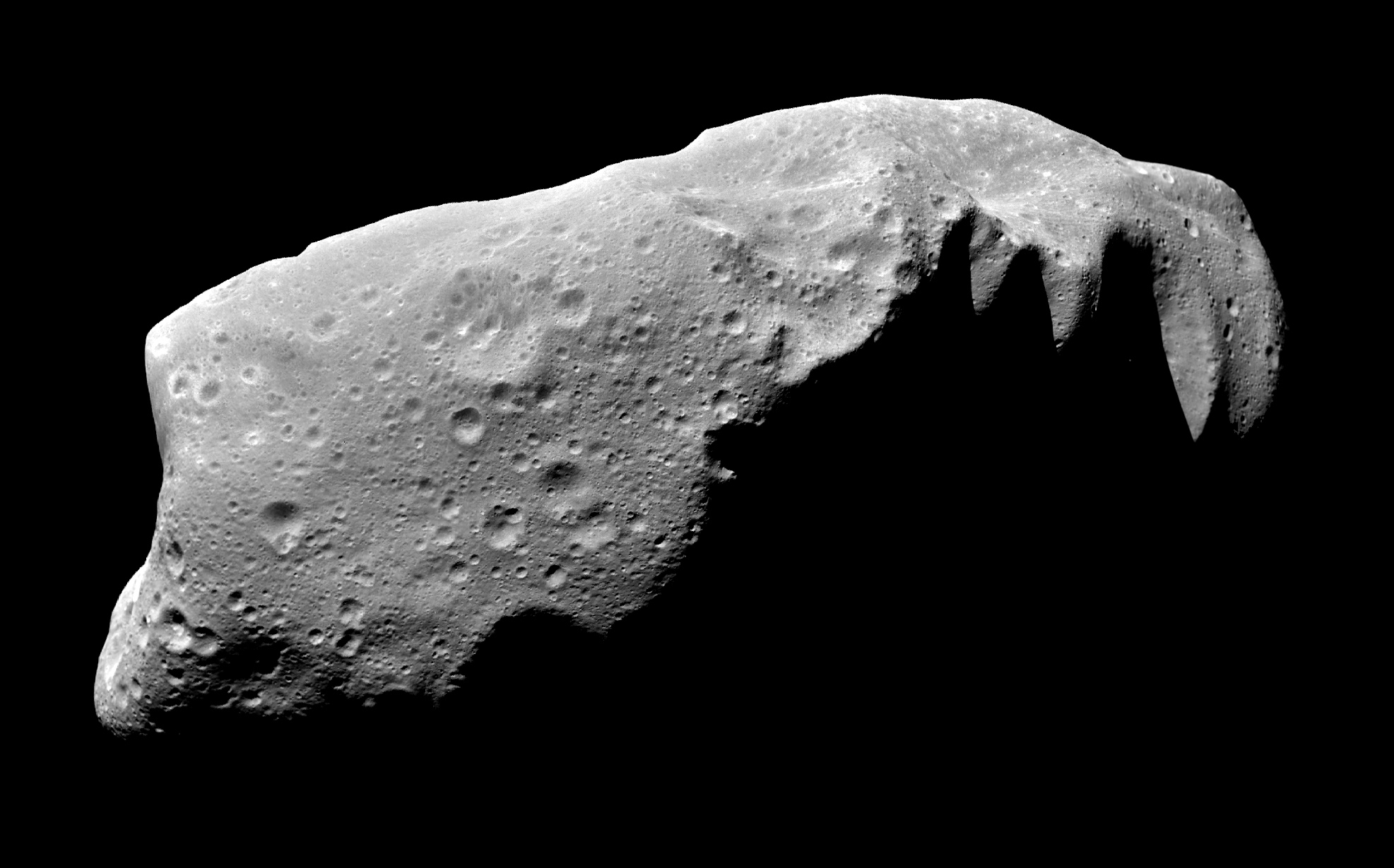
Credit: NASA/JPL · Public domain
An asteroid is a small, rocky object that orbits the Sun. Asteroids are leftovers from the early days of the solar system, about 4.6 billion years ago. Back then, dust and rock were clumping together to form the planets. Some of those clumps never joined a planet. Those leftover pieces are the asteroids we see today.
Most asteroids are found in a ring called the asteroid belt. The belt sits between Mars and Jupiter. Movies often show it as a thick cloud of tumbling rocks. The real belt is mostly empty space. If you flew a spaceship through it, you probably would not see a single asteroid without a telescope.
Asteroids come in many sizes. The biggest one is Ceres. Ceres is about 590 miles across, wide enough to stretch across the state of Texas. Scientists now call Ceres a dwarf planet. Most asteroids are much smaller. Many are only the size of a car or a house. Astronomers have found more than a million asteroids so far, and they keep finding more.
Asteroids are not all made of the same stuff. Some are dark and full of carbon. Some are lighter and full of rock. A few are made mostly of metal, like iron and nickel. Their shapes are strange too. Asteroids are usually not round. They look more like lumpy potatoes, because they are too small for gravity to pull them into a ball.
Sometimes asteroids crash into planets. One of the most famous crashes happened about 66 million years ago. A rock about six miles wide slammed into what is now Mexico. The impact threw dust into the sky, blocked the Sun, and changed the climate. Most scientists think this is what killed the dinosaurs. Not all asteroid strikes are that big, but Earth still gets hit by small pieces every day. Most burn up in the air before they reach the ground.
NASA keeps careful watch on "near-Earth" asteroids. In 2022, a spacecraft called DART crashed into a small asteroid on purpose. The goal was to nudge it onto a new path. The test worked. If humans ever spot a big asteroid heading for Earth, we now have a tool that might push it aside.
Space missions have also landed on asteroids and brought pieces home. Those rocks hold clues about how planets formed and maybe even how water and the building blocks of life arrived on Earth.
Last updated 2026-04-22