
Kuiper Belt
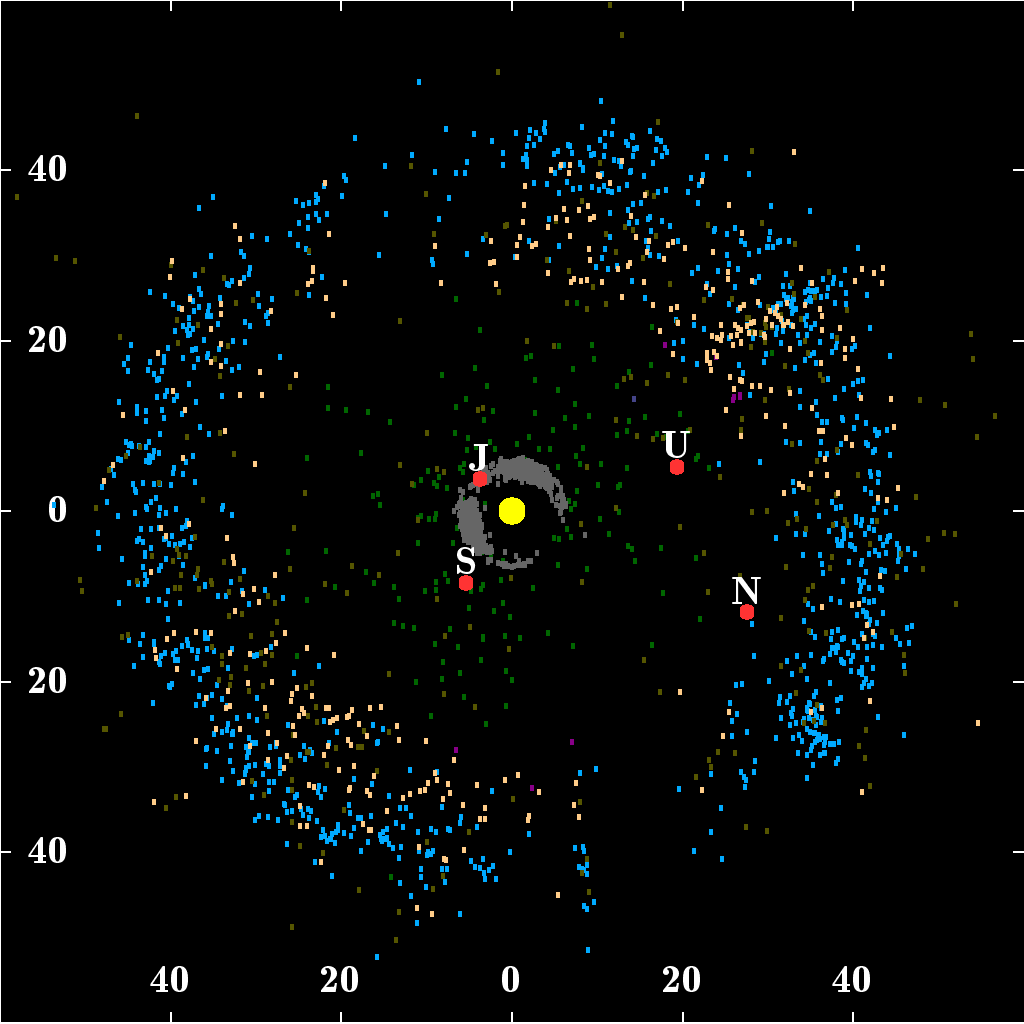
Credit: WilyD at English Wikipedia · CC BY-SA 3.0
The Kuiper Belt is a huge ring of icy objects that orbits the Sun beyond the planet Neptune. It starts about 2.8 billion miles from the Sun. It stretches for another billion miles past that. Astronomers think the belt holds hundreds of thousands of small icy worlds, plus trillions of smaller chunks of ice and rock.
The belt is named after Gerard Kuiper, a Dutch-American astronomer who wrote about the area in 1951. The first Kuiper Belt object, other than Pluto itself, was not spotted until 1992. Telescopes had to get much better before astronomers could see these faint, faraway worlds.
Pluto is the most famous member of the Kuiper Belt. For many years, people thought Pluto was alone out there. Then astronomers began finding other icy worlds nearby. One of them, Eris, is almost the same size as Pluto. Finding Eris in 2005 is part of why scientists changed Pluto's label from planet to dwarf planet in 2006. Other large Kuiper Belt objects include Haumea, which spins so fast it is shaped like an egg, and Makemake, which has a tiny moon of its own.
Most objects in the belt are made of frozen water, frozen methane, and frozen ammonia, mixed with rock. They formed around 4.5 billion years ago, at the same time as the rest of the solar system. The Kuiper Belt is like a freezer full of leftover building blocks. Scientists study it to learn what the early solar system was made of.
Many short-period comets come from the Kuiper Belt. These are comets that swing around the Sun every 200 years or less. When Neptune's gravity nudges an icy object toward the inner solar system, the Sun heats it and melts some of its ice. That is what creates a comet's glowing tail.
So far, only one spacecraft has visited the Kuiper Belt. NASA's New Horizons probe flew past Pluto in 2015. Then it kept going. In 2019, it flew past a small, odd-shaped object nicknamed Arrokoth, which looks a little like two pancakes stuck together. Arrokoth is the most distant object any spacecraft has ever visited up close.
Much about the Kuiper Belt is still a mystery. Some astronomers think there could be a hidden ninth planet, bigger than Earth, orbiting somewhere far out in this region. They have not found it yet. The search is one of the most exciting hunts in space science today.
Last updated 2026-04-22