
Peninsula
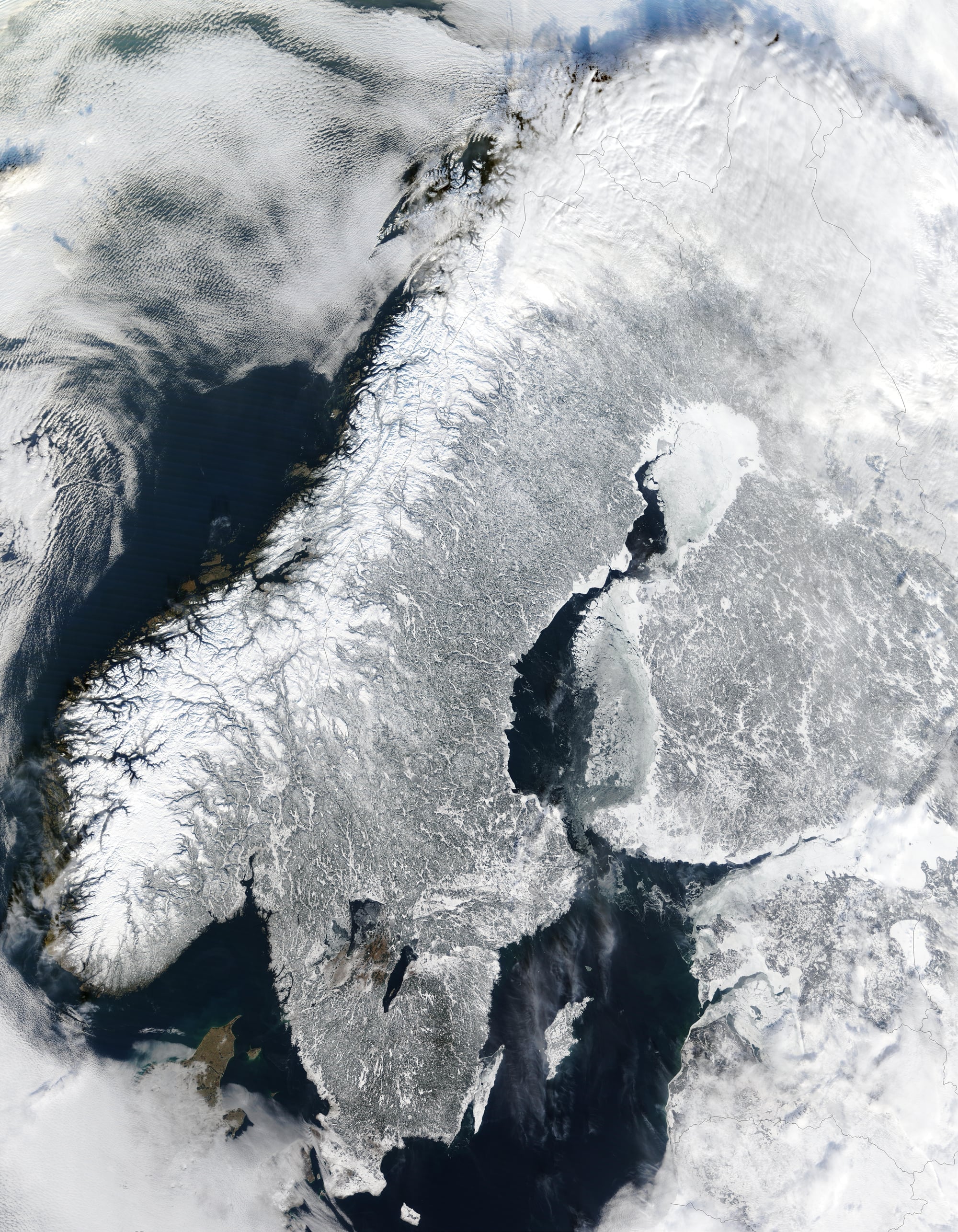
Credit: Jacques Descloitres, MODIS Land Rapid Response Team at NASA GSFC · Public domain
A peninsula is a piece of land that sticks out into water and is surrounded by water on three sides. The fourth side connects to a larger area of land. Peninsulas can be tiny, just a few feet across, or huge, covering thousands of square miles. They form along oceans, seas, lakes, and rivers all over the world.
The word itself tells you what a peninsula is. It comes from two Latin words, paene and insula, that together mean "almost an island." A peninsula is land that almost made it out into the water, but stayed attached.
Peninsulas form in several ways. Some are made when sea levels rise after an ice age. The water creeps inland and surrounds higher ground on three sides, leaving a strip still attached to the mainland. Others form from the slow movement of Earth's crust, which pushes some land up while other land sinks. Rivers also build small peninsulas by dropping sand and mud at their mouths. Waves and currents shape peninsulas too, sometimes building them up and sometimes wearing them down.
Some peninsulas are famous for their shape. Italy looks like a long boot kicking a stone into the Mediterranean Sea. Florida hangs down from the southeast corner of the United States like a thumb pointing at Cuba. The Korean Peninsula reaches south from the Asian mainland and holds two countries, North Korea and South Korea. The largest peninsula in the world is the Arabian Peninsula in the Middle East. It covers about 1.25 million square miles, an area larger than Alaska, Texas, and California combined.
Peninsulas have been important to people for thousands of years. Their long coastlines made them good places for fishing, shipping, and trade. Ancient Greece grew up on a rocky peninsula full of harbors. The Iberian Peninsula, where Spain and Portugal sit today, sent out explorers who sailed across the Atlantic Ocean. Coastal cities on peninsulas often grew rich because ships could reach them from many directions.
Peninsulas can change over time. Erosion can cut through the narrow neck of land that connects a peninsula to the mainland, turning the peninsula into an island. Cape Cod in Massachusetts is slowly being reshaped by waves and storms right now. In a few thousand years, parts of it may break off completely. The line between peninsula and island is not always permanent. Water keeps working on the land, one wave at a time.
Related
Last updated 2026-04-25