
Island
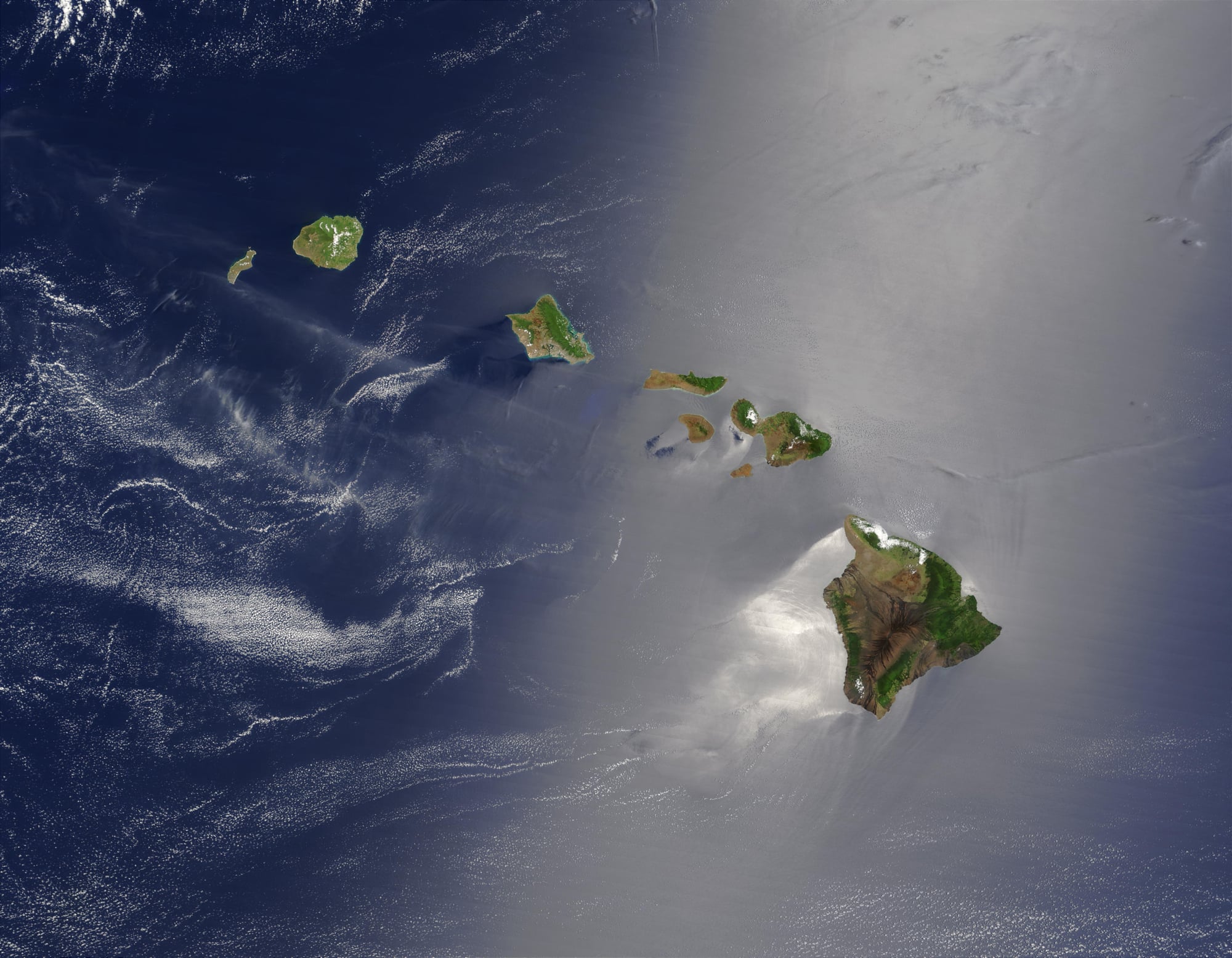
Credit: Jacques Descloitres · Public domain
An island is a piece of land that is surrounded by water on all sides. Islands can be found in oceans, seas, lakes, and rivers. Some are tiny, with room for only a few trees. Others are huge, big enough to hold whole countries. Greenland, the largest island in the world, is about three times the size of Texas.
Islands form in several different ways. Many begin as volcanoes on the ocean floor. Lava erupts again and again, building up layers of rock until the volcano finally pokes above the water. The Hawaiian Islands formed this way. They sit on top of a "hot spot," a place where hot rock from deep inside the Earth keeps melting through the crust. The Big Island of Hawaii is still growing today, since its volcanoes are still erupting.
Other islands form from coral. Tiny sea animals called coral polyps build hard skeletons. Over thousands of years, these skeletons pile up and form reefs. If a reef grows tall enough to break the ocean's surface, a low, sandy island can form on top. The Maldives, a country in the Indian Ocean, is made of nearly 1,200 coral islands.
Some islands are not built up. They are left behind. When sea levels rose at the end of the last ice age about 12,000 years ago, ocean water flooded low areas and turned the higher ground into islands. The British Isles formed this way. Long Island in New York was shaped by glaciers that dropped piles of rock and sand as they melted.
Islands are interesting places for animals and plants. Because they are cut off from the mainland, the species living there often evolve in unusual ways. The Galápagos Islands have giant tortoises that can weigh more than 500 pounds, about as much as a grand piano. Madagascar has lemurs that live nowhere else on Earth. Charles Darwin used what he saw on island animals to help build his theory of evolution.
Island life can also be fragile. Many island species have no natural predators, so they never learned to defend themselves. When humans arrived in New Zealand about 700 years ago, they brought rats and dogs. Several flightless bird species, including the giant moa, went extinct within a few centuries.
About one in ten people on Earth lives on an island. Some islands hold whole nations, like Japan, Cuba, and Iceland. Others are quiet places where almost nobody lives at all.
Related
Last updated 2026-04-25