
Volcano
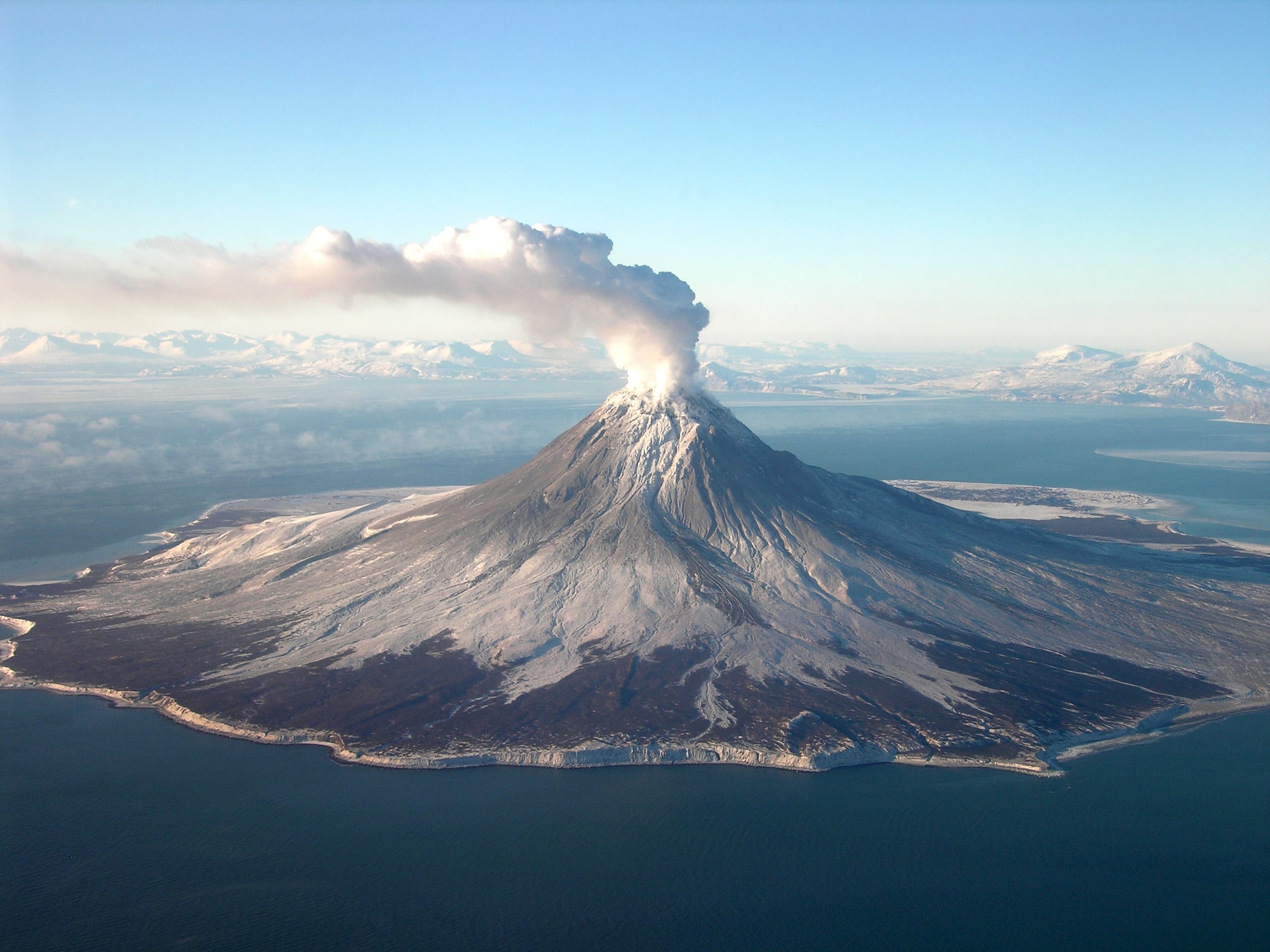
Credit: Cyrus Read Geophysicist USGS, Alaska Volcano Observatory cread@usgs.gov · Public domain
A volcano is an opening in the ground where hot melted rock, hot gas, and ash can burst out from inside a planet. On Earth, volcanoes form where heat deep inside the planet pushes melted rock up through cracks in the surface. The melted rock is called magma while it is underground. Once it reaches the surface, it is called lava. Lava can be as hot as 2,200 degrees Fahrenheit — hot enough to melt steel.
Earth is very hot inside. About 1,800 miles below your feet, the center of the planet stays at temperatures over 9,000 degrees. Above the center is a layer of hot rock called the mantle, which moves slowly like thick syrup over millions of years. Sometimes this movement breaks Earth's outer layer, called the crust. Magma finds its way up through the cracks. When it reaches the surface, a volcano is born.
Most volcanoes are found along the edges of tectonic plates. These are the huge pieces of Earth's crust that slowly move around. The most active zone is called the Ring of Fire. It surrounds the Pacific Ocean and includes volcanoes in Japan, Alaska, Indonesia, the Philippines, and along the western coasts of North and South America. About three-quarters of the world's active volcanoes are found in this ring.
Eruptions are not all the same. Some are gentle. Lava slowly flows out of the volcano, and people can sometimes walk right up to it. The Hawaiian volcanoes are famous examples. Other eruptions are violent explosions that shoot ash miles into the sky. In 79 CE, Mount Vesuvius in Italy exploded without warning and buried the Roman city of Pompeii under twenty feet of ash in a single day. The ash preserved the city so well that when archaeologists dug it up more than 1,500 years later, they could still see the outlines of its streets, buildings, and even its people.
Volcanoes can be dangerous, but they have also shaped much of the world. Over billions of years, gases from volcanoes built up most of Earth's atmosphere. Volcanic ash, over time, turns into some of the richest soil on Earth. Much of Italy's farmland, and wide areas in Indonesia and Central America, grow crops in soil made by ancient eruptions. Whole islands, including Hawaii and Iceland, were built by volcanoes.
Earth is not the only place in the solar system with volcanoes. Mars has the biggest volcano we know of — Olympus Mons, a huge mountain nearly 70,000 feet tall. That is almost three times the height of Mount Everest. Jupiter's moon Io is the most volcanic place we have ever found; it erupts almost all the time. Venus is covered in volcanoes, and many of them may still be active. Wherever a planet or moon is hot inside, volcanoes seem to follow.
Related
Last updated 2026-04-20