
Transcontinental Railroad
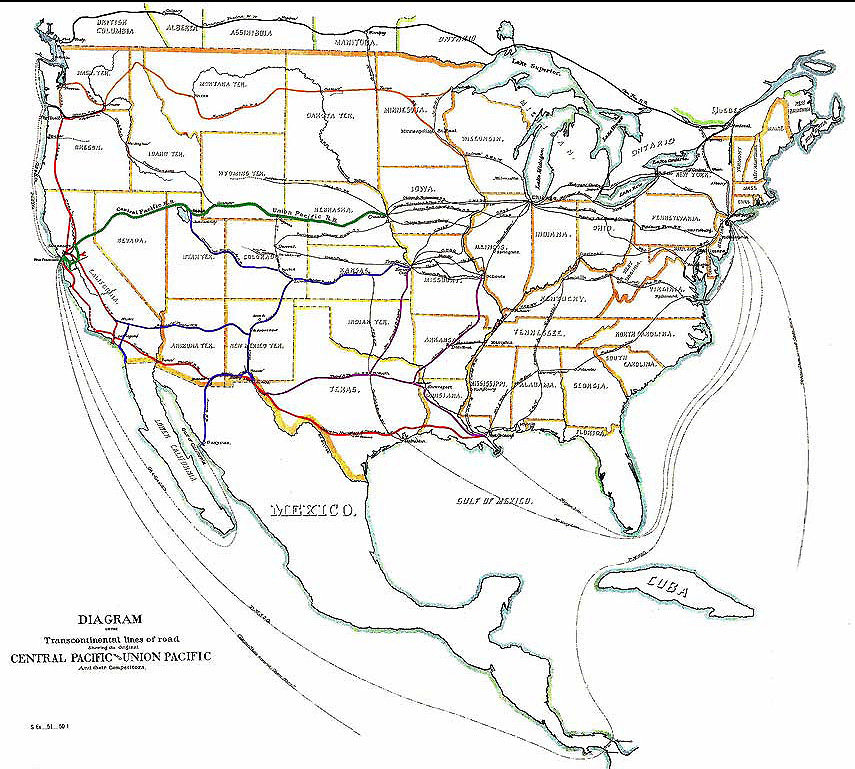
Credit: United States Pacific Railway Commission. Digital image reconstruction and restoration is by Centpacrr at en.wikipedia (DigitalImageServices.com) · CC BY-SA 3.0
The Transcontinental Railroad was the first railroad to connect the eastern and western halves of the United States. It was finished in 1869. It stretched almost 2,000 miles, from Omaha, Nebraska, to Sacramento, California. Before the railroad, traveling across the country took four to six months by wagon. The new train trip took about a week.
President Abraham Lincoln signed the law that started the project in 1862, during the Civil War. Two companies were hired to build it. The Union Pacific built west from Nebraska. The Central Pacific built east from California. The two crews would meet somewhere in the middle.
The work was incredibly hard. Crews had to cross prairies, deserts, rivers, and the Sierra Nevada mountains. In the mountains, workers blasted tunnels through solid granite using gunpowder and a new explosive called nitroglycerin. In one winter, snow piled up 40 feet deep, taller than a four-story building. Avalanches buried whole work camps.
Most of the workers were immigrants. About 15,000 to 20,000 Chinese workers built the western section through the mountains. Irish immigrants and Civil War veterans built much of the eastern section. The pay was low, the days were long, and the work was dangerous. Hundreds of workers died from explosions, avalanches, and accidents. Chinese workers were paid less than other workers and had to buy their own food.
The two railroads finally met on May 10, 1869, at Promontory Summit in Utah. Leaders drove a final golden spike into the last tie to mark the moment. A telegraph operator tapped out a single word to the rest of the country: "Done."
The railroad changed America in huge ways. Goods that once took months to ship could now cross the country in days. Towns sprang up along the tracks. Mail moved faster. Businesses grew. People who had never traveled far could now visit family thousands of miles away.
The railroad also caused great harm. It cut straight through land where Native American nations had lived and hunted for thousands of years. The U.S. government took huge areas of this land and gave it to the railroad companies. Hunters traveling on the trains shot millions of bison from the windows, almost wiping out the herds that Plains tribes depended on for food. The Lakota, Cheyenne, Arapaho, and many other nations lost their homes and their way of life.
Today, parts of the original route are still in use. Visitors can stand at Promontory Summit, where two replica steam engines sit nose to nose, marking the spot where the country was joined by iron and steam.
Related
Last updated 2026-04-26