
California Gold Rush
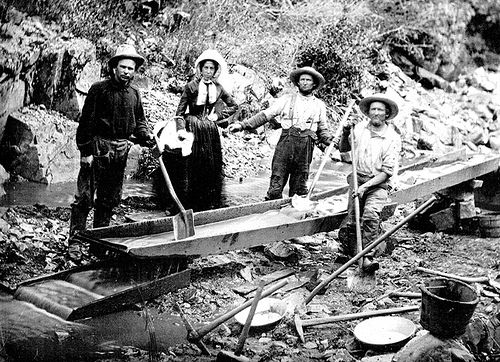
Credit: Unknown author · Public domain
The California Gold Rush was a huge wave of people rushing to California to look for gold. It started in 1848 and lasted until about 1855. During those years, around 300,000 people came to California from across the United States and from countries all over the world. The Gold Rush changed California from a quiet region into one of the busiest places in North America.
It began on January 24, 1848, at a sawmill near the town of Coloma. A worker named James Marshall spotted shiny flakes in the water of the American River. He showed them to his boss, John Sutter. The flakes were gold. Sutter tried to keep the news quiet, but word got out fast. By that summer, men across California had dropped their jobs and headed for the hills.
The big rush came the next year. In December 1848, President James K. Polk told Congress that gold had been found in California. Newspapers spread the story across the country. In 1849, around 90,000 people poured into California. They were called "forty-niners" after the year. Some came overland in wagons. Others sailed all the way around South America, a trip that could take six months.
This was not just an American event. People came from Mexico, Chile, China, Ireland, France, and Australia. By 1852, about one in five miners in California was Chinese. Many faced harsh treatment and unfair taxes from white miners. Mexican and Native American workers were often pushed off their land or attacked.
The Gold Rush was very hard on California's Native peoples. Before 1848, about 150,000 Native Americans lived in California. By 1870, only about 30,000 were left. Many died from new diseases, hunger, and violence as miners took over their lands and rivers. Historians today often describe what happened as a genocide.
A few miners struck it rich. Most did not. Panning for gold in cold rivers was slow, painful work. The people who made the most money were often the merchants who sold tools, food, and clothes to the miners. A pair of boots could cost a week's wages. An egg sometimes sold for the equivalent of $25 in today's money.
San Francisco grew from a small village of about 800 people in 1848 to a city of 25,000 by 1850. California became a state that same year, much faster than usual. The Gold Rush also pushed the United States to build the transcontinental railroad, finished in 1869, to connect the east coast to the booming west.
By 1855, the easy gold was gone. The rush ended, but California never went back to being quiet.
Related
Last updated 2026-04-26