
Venus
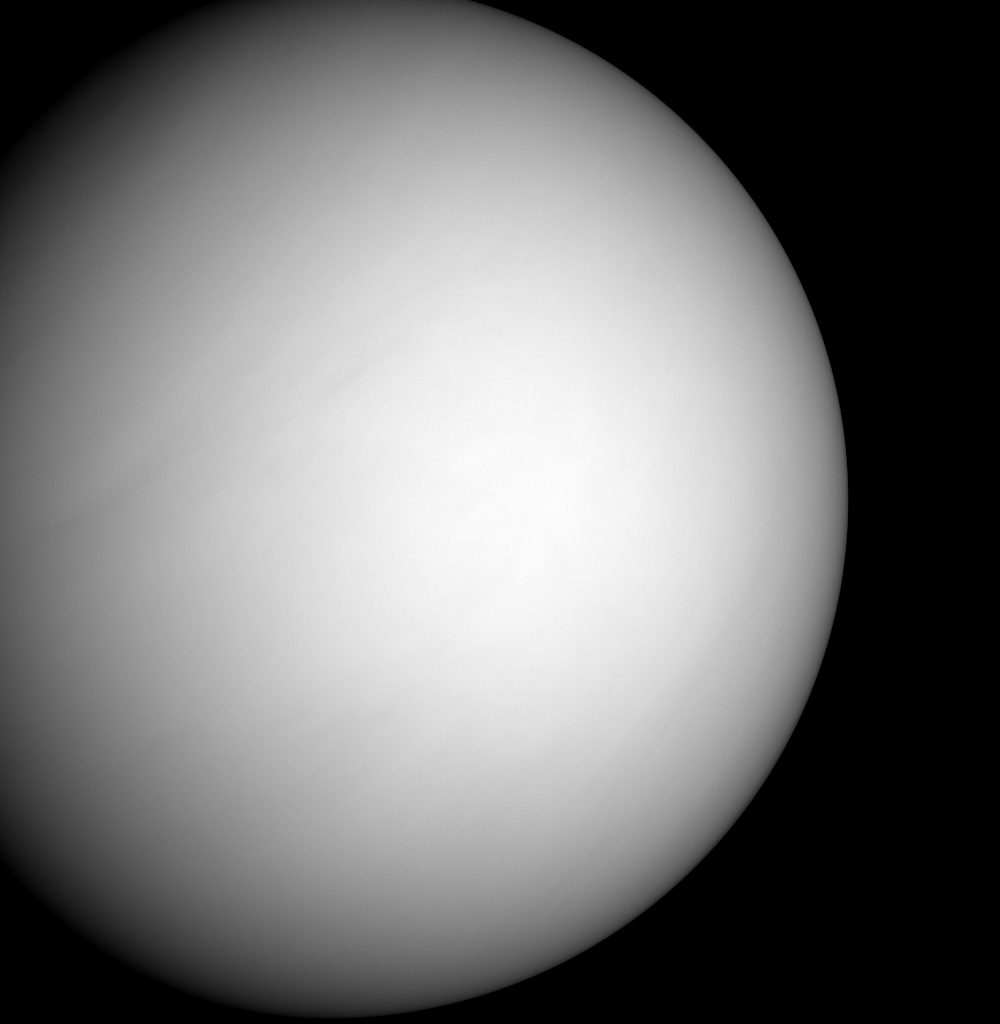
Credit: NASA/Johns Hopkins University Applied Physics Laboratory/Carnegie Institution of Washington · Public domain
Venus is the second planet from the Sun and the closest planet to Earth. It is about the same size as Earth, which is why some people call it Earth's twin. But Venus is also the hottest planet in the solar system, with a surface so harsh that no human could survive there for a single minute.
Venus is easy to spot in the sky. It often shines as the brightest point of light after the Moon. You can see it just after sunset or just before sunrise, which is why people sometimes call it the "evening star" or the "morning star." It is not really a star, though. Venus looks so bright because thick clouds cover the whole planet and reflect sunlight back into space.
Those clouds are the reason Venus is so hot. They are made mostly of carbon dioxide and drops of sulfuric acid. Sunlight passes through the clouds and warms the ground. The heat gets trapped and cannot escape. This is called the greenhouse effect. The surface temperature on Venus stays near 900 degrees Fahrenheit, hot enough to melt lead. Even Mercury, which is closer to the Sun, is cooler than Venus.
The air on Venus is also crushing. Standing on the ground there would feel like being almost a mile deep under the ocean on Earth. The pressure would squash a person instantly.
Venus spins in a strange way. Most planets, including Earth, spin from west to east. Venus spins the other direction, so the Sun would rise in the west and set in the east. Venus also spins very slowly. A single day on Venus is longer than a whole Venus year.
More than 40 spacecraft have tried to study Venus. The Soviet Union landed several probes there in the 1970s and 1980s. The probes sent back the first pictures of the surface before the heat and pressure destroyed them, usually within about two hours.
Scientists still have big questions about Venus. Could it once have had oceans of water, like Earth? Some researchers think Venus may have been a cooler, wetter world billions of years ago, before a runaway greenhouse effect dried it out. A few scientists even wonder if tiny microbes might live high in the clouds, where the temperature is milder. NASA and other space agencies are planning new missions to find out.
Last updated 2026-04-22