
Mercury (Planet)
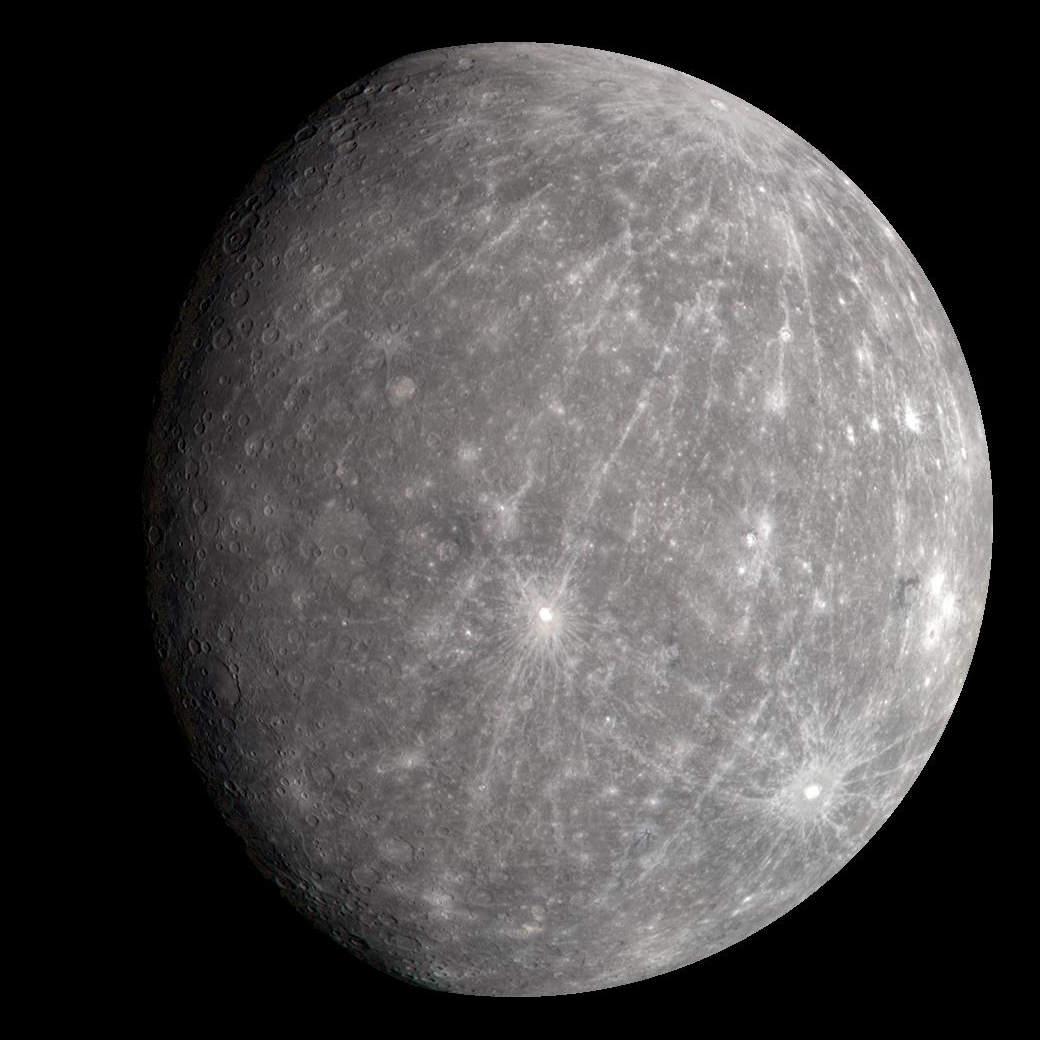
Credit: NASA/Johns Hopkins University Applied Physics Laboratory/Arizona State University/Carnegie Institution of Washington · Public domain
Mercury is the smallest planet in our solar system and the closest one to the Sun. It orbits the Sun at an average distance of 36 million miles. That is about three times closer than Earth. Mercury is a rocky planet, like Earth, Venus, and Mars. But it is only a little bigger than Earth's Moon.
The planet is named after the Roman messenger god, who was known for being fast. The name fits. Mercury zips around the Sun faster than any other planet, finishing one full orbit in just 88 Earth days. If you lived on Mercury, you would have a birthday about every three months.
Mercury spins very slowly on its axis. One full spin takes almost 59 Earth days. Because it orbits the Sun so fast while spinning so slowly, a single day on Mercury, from one sunrise to the next, lasts about 176 Earth days. That is longer than the Mercury year itself.
The temperature on Mercury is wild. During the day, the side facing the Sun can heat up to 800 degrees Fahrenheit, hot enough to melt lead. At night, the same spot can drop to nearly 300 degrees below zero. Mercury has almost no atmosphere to hold heat in, so the temperature swings are huge.
The surface of Mercury looks a lot like our Moon. It is gray, dusty, and covered in craters from billions of years of asteroid and comet strikes. The biggest crater is called the Caloris Basin. It stretches about 960 miles across, wider than the state of Texas.
Even though Mercury is the closest planet to the Sun, it is not the hottest. Venus is hotter. Venus has a thick atmosphere that traps heat like a blanket, while Mercury has almost none. Scientists also think there may be frozen water hiding in deep craters at Mercury's poles. The walls of those craters block sunlight, so the floors stay cold enough for ice to last.
Only two spacecraft have ever visited Mercury up close. NASA's Mariner 10 flew past it in the 1970s. Then NASA's MESSENGER mission orbited the planet from 2011 to 2015 and mapped its whole surface. A newer mission called BepiColombo, launched by Europe and Japan, is on its way to Mercury now.
Mercury is visible from Earth without a telescope. You can sometimes spot it low in the sky just after sunset or just before sunrise. Because it stays so close to the Sun, it is one of the trickiest planets to catch.
Last updated 2026-04-22