
Mars
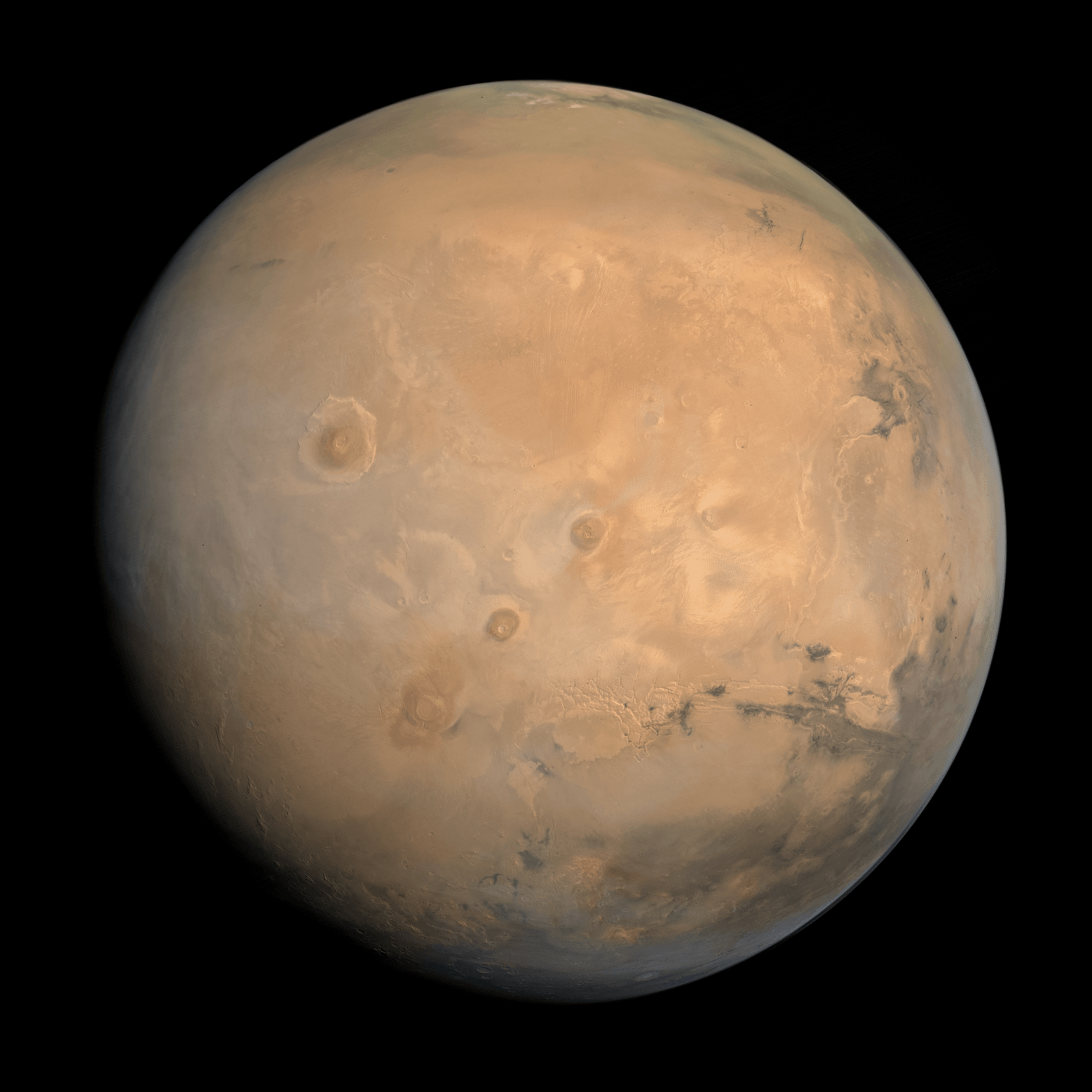
Credit: Kevin Gill from Los Angeles, CA, United States · CC BY 2.0
Mars is the fourth planet from the Sun and the second smallest planet in our solar system. It is about half the size of Earth. People often call it the Red Planet because its surface looks rusty red. The color comes from iron in the soil that has rusted over billions of years. Mars is Earth's next-door neighbor on the outer side, and it is the planet most like our own.
Mars has a thin atmosphere made mostly of carbon dioxide. The air is so thin that a person standing on Mars without a space suit would not survive. Temperatures swing wildly. A summer day near the equator might reach 70 degrees Fahrenheit, but at night the same spot can drop to negative 100. The poles are covered in ice caps made of frozen water and frozen carbon dioxide, which people call dry ice.
The surface of Mars has some of the most extreme features in the solar system. Olympus Mons is the tallest volcano we know of anywhere. It rises about 72,000 feet, almost three times the height of Mount Everest. A giant canyon called Valles Marineris cuts across the planet for 2,500 miles, as long as the United States is wide. Mars also has two small, lumpy moons named Phobos and Deimos.
Long ago, Mars was a very different place. Dry riverbeds, ancient lake floors, and minerals that only form in water all show that liquid water once flowed across the surface. Scientists think Mars had rivers, lakes, and maybe even an ocean billions of years ago. Then the planet's magnetic field weakened, and the solar wind stripped away most of its atmosphere. The water froze or escaped into space.
This is why Mars is the main target in the search for alien life. If Mars was once warm and wet, tiny living things might have lived there, and some might still survive underground. We don't know the answer yet. Robot explorers called rovers have been crawling across Mars since 1997, drilling rocks and testing soil. The newest rover, Perseverance, is collecting samples that a future mission may bring back to Earth.
People have been telling stories about Mars for a long time. The ancient Romans named it after their god of war because of its blood-red color. In the early 1900s, some astronomers thought they saw long straight lines on Mars and believed these were canals built by Martians. Better telescopes later showed that the lines were a trick of the eye. Space agencies and private companies are now planning missions to send humans to Mars, possibly within the next few decades.
Related
Last updated 2026-04-22