
Planet
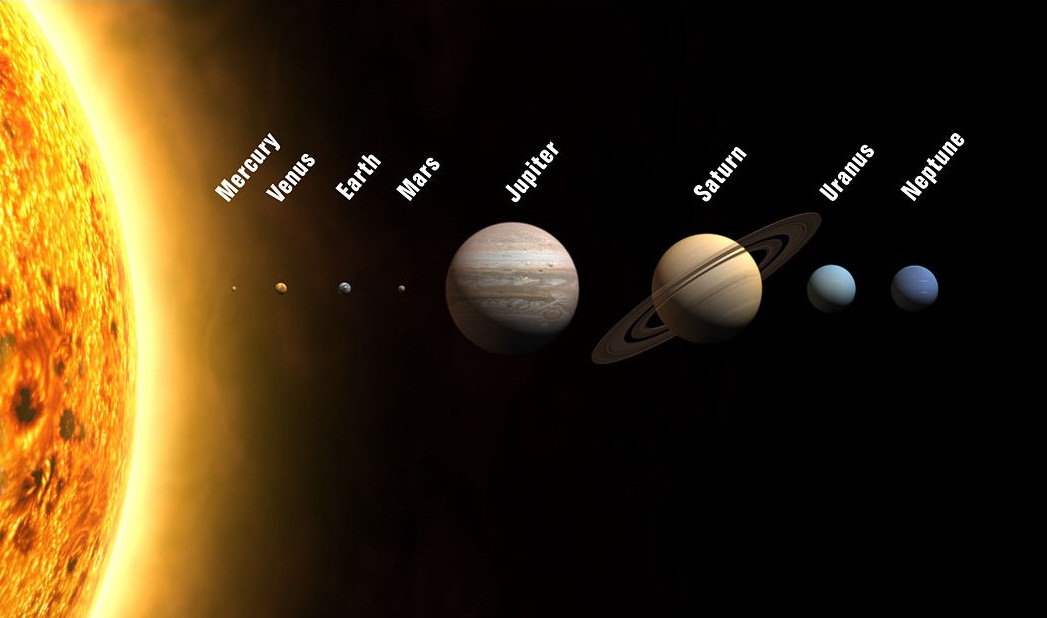
Credit: WP · CC BY-SA 3.0
A planet is a large object in space that orbits a star. In our solar system, planets orbit the Sun. To count as a planet under today's rules, an object has to do three things. It has to orbit the Sun. It has to be big enough that its own gravity pulls it into a round shape. And it has to have cleared away most of the other stuff near its orbit.
Our solar system has eight planets. The four closest to the Sun are small and rocky: Mercury, Venus, Earth, and Mars. The four farthest out are huge and made mostly of gas or ice: Jupiter, Saturn, Uranus, and Neptune. Jupiter is the biggest. You could fit more than 1,300 Earths inside it.
People have watched planets for thousands of years. The word "planet" comes from a Greek word that means "wanderer." Most stars look like they stay in fixed patterns in the night sky. But planets slowly move against those patterns from one night to the next. That wandering is what first told ancient watchers that planets were different from stars.
The rules for what counts as a planet changed in 2006. Before then, Pluto was the ninth planet. Then astronomers started finding other icy worlds out past Neptune that were about the same size as Pluto. They had to choose. Either add many new planets, or tighten the definition. They tightened it. Pluto was moved into a new group called dwarf planets. Some scientists still think the change was a mistake, and the argument goes on.
Planets are not only found in our solar system. Stars all across the galaxy have planets too. These are called exoplanets. The first one orbiting a normal star was discovered in 1995. Since then, astronomers have found more than 5,000 of them. Some are gas giants bigger than Jupiter. Some are rocky worlds a little like Earth. A few orbit at the right distance from their stars to possibly have liquid water.
That matters because water, so far, is the one thing every known living thing on Earth needs. Finding a planet with water somewhere else would not prove life exists out there. But it would be a strong hint about where to look. Astronomers think the Milky Way galaxy alone may hold hundreds of billions of planets. We have only just started counting.
Last updated 2026-04-22