
Star
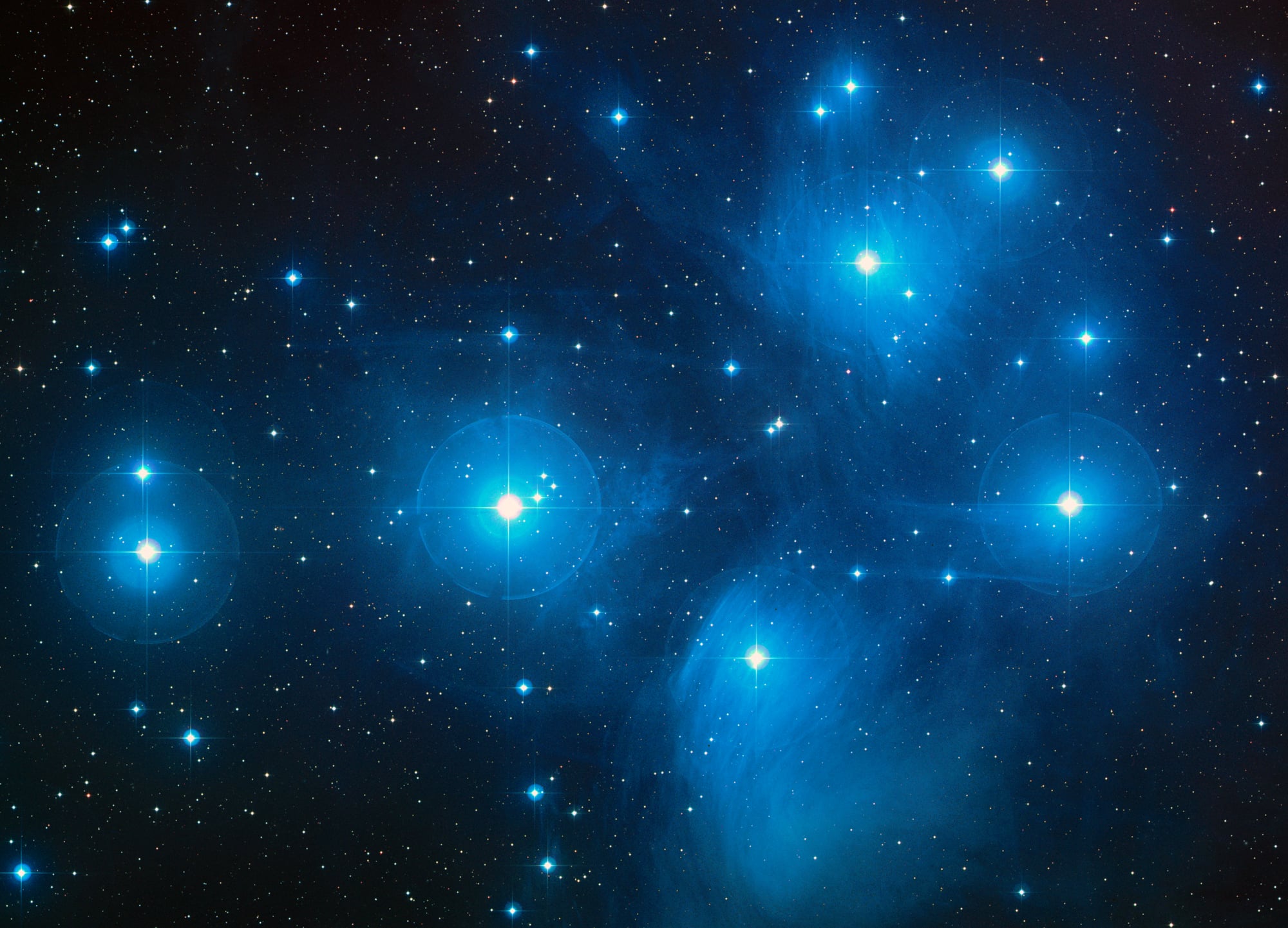
Credit: NASA, ESA, AURA/Caltech, Palomar Observatory The science team consists of: D. Soderblom and E. Nelan (STScI), F. Benedict and B. Arthur (U. Texas), and B. Jones (Lick Obs.) · Public domain
A star is a giant ball of hot gas that makes its own light and heat. Stars are held together by their own gravity. Inside each star, lighter gases get squeezed into heavier ones, which releases huge amounts of energy. This is called nuclear fusion. The closest star to Earth is the Sun. Every other star you see in the night sky is much, much farther away.
Most stars are made of hydrogen and helium, the two simplest gases in the universe. At a star's center, the pressure and heat are so strong that hydrogen atoms smash together and turn into helium. The temperature in the core of the Sun reaches about 27 million degrees Fahrenheit. That energy slowly works its way out to the surface, then flies off into space as light.
Stars come in many sizes and colors. The color tells you how hot a star is. Blue stars are the hottest. White and yellow stars are in the middle. Red stars are the coolest, though "cool" here still means thousands of degrees. Our Sun is a yellow star of ordinary size. Some stars are tiny, only a little bigger than Earth. Others are so huge that if you placed them where the Sun is, they would swallow up all the inner planets.
Stars are born inside giant clouds of gas and dust called nebulas. Gravity pulls the gas together until it gets hot enough to start fusion, and a new star switches on. Stars live for millions or billions of years. The Sun is about 4.6 billion years old, and it will keep shining for roughly another 5 billion years.
Stars do not last forever. When a medium star like the Sun runs out of fuel, it swells into a red giant, then shrinks into a small, dim cinder called a white dwarf. A much bigger star ends in a huge explosion called a supernova. The blast can outshine a whole galaxy for a few weeks. What is left behind may be a tiny, super-dense neutron star or a black hole.
From Earth, stars look like small points of light. That is only because they are so far away. The closest star after the Sun, called Proxima Centauri, is about 25 trillion miles from us. Light itself, the fastest thing in the universe, takes more than four years to cross that distance. When you look up on a clear night, you are seeing light that began its trip long before you were born.
Last updated 2026-04-22