
Meteor
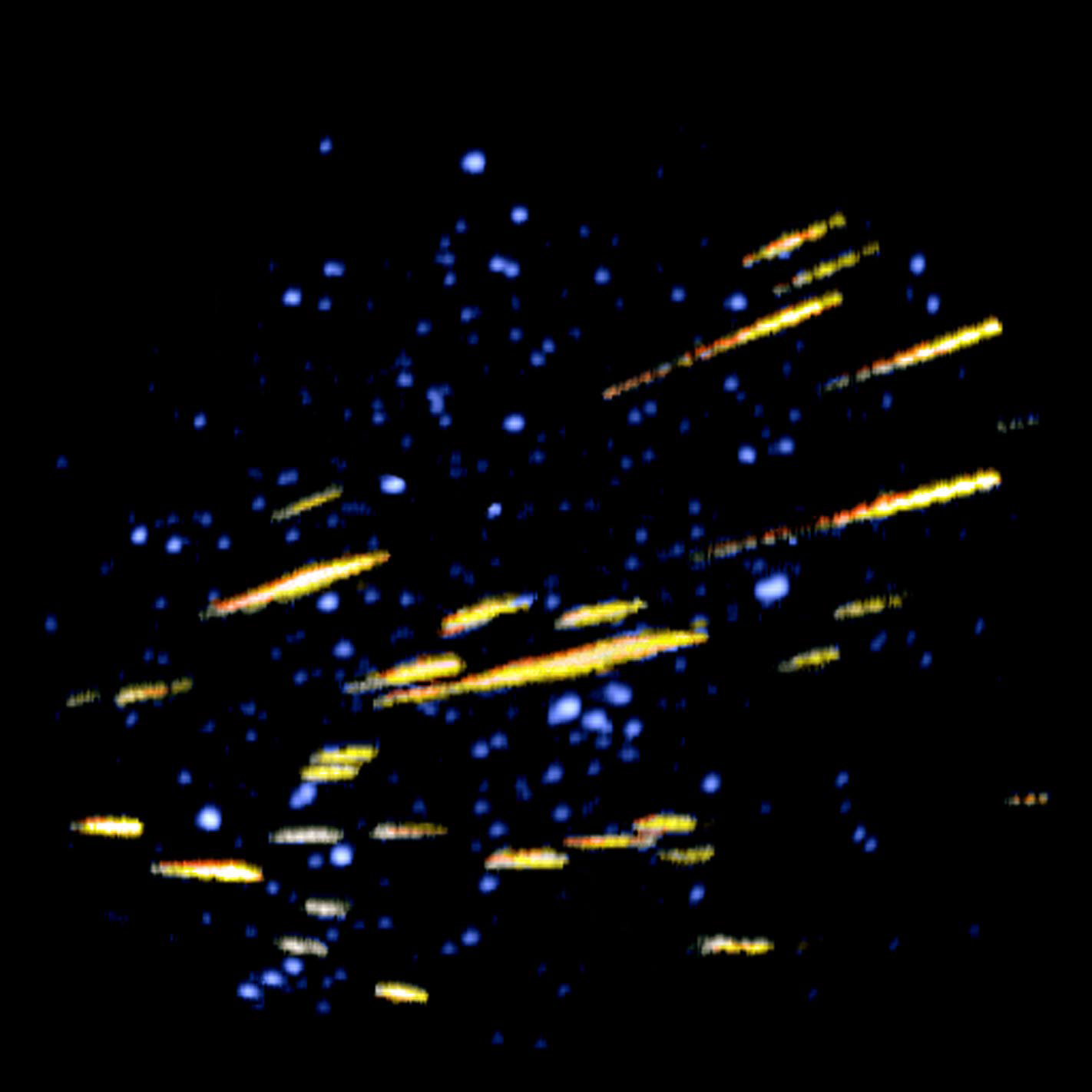
Credit: NASA Ames Research Center/S. Molau and P. Jenniskens · Public domain
A meteor is a bright streak of light in the sky, made when a small piece of space rock or dust falls into Earth's atmosphere. People often call meteors "shooting stars," but they are not stars at all. The rock itself, while it is still out in space, is called a meteoroid. If any piece of it survives the fall and lands on the ground, that piece is called a meteorite.
Meteors happen because space is full of leftover bits from comets and asteroids. Earth travels around the Sun at about 67,000 miles per hour. When our planet runs into one of these tiny bits, the bit slams into the air at enormous speed. The air cannot get out of the way fast enough. It gets squeezed and heated to thousands of degrees. That hot, glowing air is the streak you see.
Most meteoroids are very small. A piece the size of a pea can make a bright streak that crosses half the sky. A piece the size of a basketball can make a fireball bright enough to cast shadows at night. Scientists think about 48 tons of space material hit Earth's atmosphere every single day. Almost all of it burns up high above the ground, around 50 to 75 miles up.
Sometimes Earth passes through a thick trail of dust left behind by a comet. When that happens, dozens or hundreds of meteors flash across the sky in one night. This is called a meteor shower. The Perseid shower in August and the Geminid shower in December are two of the most famous.
Most meteors burn up completely. But once in a long while, a bigger rock makes it through. In 2013, a rock about 60 feet wide exploded over the city of Chelyabinsk in Russia. The blast was stronger than a large bomb. It shattered windows across the city and hurt more than 1,000 people, mostly from flying glass. Nobody saw it coming, because it came from the direction of the Sun.
Scientists now watch the sky carefully for big incoming rocks. They have found most of the really large ones, the kind that could cause global damage. Smaller ones, like the Chelyabinsk rock, are much harder to spot in time. The next clear night, look up for a few minutes. If you are patient, the solar system will throw a tiny piece of itself past your eyes.
Last updated 2026-04-22