
Dinosaurs
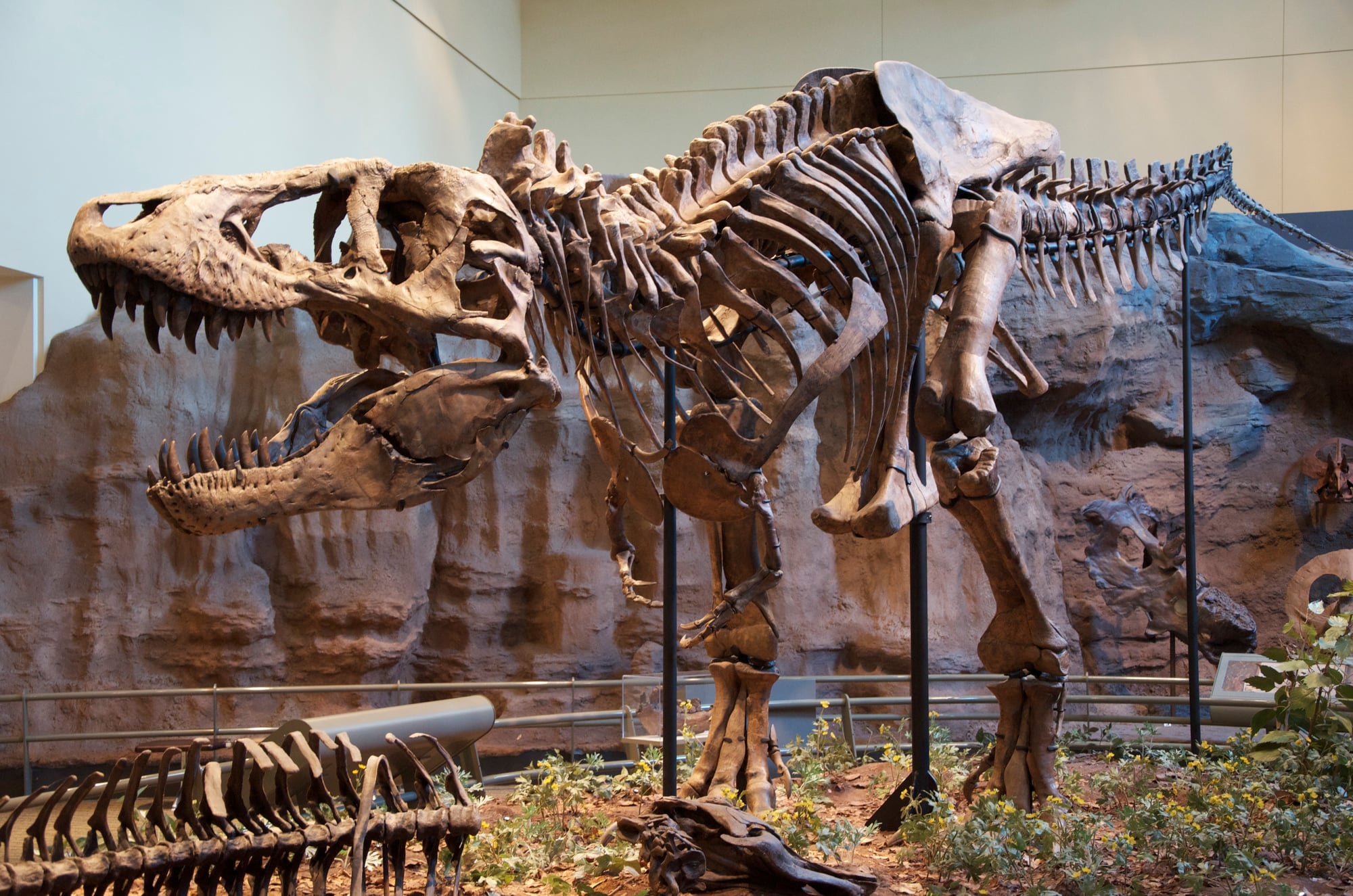
Credit: ScottRobertAnselmo · CC BY-SA 3.0
Dinosaurs were a group of reptiles that ruled the land on Earth for about 165 million years. They first appeared around 230 million years ago and died out 66 million years ago, except for one group that survived and became birds. Scientists have named more than 1,000 different kinds of dinosaurs so far, and they find new ones almost every week.
What makes a dinosaur a dinosaur
Not every prehistoric animal was a dinosaur. Dinosaurs were land animals with legs that went straight down under their bodies, like a dog's legs, not out to the sides like a lizard's. This upright stance helped them walk, run, and grow huge. The flying reptiles called pterosaurs were not dinosaurs. Neither were the giant sea reptiles like plesiosaurs. They were cousins, but they belonged to different groups.
Dinosaurs came in two main kinds, based on the shape of their hip bones. One group had hips shaped a bit like a lizard's. The other group had hips shaped a bit like a bird's. Oddly, birds actually came from the lizard-hipped group, not the bird-hipped one. Scientists are still working out why the names ended up so confusing.
The three ages of dinosaurs
The time when dinosaurs lived is split into three parts. The Triassic period came first, from about 252 to 201 million years ago. Dinosaurs were small then, no bigger than a big dog. The Jurassic period followed, from 201 to 145 million years ago. This was the age of giants like Brachiosaurus and Stegosaurus. The Cretaceous period came last, from 145 to 66 million years ago. Tyrannosaurus rex and Triceratops lived near the very end of it.
One fact surprises many people. Stegosaurus lived closer in time to Tyrannosaurus rex than Stegosaurus did to the first dinosaurs. In fact, T. rex lived closer in time to us than it did to Stegosaurus. The age of dinosaurs was enormously long.
How big, how small
The biggest dinosaurs were the long-necked plant eaters called sauropods. Argentinosaurus may have weighed 75 tons, about as much as ten male African elephants. Some sauropods were longer than a blue whale. At the other end, some dinosaurs were the size of a chicken. Microraptor was about the size of a crow and had feathers on all four of its limbs.
Most dinosaurs were somewhere in between. The popular picture of giant monsters everywhere is a little misleading. Many dinosaurs were small, fast, and probably pretty ordinary looking.
Feathers and colors
For a long time, people pictured dinosaurs as huge scaly lizards. Now we know that many dinosaurs had feathers. Fossils with feathers clearly preserved have been found in China, and they are not rare. Velociraptor had feathers. Some scientists think young T. rex may have had a fuzzy coat too, though adults were probably mostly bare.
Scientists have even figured out the colors of a few dinosaurs. Tiny structures inside feather fossils hold clues about color. One small dinosaur called Sinosauropteryx had a reddish-brown and white striped tail. But for most dinosaurs, color is still a guess. Paleontologists argue about what many of them really looked like.
What they ate and how they lived
Some dinosaurs were meat eaters, called carnivores. T. rex, Allosaurus, and Velociraptor hunted or scavenged other animals. Others were plant eaters, called herbivores. Triceratops, Stegosaurus, and the huge sauropods spent their days chewing and swallowing leaves. A few, like Oviraptor, probably ate both plants and animals.
Many dinosaurs lived in herds or hunted in groups. Fossil trackways show long lines of footprints heading the same direction, which suggests travel together. Dinosaurs laid eggs, built nests, and in at least some cases cared for their babies.
The end and the survivors
About 66 million years ago, a giant asteroid about six miles wide slammed into what is now Mexico. The crash threw dust and soot into the sky and blocked the sun for years. Plants died. Plant eaters died. Meat eaters died. Three-quarters of all species on Earth, including every large dinosaur, disappeared. A huge series of volcanic eruptions in India may have made things worse, and scientists still debate how much each event mattered.
But one group of small, feathered, meat-eating dinosaurs pulled through. Their descendants are still here. Every bird you see is a living dinosaur. There are more than 10,000 species of birds today, which is more than the number of mammal species. So dinosaurs never fully went extinct. They just got smaller, grew wings, and learned to sing from the trees.
Related
Last updated 2026-04-22