
Evolution
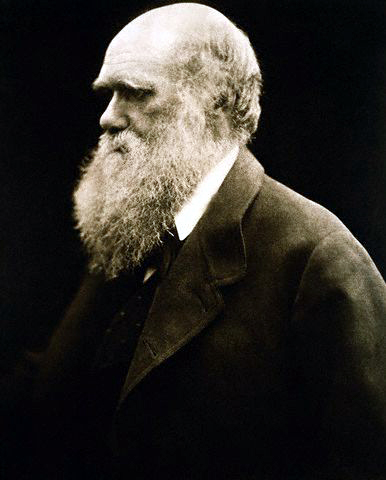
Credit: Julia Margaret Cameron · Public domain
Evolution is the process by which living things change over many generations. It explains why there are so many different kinds of plants, animals, and other life on Earth. It also explains why all living things share some of the same parts inside their cells. Evolution does not happen to one animal during its life. It happens to whole groups of living things, over thousands or millions of years.
How it works
The basic idea is simple. Living things are not all exactly the same, even within one species. Some rabbits run faster. Some plants grow taller. Some birds have slightly longer beaks. These small differences are called variations. Many variations are passed from parents to their young through genes.
Now add one more piece. In every generation, more babies are born than can survive. Food runs out, predators hunt, diseases spread, and weather turns harsh. The individuals whose traits happen to fit the world around them are more likely to live long enough to have young of their own. Those young inherit the helpful traits. Over many generations, the helpful traits become more common, and the unhelpful ones fade away. This is called natural selection.
Given enough time, small changes add up. A group of animals cut off on an island might slowly become so different from their cousins on the mainland that the two groups can no longer have young together. When that happens, a new species has formed.
Darwin and Wallace
The idea of evolution by natural selection was worked out in the 1850s by two British scientists, Charles Darwin and Alfred Russel Wallace. They reached the same conclusion while studying different parts of the world. Darwin had spent five years sailing around South America on a ship called the Beagle. On the Galápagos Islands, he noticed that finches on different islands had different beaks, each shaped for the food on that island.
Darwin published his ideas in 1859 in a book called On the Origin of Species. The book was a huge deal. Some people were excited. Others were upset, because the idea suggested that humans shared ancestors with apes. Darwin did not know about genes, so he could not explain exactly how traits were passed down. That part was worked out later by a monk named Gregor Mendel and, much later, by the scientists who discovered DNA.
The evidence
Evolution is supported by many kinds of evidence that all point the same way.
Fossils, which are the remains of living things from long ago, show how life has changed over time. The oldest fossils are about 3.5 billion years old and look like tiny bacteria. Younger rock layers hold fish, then amphibians, then reptiles, then mammals and birds. Scientists have even found fossils of creatures that are part fish and part land animal, part dinosaur and part bird.
Living bodies hold clues too. The bones in a human arm, a bat's wing, a whale's flipper, and a cat's front leg are arranged in almost the same pattern. This makes sense if all four came from a shared ancestor and then changed for different jobs.
DNA, the chemical code inside every cell, tells the clearest story. The DNA of two living things shows how closely they are related. Humans and chimpanzees share about 98 percent of their DNA. Humans and bananas share almost 50 percent, because all life on Earth comes from the same distant ancestors more than 3 billion years ago.
Settled science and open questions
Scientists sometimes ask, "Is evolution still just a theory?" The answer depends on what "theory" means. In everyday talk, a theory is a guess. In science, a theory is a carefully tested explanation backed by huge amounts of evidence. Evolution is one of the most tested ideas in all of science. The basic framework is settled.
The interesting debates are about the details. Scientists argue about exactly how birds evolved from small feathered dinosaurs. They argue about how life first began on Earth more than 3.5 billion years ago, before there were any fossils to find. They argue about how fast evolution can happen, and whether it speeds up during times of big change. These are real, active questions, and new answers come in every year.
Evolution right now
Evolution is not only something that happened in the past. It is still happening. Bacteria evolve quickly to resist the medicines doctors use against them. Insects evolve to survive bug sprays. Fish in polluted rivers have evolved in just a few decades to handle the pollution. Life keeps changing, quietly, all around us.
Related
Last updated 2026-04-23