
DNA
Credit: Zephyris · CC BY-SA 3.0
DNA is a molecule inside living things that holds the instructions for how they grow and work. The letters stand for deoxyribonucleic acid. Every plant, animal, fungus, and bacteria on Earth uses DNA. It is found inside almost every cell of your body, tucked into a part called the nucleus.
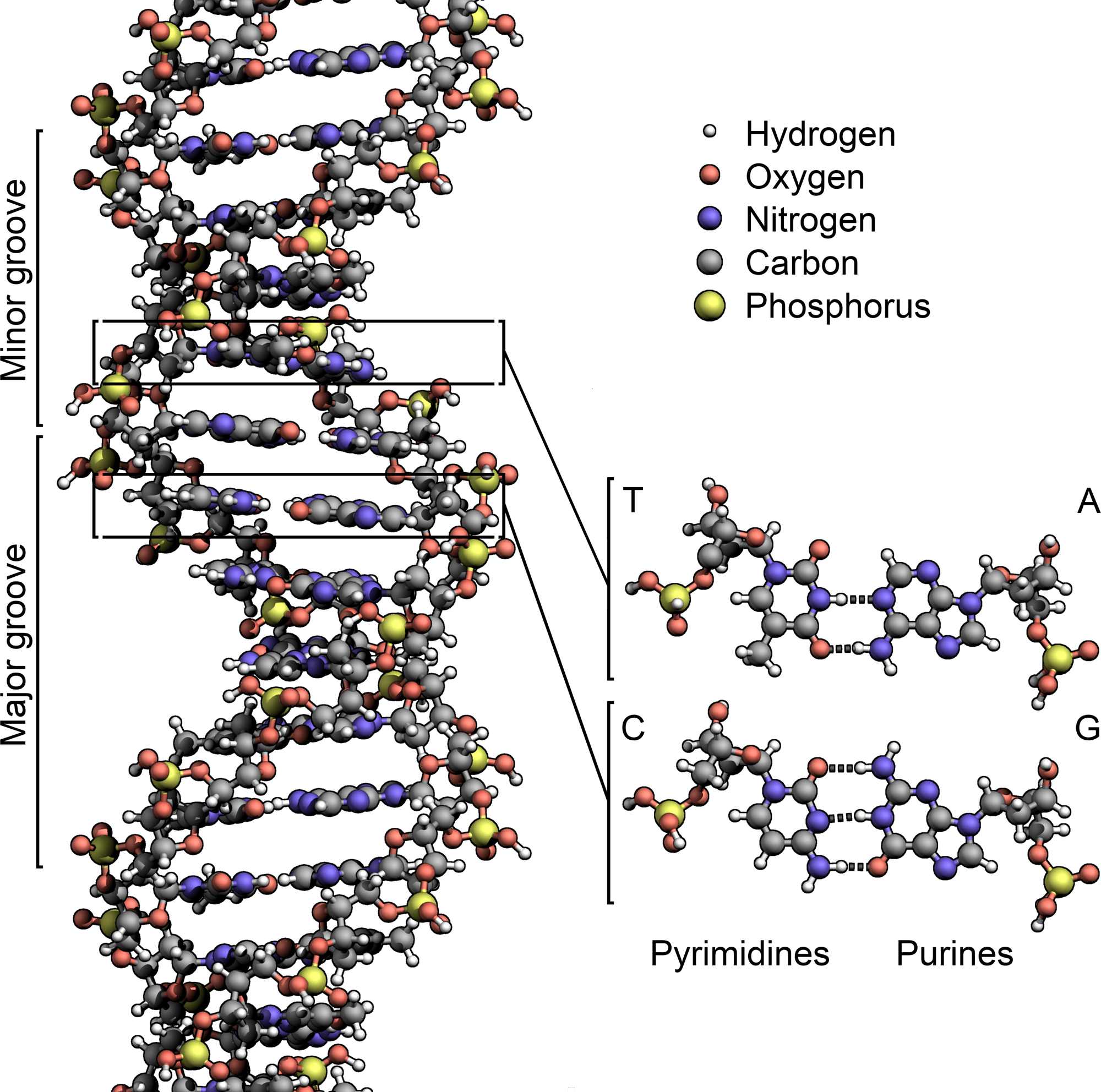
DNA is shaped like a twisted ladder. Scientists call this shape a double helix. The two long sides of the ladder are made of sugar and a chemical called phosphate. The rungs between them are made of four smaller pieces called bases. The bases are named adenine, thymine, guanine, and cytosine. Most people just call them A, T, G, and C. A always pairs with T. G always pairs with C.
The order of these letters is a code. It works a little like the letters in a book. A short section of DNA that spells out one instruction is called a gene. You might have one gene for eye color and another for whether your earlobes hang loose or attach to your head. Humans have about 20,000 genes in total.
Your DNA comes from your parents. Half of it came from the person who gave you an egg cell. The other half came from the person who gave you a sperm cell. That is why you might have your mother's nose and your father's hair color. It is also why no two people have the exact same DNA, unless they are identical twins.
When a cell needs to make a copy of itself, it first copies its DNA. Sometimes the copy is not perfect. A small mistake is called a mutation. Most mutations do nothing. A few cause problems. But over millions of years, helpful mutations have let living things change and adapt. This is the basic idea behind evolution.
Scientists first worked out the shape of DNA in 1953. Rosalind Franklin took X-ray photos of DNA crystals. James Watson and Francis Crick used her photos, along with other clues, to figure out the double helix. Franklin died before the Nobel Prize was given for the discovery, and many people today argue that she did not get enough credit at the time.
Today, doctors and scientists read DNA to study diseases, solve crimes, and track how animals are related. The tiny coded ladder inside your cells holds the story of your body and, in a way, the story of life itself.
Related
Last updated 2026-04-23