
Blood
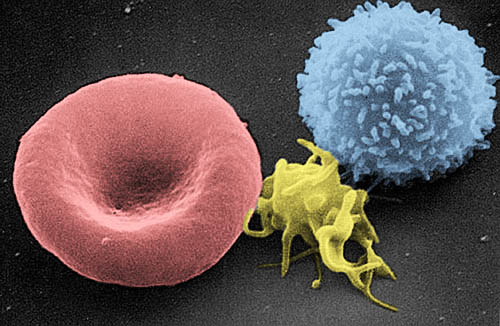
Credit: Electron Microscopy Facility at The National Cancer Institute at Frederick (NCI-Frederick) · Public domain
Blood is the red liquid that flows through your body. It moves through tubes called blood vessels, pushed along by your heart. Blood carries oxygen, food, water, and other things your cells need to stay alive. It also picks up waste and carries it away. An adult body holds about 1.5 gallons of blood, which is roughly the amount in a large milk jug.
Blood may look like a single red liquid, but it is really four things mixed together. About half of your blood is plasma. Plasma is a pale yellow liquid, mostly water, that carries everything else around. Floating in the plasma are three kinds of cells.
Red blood cells are the most common. There are around 25 trillion of them in your body. Their job is to carry oxygen from your lungs to every other cell. Each red blood cell holds a special protein called hemoglobin, which grabs onto oxygen. Hemoglobin contains iron, and that iron is what makes blood red.
White blood cells are the body's defenders. They hunt down germs and fight infections. You have far fewer white blood cells than red ones, but their numbers shoot up when you get sick. They are a key part of your immune system.
Platelets are tiny pieces of cells that help stop bleeding. When you get a cut, platelets rush to the spot and stick together. They form a plug, then help build a scab. Without platelets, even a small scrape could keep bleeding for hours.
Not everyone's blood is exactly the same. People have different blood types, called A, B, AB, and O. Each type can also be positive or negative. If a person needs blood after an accident or surgery, doctors must give them a matching type. The wrong type can make a person very sick. This is why hospitals always need blood donations from many different people.
Blood is made deep inside your bones, in a soft material called bone marrow. Your marrow makes millions of new blood cells every second of every day. A red blood cell only lives about four months. Then your body breaks it down and builds a new one to take its place.
Some animals have very different blood. Horseshoe crabs have blue blood, because they use copper instead of iron to carry oxygen. Their blood is so good at spotting germs that scientists use it to test medicines for safety.
Related
Last updated 2026-04-25