
Galápagos Islands
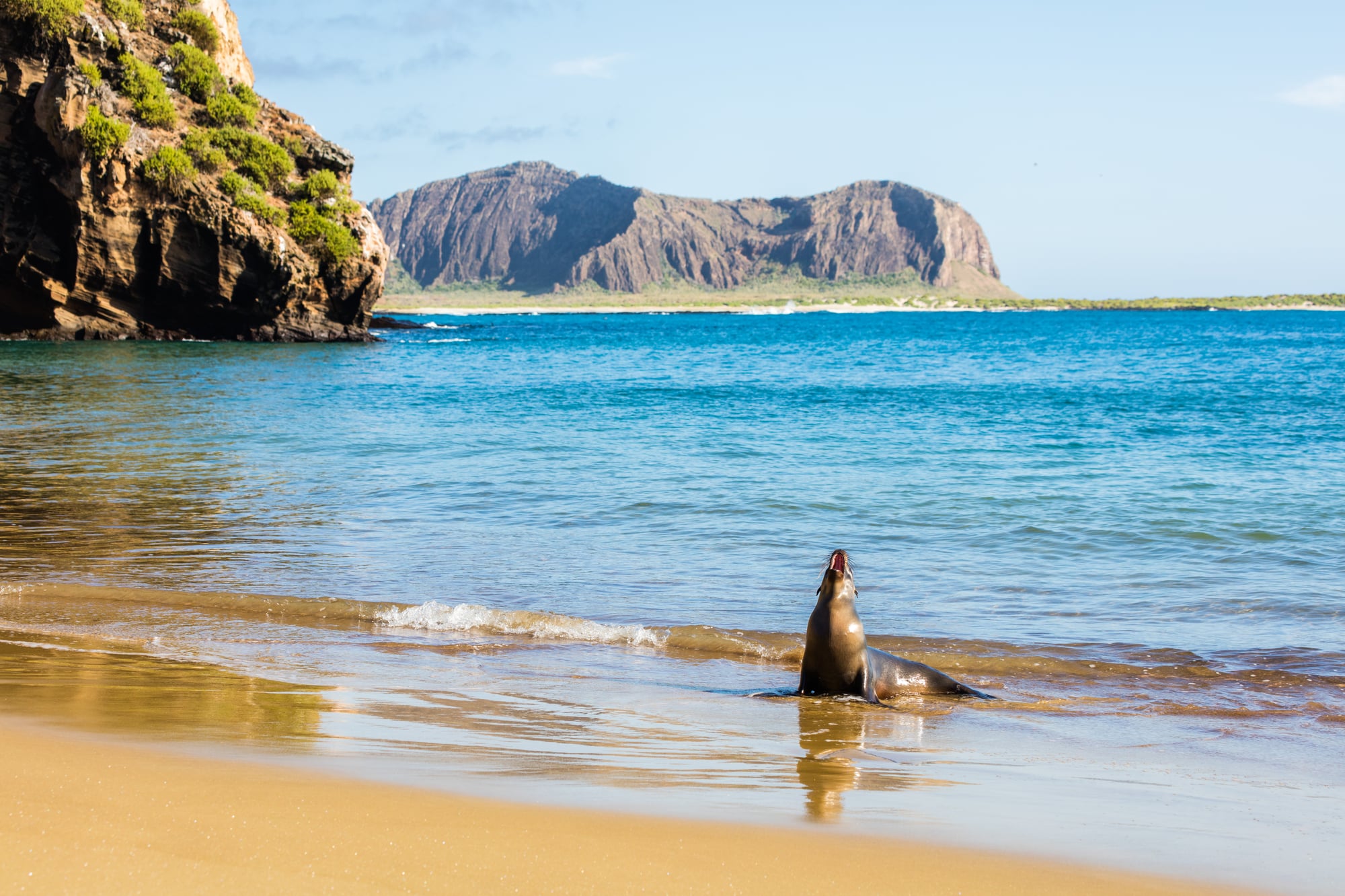
Credit: Diego Delso · CC BY-SA 4.0
The Galápagos Islands are a group of volcanic islands in the Pacific Ocean. They sit about 600 miles west of the coast of Ecuador, the country that owns them. There are 13 main islands, 6 smaller islands, and more than 100 tiny rocks and islets. The islands sit right on the equator. They are famous for their strange animals and for the scientist who studied them, Charles Darwin.
Every Galápagos island was built by a volcano. Deep under the ocean floor, a hot spot pushes magma up through Earth's crust. Over millions of years, that magma piles up until it breaks the surface as an island. Some of the islands are still active. Fernandina, the youngest big island, has erupted many times in the last hundred years. The oldest islands have been slowly worn down by waves for about 4 million years.
Because the islands are far from any continent, animals had to travel a long way to get there. Most came by accident. Birds flew in. Reptiles and small mammals floated over on mats of plants. Once they arrived, they changed over time to fit the new home. Animals that got stuck on one island slowly became different from animals on other islands, even when they started out the same. This is why the Galápagos have so many species found nowhere else on Earth.
Some of the most famous animals live only here. Giant tortoises can weigh over 500 pounds, about as much as a grand piano. Marine iguanas are the only lizards in the world that swim in the ocean and eat seaweed. Blue-footed boobies have bright blue feet that they show off in a slow dance. Flightless cormorants lost the ability to fly because they never needed to escape predators. There are also penguins here, the only penguins that live north of the equator.
A young scientist named Charles Darwin visited the islands in 1835. He noticed that the finches on each island had beaks shaped differently, matching the food each island offered. That observation helped him build his theory of evolution by natural selection, one of the most important ideas in all of science.
Today the Galápagos are a national park and a World Heritage Site. Nearly all of the land is protected. Still, the islands face real problems. Animals brought by people, like goats, rats, and cats, hunt native species and eat their food. Plastic trash washes up on the beaches. Scientists are working to remove invasive animals and keep the islands as wild as Darwin found them.
Related
Last updated 2026-04-23