
Arctic Ocean
Credit: CIA · Public domain
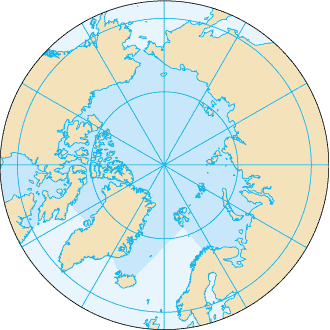
The Arctic Ocean is the smallest and shallowest of Earth's five oceans. It sits at the top of the world, around the North Pole. It is surrounded by the northern coasts of North America, Europe, and Asia. Much of its surface is covered by floating sea ice for most of the year.
The Arctic Ocean covers about 5.4 million square miles. That sounds huge, but it is less than one-seventh the size of the Pacific Ocean. Its average depth is about 3,400 feet, which is shallow for an ocean. The deepest spot, called Molloy Hole, drops to around 18,000 feet. That is more than three miles straight down.
Sea ice is what makes this ocean different from all the others. In winter, a layer of frozen seawater covers most of the ocean. The ice shrinks in summer and grows back in winter. Some of it used to last for many years, growing thick and hard. Most of that old ice is now gone.
The Arctic is warming faster than any other part of the planet. Satellite photos show that summer sea ice has shrunk by almost half since 1980. Scientists agree that this is caused by climate change. They debate exactly when the Arctic could see its first ice-free summer, but many think it could happen within the next few decades.
Life in the Arctic Ocean is tougher than it looks. Tiny plant-like creatures called phytoplankton bloom under the ice each spring. They feed small shrimp-like animals, which feed fish, which feed seals, which feed polar bears. Walruses, narwhals, beluga whales, and bowhead whales all live here. A bowhead whale can live more than 200 years, making it one of the longest-living mammals on Earth.
People have lived around the Arctic Ocean for thousands of years. The Inuit, Yupik, Sámi, and other Indigenous peoples built cultures around hunting, fishing, and traveling across the ice. They learned to read the weather, the snow, and the moods of the sea. Many still live in the region today.
The Arctic Ocean has also drawn explorers for centuries. Ships searched for a "Northwest Passage" across the top of North America, and many crews got stuck or died in the ice. Today, as the ice melts, big cargo ships can sail routes that were blocked just 20 years ago. Countries are now arguing over who controls the shipping lanes, the fish, and the oil and gas beneath the seafloor. The frozen ocean at the top of the world is becoming one of the most watched places on Earth.
Related
Last updated 2026-04-23