
Narwhal
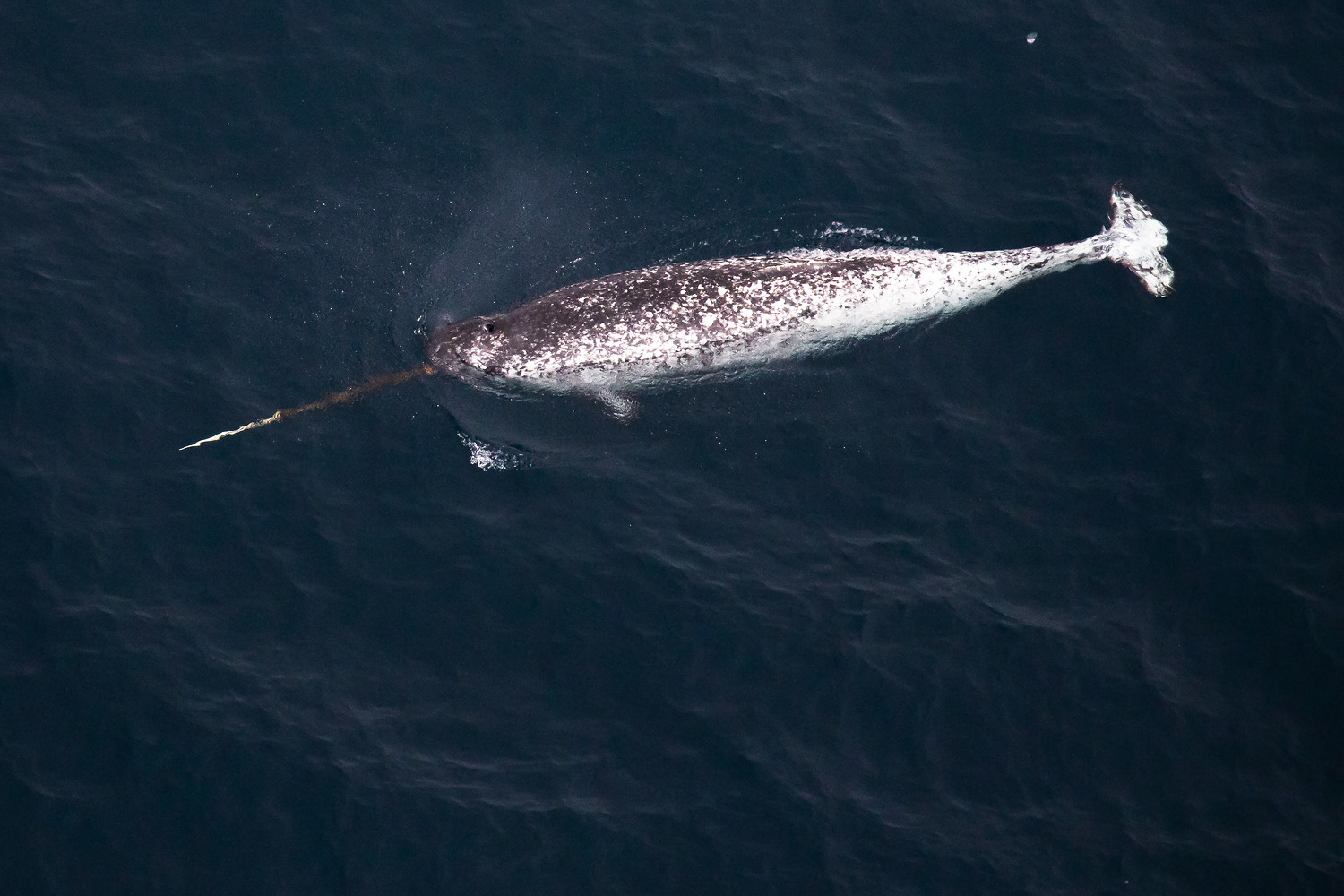
Credit: пресс-служба ПАО "Газпром нефть" · CC BY-SA 4.0
The narwhal is a medium-sized whale that lives in the icy waters of the Arctic Ocean. It is famous for one strange feature: a long, straight, spiral tusk that grows out of its head. Because of this tusk, narwhals are sometimes called the "unicorns of the sea." They live year-round in the freezing waters near Canada, Greenland, Norway, and Russia.
An adult narwhal is about 13 to 18 feet long, not counting the tusk. It weighs between 1,800 and 3,500 pounds, about as much as a small car. Narwhals have smooth, mottled gray skin and no dorsal fin on their back. Most scientists think this helps them swim under sheets of sea ice without getting stuck. Young narwhals are dark. As they age, their skin turns lighter, and very old narwhals can be almost pure white.
The tusk is the narwhal's most famous feature. It is not really a horn at all. It is a tooth. In males, the left front tooth grows straight through the upper lip and out into the water, twisting in a spiral shape as it goes. A full-grown tusk can reach nine feet long. Females usually do not have a tusk, though a few do. Once in a while, a male grows two tusks instead of one.
What is the tusk for? Scientists are still arguing about that. For a long time, people thought it was only used for fighting or showing off to other males. But recent studies found that the tusk is packed with millions of tiny nerve endings. That means narwhals may use it to sense the water around them, including the temperature and how salty it is. Drone videos have also shown narwhals tapping fish with their tusks to stun them before eating.
Narwhals are deep divers. They dive more than 5,000 feet below the surface to hunt, which is deeper than almost any other whale. Down in the dark, they eat squid, shrimp, and arctic fish like halibut and cod. A single dive can last more than 25 minutes. Narwhals travel and hunt in groups called pods, usually made up of 10 to 20 animals.
Narwhals face real danger today. As the Arctic warms, the sea ice they depend on is melting. Orcas, their main predator, are moving into waters that used to be too icy for them. Narwhals are not yet listed as endangered, but scientists are watching them closely. In the changing Arctic, the unicorn of the sea may have a harder future ahead.
Related
Last updated 2026-04-22