
Atlantic Ocean
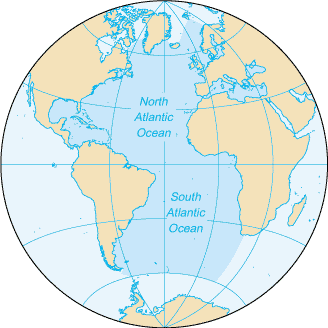
Credit: CIA · Public domain
The Atlantic Ocean is the second-largest ocean on Earth. It sits between the Americas to the west and Europe and Africa to the east. The Atlantic stretches from the Arctic Ocean in the north all the way down to the Southern Ocean near Antarctica. It covers about 41 million square miles, which is roughly one-fifth of the planet's surface.
The Atlantic is deep, but not as deep as the Pacific. Its average depth is about 12,000 feet. The deepest spot is the Puerto Rico Trench, which drops more than 28,000 feet below the surface. That is deeper than Mount Everest is tall. If you could flip Everest upside down and drop it into the trench, the peak would still not reach the top of the water.
Down the middle of the Atlantic runs a giant underwater mountain range called the Mid-Atlantic Ridge. It stretches about 10,000 miles from near the Arctic to near Antarctica. The ridge formed because two of Earth's tectonic plates are pulling apart there. Hot rock rises up through the gap and hardens into new seafloor. This slow spread pushes the Americas and Europe farther apart each year, at about the speed your fingernails grow. Iceland sits right on top of the ridge, which is why it has so many volcanoes and hot springs.
The Atlantic controls weather for much of the world. A powerful current called the Gulf Stream carries warm water from the Gulf of Mexico up past the eastern United States and across to Europe. The Gulf Stream keeps places like Britain and Ireland much warmer than they would be otherwise. Without it, winters in London would feel more like winters in Canada. Hurricanes also form over the warm Atlantic each year and sometimes slam into the Caribbean and the U.S. East Coast.
People have crossed the Atlantic for thousands of years. Vikings sailed from Scandinavia to North America around the year 1000, long before Columbus. The ocean became the highway of the Age of Exploration, and later the grim route of the trans-Atlantic slave trade, which forced more than 12 million Africans across the water in chains. In 1912, the passenger ship Titanic hit an iceberg in the North Atlantic and sank on its very first voyage.
The Atlantic is still one of the busiest oceans on Earth. Huge cargo ships carry goods between continents every day. Fishing boats pull up cod, tuna, and lobster. Beneath the waves, scientists are still mapping a seafloor that most humans will never see.
Related
Last updated 2026-04-22