
Rock Cycle
Credit: Emily Haddad · CC BY 4.0
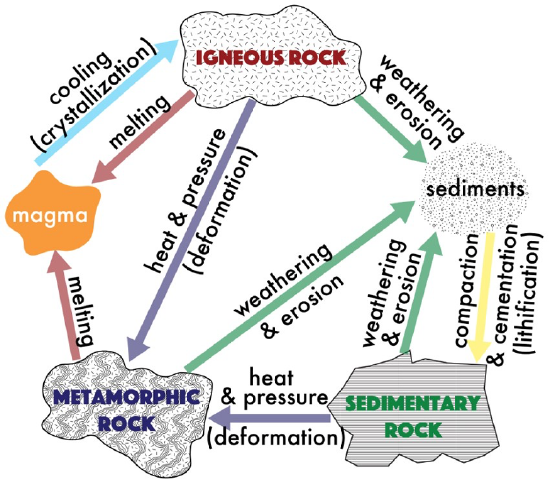
The rock cycle is the slow process that turns rocks on Earth from one kind into another. There are three main kinds of rock: igneous, sedimentary, and metamorphic. Over millions of years, any rock can become any other kind. The rock cycle never stops, but it works so slowly that most changes take longer than human history.
Igneous rock forms when hot melted rock cools and gets hard. Underground, this melted rock is called magma. When it bursts out of a volcano, it is called lava. Granite is a common igneous rock that cooled deep underground. Basalt is an igneous rock that cooled at the surface. Both are very strong.
Once a rock sits on the surface, it starts to break down. Wind, rain, ice, and rivers slowly chip and grind it into smaller pieces. This wearing away is called erosion. The tiny pieces are called sediment. Rivers carry sediment to lakes and oceans, where it settles in flat layers on the bottom. Over time, more layers pile on top. The weight presses the lower layers together until they become solid. That is how sedimentary rock forms. Sandstone, limestone, and shale are all sedimentary rocks. Most fossils are found in this kind of rock, because dead plants and animals get buried in the layers.
Metamorphic rock forms when an existing rock is squeezed or heated deep inside the Earth, but does not melt. The heat and pressure change the rock's minerals into new ones. Limestone turns into marble this way. Shale turns into slate. The word "metamorphic" comes from Greek words meaning "change shape."
The cycle keeps going because Earth itself keeps moving. Huge slabs of crust, called tectonic plates, slide around on the hot rock below. When one plate slips under another, the rock on it gets pushed deep into the Earth. Down there, it can melt back into magma. The magma may rise again, cool, and become new igneous rock. Then erosion starts the whole process over.
The rock cycle is incredibly slow. A piece of granite might sit in a mountain for 100 million years before erosion grinds it into sand. That is longer than the age of most dinosaur fossils. Some rocks in Canada and Greenland are nearly 4 billion years old, almost as old as the planet itself. Every rock you pick up has a long story, and that story is not finished.
Related
Last updated 2026-04-25