
Clouds
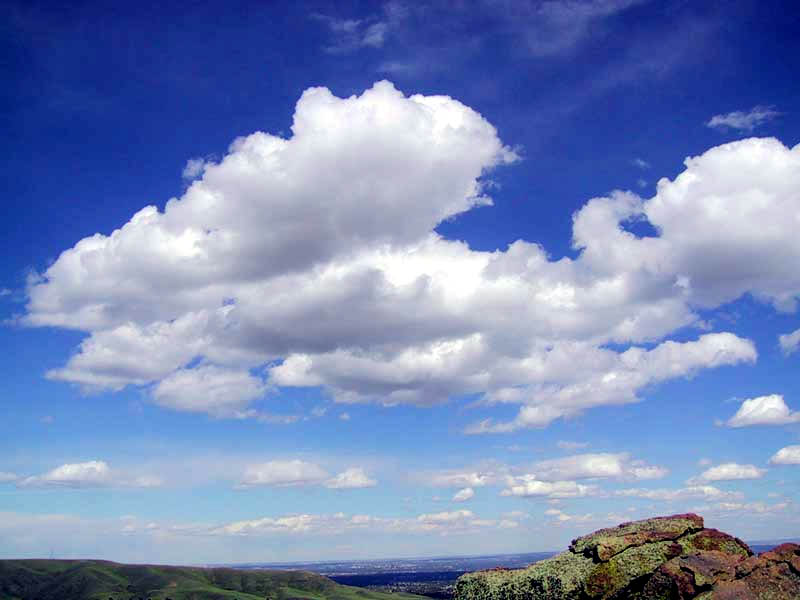
Credit: Michael Jastremski · CC BY-SA 2.0
A cloud is a large group of tiny water droplets or ice crystals floating in the sky. Clouds form in the atmosphere, the layer of air that wraps around Earth. They are part of the water cycle, which moves water between the ground, the oceans, and the sky.
Clouds form when warm, wet air rises. As the air goes up, it cools down. Cool air cannot hold as much water as warm air. So the extra water turns into tiny droplets around bits of dust, smoke, or salt floating in the sky. Billions of these droplets together make a cloud.
The droplets in a cloud are very small. A single droplet is about a hundred times thinner than a human hair. That is why clouds float. The droplets are so light that the moving air holds them up. When droplets bump together and grow heavy enough, they fall as rain. If the air is cold enough, they fall as snow or hail.
Scientists sort clouds into groups based on their shape and how high up they form. Cumulus clouds are the puffy white ones that look like cotton balls. They usually mean fair weather. Stratus clouds are flat, gray sheets that cover the whole sky and often bring drizzle. Cirrus clouds are thin and wispy. They form very high up, about six miles above the ground, and are made of ice crystals instead of water. Cumulonimbus clouds are the giants. They can grow more than ten miles tall, taller than Mount Everest, and they bring thunderstorms.
Clouds also change Earth's temperature. White cloud tops bounce sunlight back into space, which cools the planet. But clouds also trap heat rising from the ground, which warms the planet. Whether a cloud cools things or warms things depends on how thick it is, how high it sits, and the time of day. Scientists are still working out exactly how clouds will behave as Earth's climate changes. It is one of the biggest open questions in climate science today.
Other planets have clouds too, but not all of them are made of water. Venus has clouds of sulfuric acid. Jupiter has clouds of ammonia. On Saturn's moon Titan, the clouds rain liquid methane onto a frozen surface. Earth, so far, is the only place we know of where clouds rain water you can drink.
Related
Last updated 2026-04-25