
Stingray
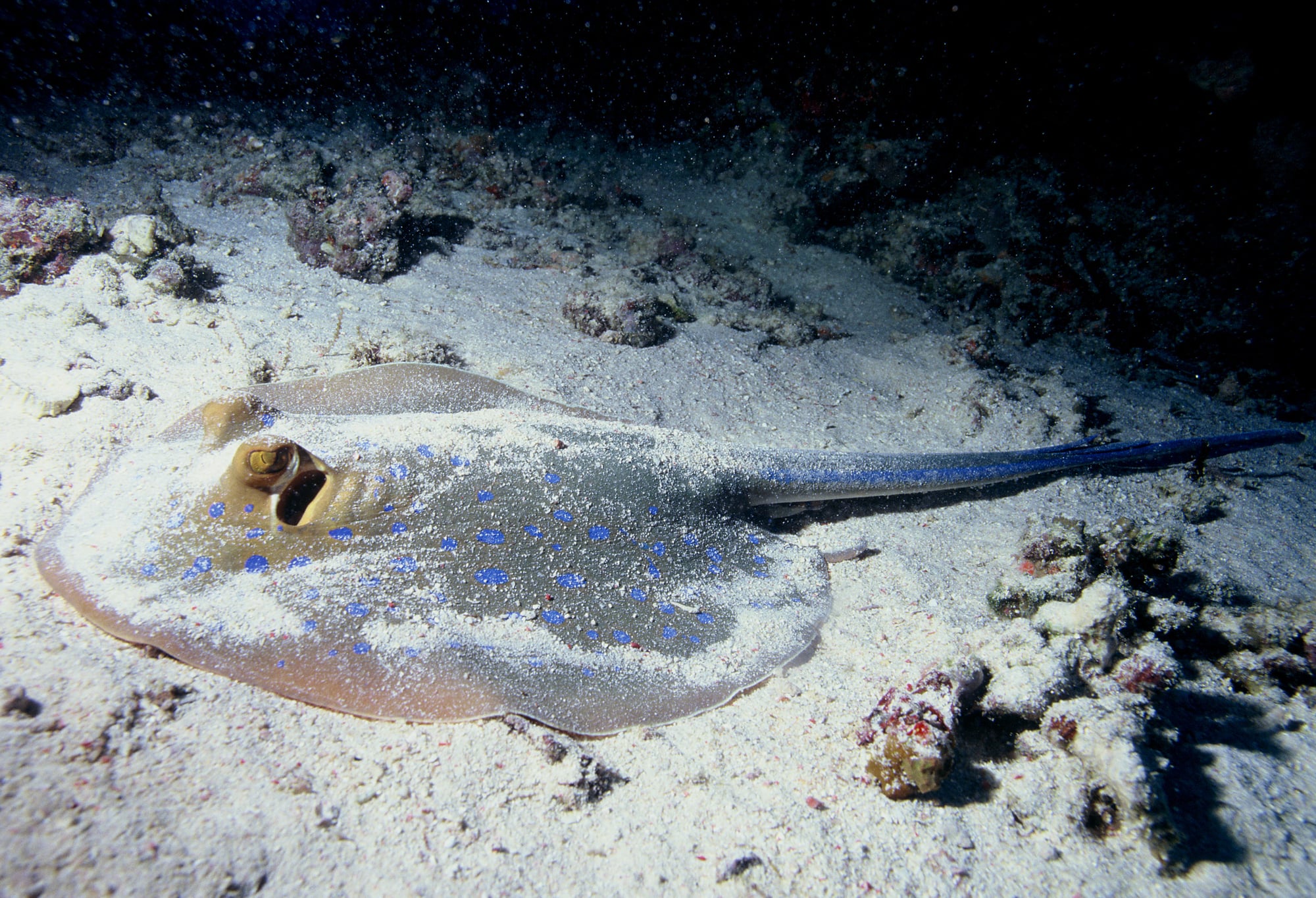
Credit: Albert Kok · Public domain
A stingray is a flat fish that lives in oceans and some rivers around the world. Stingrays are close cousins of sharks. Like sharks, they do not have any bones. Their whole body is held together by a bendy material called cartilage, the same stuff in the tip of your nose. There are more than 200 different species of stingrays. They range from the size of a dinner plate to more than 6 feet across.
A stingray's body is shaped like a wide, flat diamond. Its "wings" are really giant fins called pectoral fins. The stingray flaps them in slow waves to glide through the water. It looks like a bird flying in slow motion. A long, thin tail trails behind. Most stingrays are brown, gray, or sandy colored on top. That color helps them hide on the ocean floor.
Stingrays spend a lot of time buried in sand. They flick sand over their backs with their fins until only their eyes and a small breathing hole, called a spiracle, stick out. From this hidden spot they wait for food. They eat clams, shrimp, crabs, snails, and small fish. Their mouths are on the underside of their bodies. Strong, flat teeth crush shells like a nutcracker.
The stingray's most famous feature is the stinger. It sits near the base of the tail. The stinger is a sharp, bony spine coated in venom. A stingray does not use it to hunt. It uses it only when something steps on it or grabs it. The venom causes serious pain in humans but is almost never deadly. Most people who get stung were wading in shallow water and did not see the ray in the sand. Lifeguards tell swimmers to do the "stingray shuffle," dragging their feet along the bottom so rays can feel them coming and swim away.
Baby stingrays are called pups. Unlike most fish, stingrays do not lay eggs outside their body. The eggs hatch inside the mother, and she gives birth to live pups that already look like tiny adults. A newborn pup can swim and hunt right away.
Scientists are still learning how stingrays sense the world. Like sharks, they have tiny jelly-filled pores on their snouts called ampullae of Lorenzini. These pores can pick up the faint electric signals that every living animal gives off. A stingray can find a clam buried under the sand without ever seeing it.
Last updated 2026-04-22