
Electric Eel
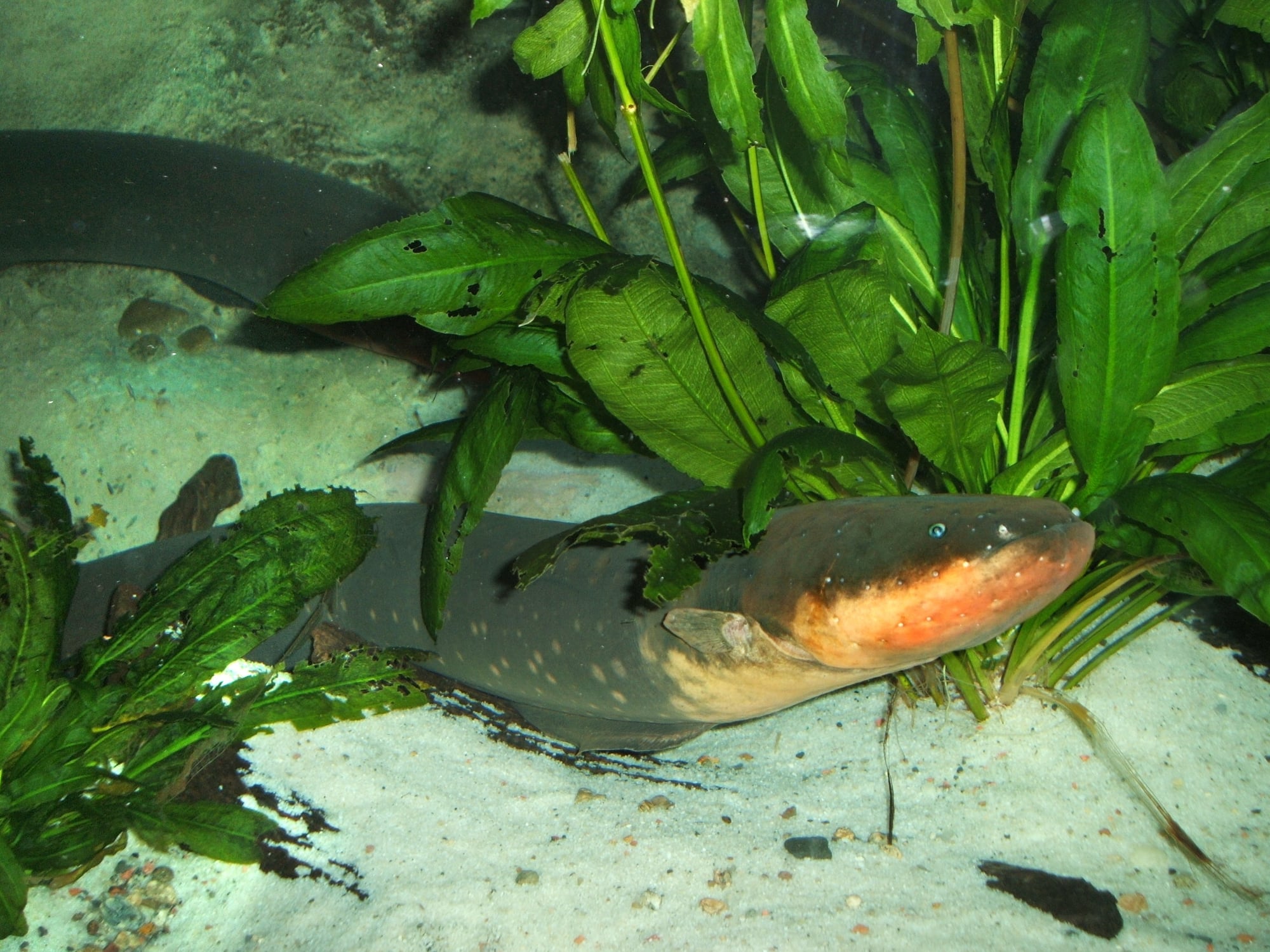
Credit: Steven G. Johnson · CC BY-SA 3.0
The electric eel is a long fish from South America that can make its own electricity. Despite its name, it is not really an eel. Scientists put it in the group of fish called knifefish. It lives in the muddy, slow-moving rivers and swamps of the Amazon and Orinoco basins. An adult can grow up to eight feet long, about the height of a tall adult standing up.
Electric eels breathe air. Every few minutes, one swims to the surface and gulps a mouthful of air. It would actually drown if it were kept underwater. This is unusual for a fish, but it helps the eel survive in warm, muddy water that often has very little oxygen in it.
The eel's body is shaped like a long tube. Most of that length is not guts or muscle for swimming. About four-fifths of the body is taken up by three special organs that make electricity. These organs are made of thousands of cells called electrocytes. Each cell makes only a tiny bit of power. But when all of them fire at the same time, the shocks add up. A big electric eel can zap its prey with about 600 volts.
Eels use this power in two ways. Weak pulses work like a radar system. The eel sends out small zaps and senses how they bounce back off objects in the muddy water. That is important because eels have poor eyesight. Strong pulses are used for hunting and defense. When an eel finds a small fish, it fires a burst of shocks that freezes the fish's muscles. Then the eel swallows the stunned prey whole.
A shock from an electric eel can knock down a horse or a person standing in the water. People are almost never killed by one, but the jolt can make a swimmer pass out and drown. In 2019, scientists discovered that what they had long called one species was actually three. One of the new species, Electrophorus voltai, delivers the strongest shock ever measured from any animal: 860 volts.
The eel's electric powers have fascinated scientists for hundreds of years. Benjamin Franklin studied them. Alessandro Volta, who built the first battery in 1800, based its design on the stacked cells he saw inside an electric eel. In a real way, every battery in every phone and flashlight today traces back to the body of this strange Amazon fish.
Last updated 2026-04-22