
Butterfly
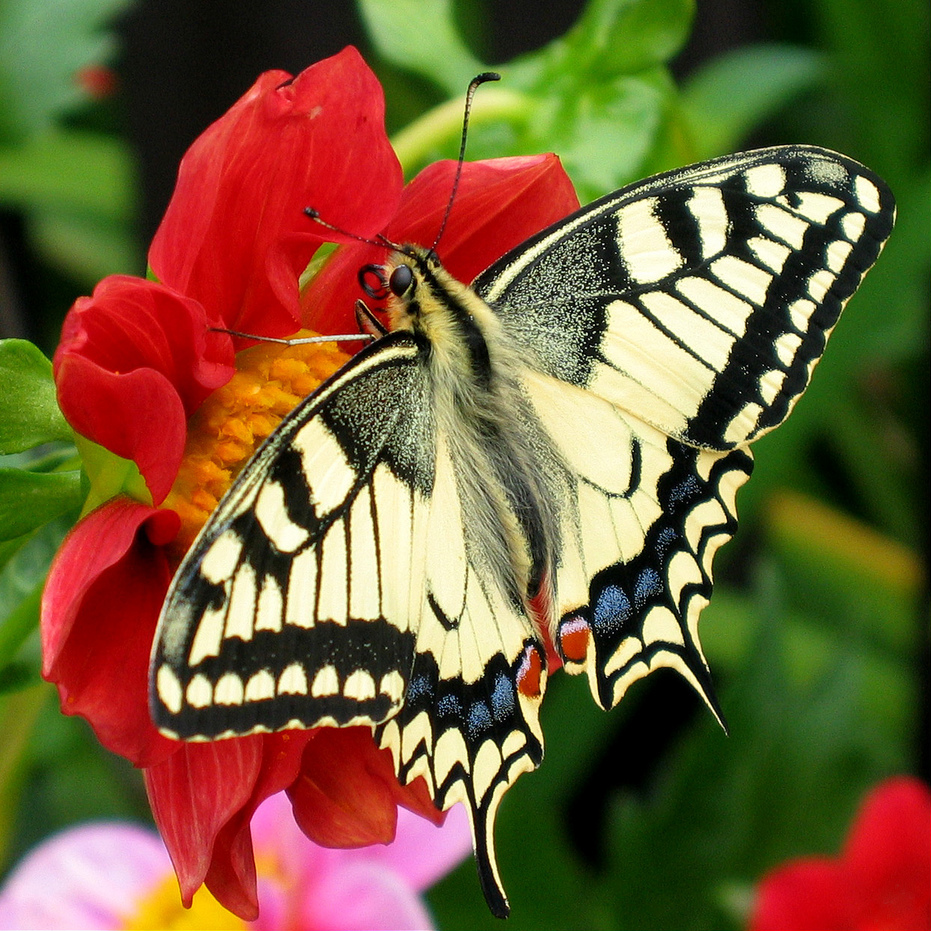
Credit: fesoj · CC BY 2.0
A butterfly is a flying insect with four large, colorful wings. Butterflies live on every continent except Antarctica. Scientists have named about 20,000 different kinds. Like all insects, a butterfly has six legs, two antennae, and a body split into three parts: head, thorax, and abdomen.
Butterfly wings look smooth from far away. Up close, they are covered in thousands of tiny scales. These scales overlap like shingles on a roof. They give the wings their bright colors and patterns. If you touch a butterfly's wing, some of the scales rub off like colored dust.
A butterfly's life has four stages. It starts as a tiny egg, usually laid on a leaf. The egg hatches into a caterpillar. The caterpillar eats leaves almost nonstop and grows fast. When it is big enough, it forms a hard case called a chrysalis. Inside the chrysalis, the caterpillar's body breaks down and rebuilds itself into a butterfly. This amazing change is called metamorphosis. After a week or two, the adult butterfly pushes out, dries its wings, and flies away.
Adult butterflies drink nectar, a sweet liquid inside flowers. They use a long, thin mouthpart called a proboscis, which works like a drinking straw. When not in use, the proboscis rolls up tight against the butterfly's head. As butterflies move from flower to flower, pollen sticks to their bodies. They help plants make seeds, just as bees do.
The monarch butterfly makes one of the most amazing trips in nature. Each fall, millions of monarchs fly from the United States and Canada down to a few forests in central Mexico. Some travel up to 3,000 miles, farther than the distance from New York to Los Angeles. What is strange is that no single butterfly makes the whole round trip. The butterflies that fly north in spring are the great-grandchildren of the ones that flew south. How they find the exact same forests their ancestors used is still a mystery. Scientists think the monarchs use the sun and Earth's magnetic field, but they do not fully understand how it works.
Butterflies are in trouble in many places. Farms, cities, and pesticides have destroyed the wild plants that caterpillars need to eat. Monarch numbers have dropped sharply in the last 30 years. People can help by planting milkweed, the only plant monarch caterpillars will eat.
Last updated 2026-04-22