
Silk Road
Credit: Whole_world_-_land_and_oceans_12000.jpg: NASA/Goddard Space Flight Center derivative work: Splette (talk) · Public domain
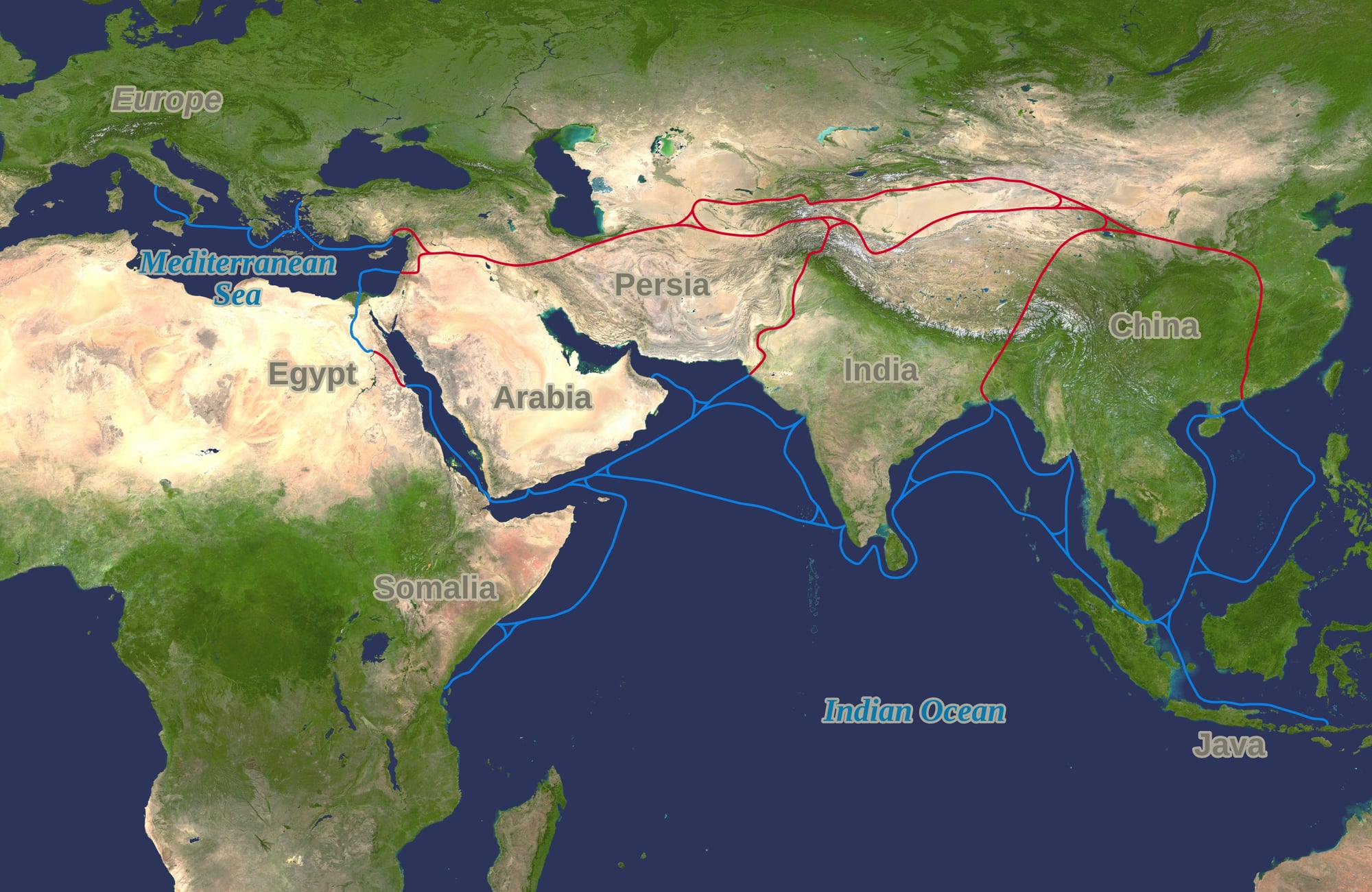
The Silk Road was a network of trade routes that connected China to Europe. It stretched across Asia for about 4,000 miles, longer than the width of the United States. Traders used these routes for more than 1,500 years, starting around 130 BCE. The Silk Road was not one single road. It was a web of paths across deserts, mountains, and grasslands.
The routes got their name from silk, China's most famous product. Silk is a soft, shiny cloth made from the cocoons of silkworms. The Chinese kept the secret of how to make silk for thousands of years. People in Rome and other faraway places paid huge amounts of money for it. A pound of silk could cost as much as a pound of gold.
But silk was only one item among many. Traders also carried spices, tea, jade, paper, and gunpowder west from Asia. Heading east, they brought gold, silver, glass, wool, and horses. Most traders did not travel the whole route themselves. They moved goods a few hundred miles, sold them to other traders, and turned back. An item from China might pass through 20 different hands before reaching Rome.
Travel was hard and dangerous. Traders crossed the Gobi Desert and the high passes of the Pamir Mountains. They traveled in groups called caravans, often with dozens of camels. Camels could carry heavy loads and go for days without water. Cities like Samarkand, Kashgar, and Bukhara grew rich serving the caravans. They became famous for their markets, libraries, and beautiful buildings.
Ideas traveled the Silk Road too, and this may have mattered even more than the goods. Buddhism spread from India into China along these routes. Islam spread from the Middle East into Central Asia. Chinese inventions like paper and the compass eventually reached Europe. Mathematics from India reached the Arab world and then Europe. The numbers you use today traveled part of this path.
Sickness traveled too. In the 1340s, a deadly disease called the Black Death moved west along the Silk Road. It reached Europe and killed about one-third of the people there.
The Silk Road slowly faded after the 1400s. European sailors found ocean routes to Asia, which were faster and cheaper than crossing the deserts. The old caravan cities lost their importance. But the Silk Road's effect lasted. It was one of the first times people on opposite sides of the world traded with each other, and it shaped languages, foods, and religions that millions of people still share today.
Related
Last updated 2026-04-26