
Athenian Democracy
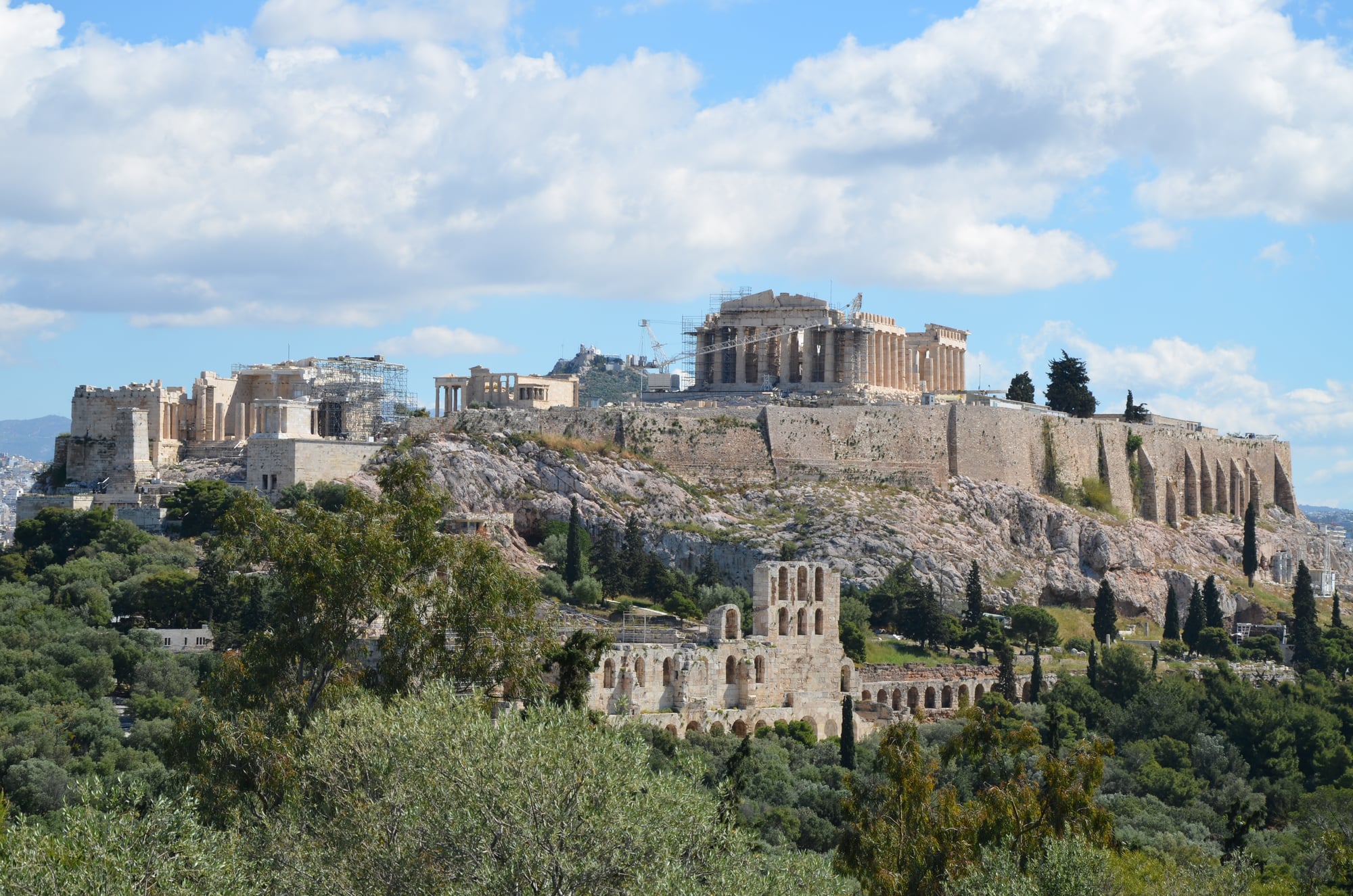
Credit: Carole Raddato from FRANKFURT, Germany · CC BY-SA 2.0
Athenian democracy was a system of government in the ancient Greek city of Athens. It began around 508 BCE and lasted, on and off, for almost 200 years. It was one of the first times in history that ordinary people, not kings or nobles, made the laws of their own city. The word "democracy" comes from two Greek words: demos, meaning people, and kratos, meaning power.
Before democracy, Athens was ruled by rich families and sometimes by single strong rulers called tyrants. A leader named Cleisthenes changed the system in 508 BCE. He gave every citizen the right to speak and vote in a big meeting called the Assembly. Any citizen could show up, listen to debates, and raise his hand on questions of war, money, and law.
The Assembly met about 40 times a year on a hill called the Pnyx. Around 6,000 men often showed up. Decisions were made by simple majority vote. There were no political parties, no presidents, and no kings. The people were the government.
Many jobs in the city were filled by random lottery, not by election. Athenians believed elections favored rich and famous people. A lottery gave every citizen a fair chance. Juries were also huge by modern standards. A trial might have 500 jurors hearing the case in a single day.
But Athenian democracy was not democracy as we know it today. Only adult male citizens could vote. Women had no political rights. Enslaved people, who made up a large part of the population, had none either. People born outside Athens, even if they lived there their whole lives, could not vote. Out of perhaps 300,000 people in Athens, only about 30,000 to 40,000 had a real voice.
The system also had famous failures. In 399 BCE, an Athenian jury voted to put the philosopher Socrates to death for asking too many uncomfortable questions. Many later thinkers used his trial to argue that crowds can make cruel decisions.
Athenian democracy ended after the city was conquered, first by Macedon under Philip II and later by Rome. But the idea did not die. More than 2,000 years later, the people who wrote the United States Constitution studied Athens carefully. They borrowed some ideas, like citizen voting and trial by jury, and rejected others, like rule by direct Assembly. Every time a class votes on where to go for a field trip, a small piece of an idea from a hill in Athens is still at work.
Related
Last updated 2026-04-26