
Ancient Greece
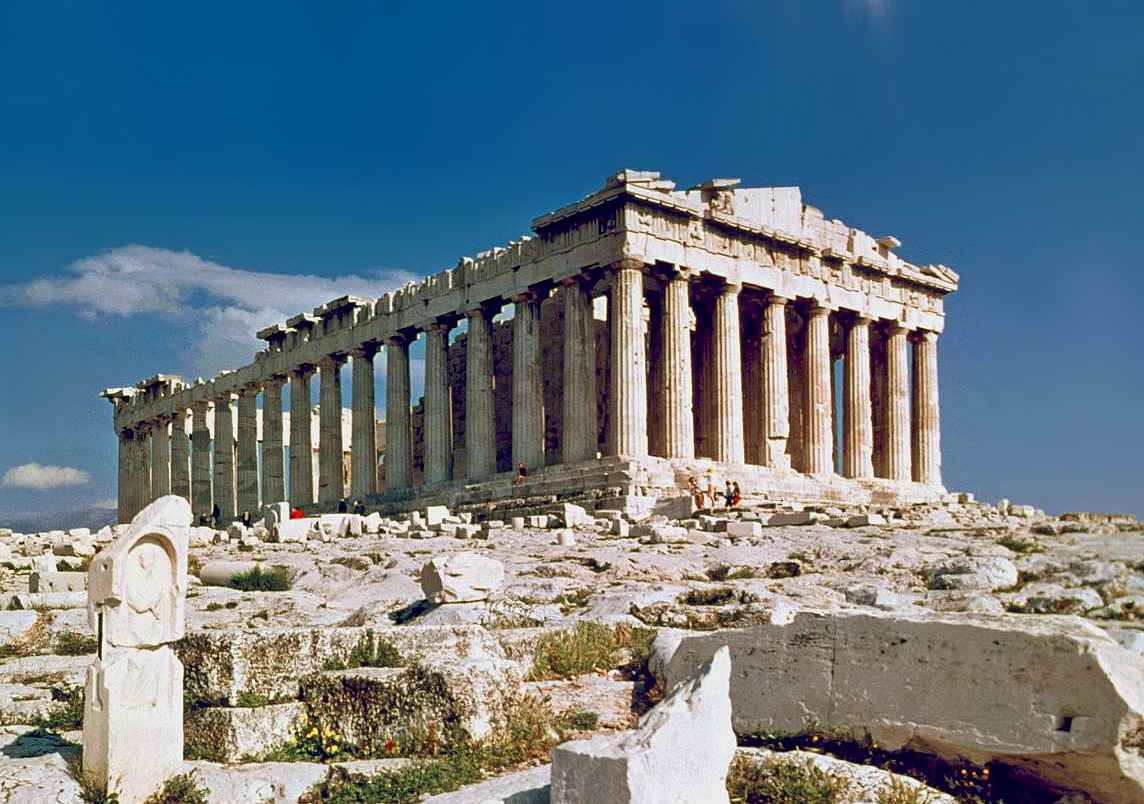
Credit: Steve Swayne · CC BY 2.0
Ancient Greece was a civilization that grew up around the Aegean Sea more than 2,500 years ago. It was not one big country. Instead, it was a group of small city-states that shared a language, gods, and customs. The most famous city-states were Athens and Sparta. Ancient Greece reached its peak between about 500 and 323 BCE, a stretch of time historians call the Classical Period.
The land
Greece is a rocky place with mountains, islands, and a long coastline. The land is hard to farm, but the sea is everywhere. Most Greeks lived close to the water. They became excellent sailors and traders. They set up Greek towns all around the Mediterranean and Black Seas, from Spain to Turkey.
The mountains split Greece into many small valleys. Each valley grew into its own city-state, called a polis. A polis included a city and the farmland around it. The city-states often fought each other, but they also shared the same gods and the same Greek language.
City-states
Athens and Sparta were the two most powerful city-states, and they were almost opposites.
Athens was famous for its art, theater, and ideas. Around 500 BCE, the Athenians invented a new way of running their city. They called it democracy, which means "rule by the people." Adult male citizens could vote on laws and serve in the government. Women, enslaved people, and foreigners could not vote. Even so, this was a huge change. Most kingdoms back then were ruled by one king.
Sparta was different. Spartan boys left home at age seven to train as soldiers. They lived in barracks, ate plain food, and learned to fight. Spartan women had more freedom than women in other Greek cities. They could own property and were taught to be strong. Spartan armies were the most feared in Greece.
Gods and myths
The Greeks believed in many gods and goddesses. The most important ones lived on top of Mount Olympus. Zeus ruled the sky and threw lightning bolts. Poseidon ruled the sea. Athena was the goddess of wisdom. Apollo drove the sun across the sky. Hades ruled the world of the dead.
Greek myths are still told today. Hercules did twelve impossible tasks. Odysseus took ten years to sail home from war. Pandora opened a jar that let suffering loose in the world. These stories were not just for fun. The Greeks used them to explain weather, seasons, love, and death.
Big ideas
The Greeks asked questions that nobody had written down before. What is the world made of? How should people live? What is fair? Thinkers called philosophers tried to answer these questions using reason instead of myths. Socrates taught his students by asking them hard questions. His student Plato wrote books about what makes a good government. Plato's student Aristotle studied animals, plants, stars, and politics, and his ideas shaped science for nearly 2,000 years.
Greek scientists made real discoveries. Pythagoras worked out a rule about triangles that students still learn today. Eratosthenes measured the size of the Earth using only shadows and math. He got the answer almost exactly right.
Theater and the Olympics
The Greeks invented the kind of theater we still watch today. Plays were performed in huge open-air stone theaters that held thousands of people. Some were comedies meant to make audiences laugh. Others were tragedies about heroes who suffered terrible fates.
The Olympic Games started in 776 BCE in the city of Olympia. Athletes from all over Greece came to run, wrestle, throw the discus, and race chariots. The games were held every four years to honor Zeus. During the Olympics, wars between city-states had to pause so athletes could travel safely.
War and Alexander
Around 480 BCE, the huge Persian Empire invaded Greece. The Greek city-states put aside their fights and joined together. They beat the Persians in famous battles at Marathon, Thermopylae, and Salamis.
Later, a kingdom in northern Greece called Macedon grew strong. Its young king, Alexander the Great, conquered an empire that stretched from Greece to Egypt to India. He died at age 32, but his armies spread Greek language and ideas across three continents.
What Greece left behind
Ancient Greece ended when Rome conquered it around 146 BCE. But Greek ideas never really died. Democracy, theater, the Olympics, geometry, and philosophy all began in Greece. Modern words like "school," "music," "theater," and "politics" come from Greek. Cracked marble columns still stand on Athenian hilltops, reminders of a small group of city-states that changed the world.
Related
Last updated 2026-04-26