
Trail of Tears
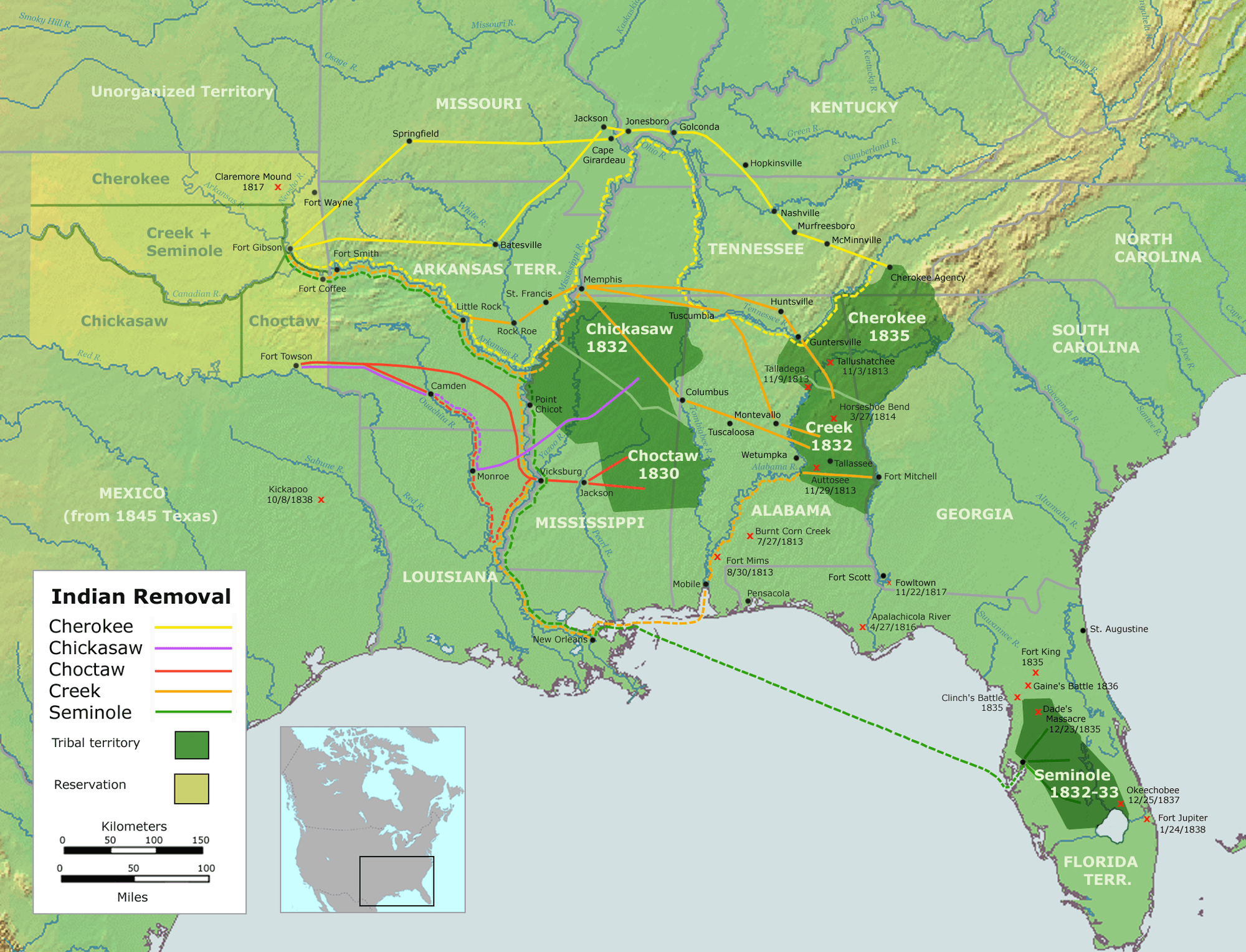
Credit: User:Nikater · Public domain
The Trail of Tears was the forced removal of tens of thousands of Native Americans from their homelands in the southeastern United States to land west of the Mississippi River. It happened mostly between 1830 and 1850. The U.S. government drove out members of the Cherokee, Muscogee (Creek), Seminole, Chickasaw, and Choctaw nations. Thousands died on the journey from cold, hunger, and disease. The name "Trail of Tears" comes from a Cherokee phrase that means "the trail where they cried."
For hundreds of years, these five nations had lived in what is now Georgia, Alabama, Tennessee, Mississippi, Florida, and the Carolinas. They had farms, schools, towns, and written laws. The Cherokee even had their own written language, created by a man named Sequoyah, and they printed their own newspaper.
But white settlers wanted the land. Cotton farming was spreading fast, and gold was found on Cherokee land in Georgia in 1828. President Andrew Jackson pushed Congress to pass the Indian Removal Act in 1830. The law gave the government power to trade Native lands in the East for land in what is now Oklahoma.
The Cherokee fought the law in court. In 1832, the Supreme Court ruled in their favor in the case Worcester v. Georgia. The court said Georgia had no right to take Cherokee land. President Jackson ignored the ruling. Removal went ahead anyway.
The Choctaw were forced out first, starting in 1831. The Muscogee, Chickasaw, and Seminole followed. The Cherokee removal happened in 1838 and 1839. U.S. soldiers showed up at Cherokee homes with guns and marched families into camps. From there, about 16,000 Cherokee were sent west on foot, by wagon, and by riverboat. The trip was about 1,000 miles long, longer than the distance from New York City to Florida. Winter storms hit the marchers hard. Food ran out. Sickness spread through the camps.
Historians believe about 4,000 Cherokee died on the journey, roughly one out of every four. Thousands more died from the other nations. The survivors arrived in a strange land and had to start over with almost nothing.
Today, the descendants of those who survived are still here. The Cherokee Nation, the Choctaw Nation, and the other removed nations remain among the largest tribes in the United States. The Trail of Tears is now marked as a National Historic Trail across nine states. Visitors can walk parts of the same route the marchers walked, and the National Park Service works with tribes to teach the story honestly.
Related
Last updated 2026-04-26