
Slavery in the United States
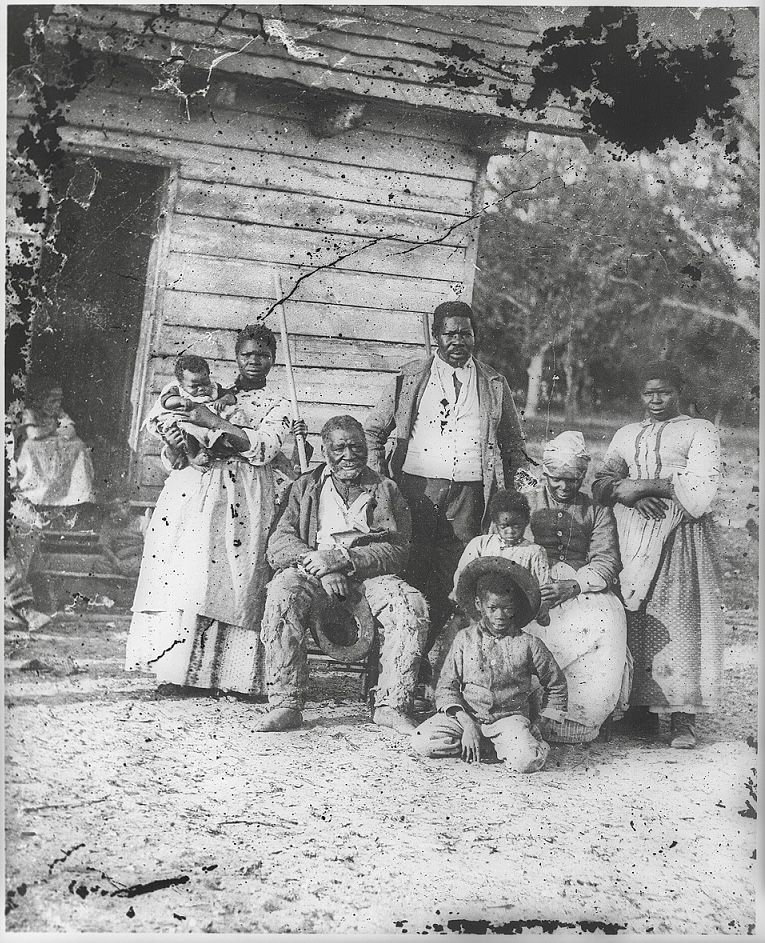
Credit: Timothy H. O'Sullivan · Public domain
Slavery in the United States was a system in which Black people were owned as property and forced to work without pay. It lasted for almost 250 years, from the early 1600s until 1865. During that time, millions of African people and their children were held in slavery, mostly in the southern part of the country. Slavery shaped almost every part of early American life, from farming to politics, and its effects still reach into the present day.
How it began
The first enslaved Africans arrived in the English colonies in 1619. A ship landed in Virginia carrying about 20 captive people from Africa. Over the next two centuries, ships brought hundreds of thousands more across the Atlantic Ocean. The trip was called the Middle Passage. Enslaved people were chained together in the dark below deck for weeks. About one in seven died on the way.
By the 1700s, slavery was legal in all thirteen colonies. Most enslaved people were forced to work on large farms called plantations. They grew tobacco, rice, and indigo. Later, cotton became the biggest crop of all.
Life under slavery
Enslaved people had no rights. They could not own property, vote, or learn to read in most places. They could be bought, sold, and separated from their families at any moment. A child born to an enslaved mother was also enslaved, even if the father was free. Owners used whips, chains, and other punishments to force people to obey.
Most enslaved people worked from before sunrise until after dark. On cotton plantations, a worker was expected to pick around 200 pounds of cotton a day, about the weight of a large adult. Children as young as six were put to work in the fields or in the owner's house.
Even under these conditions, enslaved people built rich lives where they could. They formed families, raised children, kept African music and stories alive, and created new traditions. Spirituals, a kind of religious song, were sung in the fields. Some spirituals carried hidden messages about escape.
Resistance
Enslaved people resisted in many ways. Some worked slowly, broke tools, or pretended to be sick. Others ran away. The Underground Railroad was a secret network of free Black people, formerly enslaved people, and white helpers who guided runaways north to free states and Canada. Harriet Tubman, who escaped slavery in 1849, returned to the South again and again to lead about 70 people to freedom.
A few people led armed rebellions. The most famous was led by Nat Turner in Virginia in 1831. The rebellion was quickly put down, and the laws against enslaved people were made even harsher afterward.
A nation divided
By the 1800s, the country was splitting in two. Northern states had ended slavery, partly because their economy did not depend on it. Southern states kept it and grew rich from cotton. Cotton sold to factories in the North and in Europe brought in huge amounts of money. By 1860, there were about 4 million enslaved people in the United States, almost one out of every eight people in the country.
Many Americans worked to end slavery. They were called abolitionists. Frederick Douglass, who had escaped slavery, gave powerful speeches and wrote books about his life. Sojourner Truth traveled the country speaking for both the end of slavery and the rights of women. White abolitionists like William Lloyd Garrison printed newspapers calling slavery a moral evil.
Southern leaders fought back. They passed laws like the Fugitive Slave Act of 1850, which forced people in free states to help return runaways. The Supreme Court ruled in 1857 that Black people, free or enslaved, were not citizens.
The end of slavery
In 1860, Abraham Lincoln was elected president. He had said he wanted to stop slavery from spreading. Eleven southern states broke away from the United States to form their own country, the Confederacy. The Civil War began in 1861.
In 1863, while the war was still being fought, Lincoln issued the Emancipation Proclamation. It declared that enslaved people in the rebelling states were free. Many ran to Union army lines, and about 200,000 Black men joined the Union forces. The war ended in 1865 with the Confederacy defeated. That same year, the Thirteenth Amendment to the Constitution officially ended slavery everywhere in the United States.
What came after
The end of slavery did not end the harm it caused. Black Americans faced new laws, called Jim Crow laws, that kept them poor and separated for another hundred years. Historians today still study how the wealth, the laws, and the divisions built during slavery continue to shape the country.
Related
Last updated 2026-04-26