
Submarine
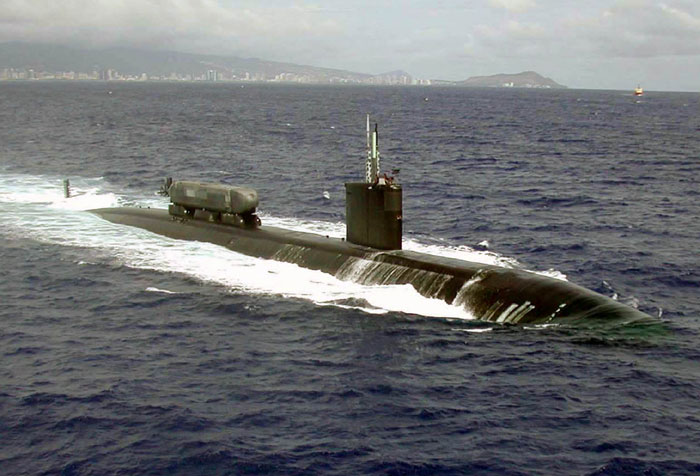
Credit: First uploaded to engl. Wikipedia at 07:49, 2 April 2004 by Minesweeper. · Public domain
A submarine is a ship that can travel underwater. It is built to dive below the surface of the ocean, move around for hours or days or even months, and then come back up. Submarines are used by navies around the world. They are also used by scientists who study the deep sea.
A submarine works because of a clever trick with weight. Inside the hull are big spaces called ballast tanks. To dive, the crew lets seawater flow into the tanks. The extra weight makes the submarine sink. To come back up, the crew pushes the water out of the tanks with compressed air. The submarine becomes lighter and floats to the surface. Propellers in the back push the submarine forward, and small fins called diving planes tilt it up or down.
The first working submarine was built more than 400 years ago. In 1620, a Dutch inventor named Cornelius Drebbel built a wooden boat covered in greased leather. He rowed it under the River Thames in London. During the American Revolution, an inventor named David Bushnell built a one-person submarine called the Turtle. It tried to attack a British warship in 1776 but failed.
Modern submarines are huge. A United States Navy submarine can be longer than a football field and weigh more than 7,000 tons. That is heavier than 1,000 elephants. The biggest submarines ever built were Russian Typhoon class boats. They were so large that the crew had a small swimming pool inside.
Most large military submarines today run on nuclear power. A nuclear reactor makes heat, the heat turns water into steam, and the steam spins a turbine. These submarines can stay underwater for months without coming up. They only need to surface when the crew runs out of food.
Submarines cannot use radio under the ocean because radio waves do not travel well through water. Instead, they use sonar. The submarine sends out a sound pulse. When the sound bounces back, the crew can tell what is around them. Whales and dolphins use the same trick, called echolocation.
Scientists also use small submarines called submersibles to explore the deep sea. In 1960, two men rode a submersible called Trieste down to the bottom of the Mariana Trench in the Pacific Ocean. They reached almost 36,000 feet below the surface. Down there, the water is pitch black, near freezing, and the pressure could crush a car. Even so, they saw a fish swim past the window.
Last updated 2026-04-25