
Battery
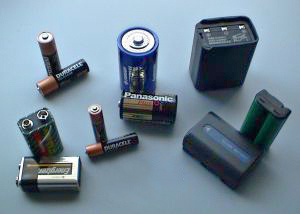
Credit: en:User:Brianiac · Public domain
A battery is a device that stores energy and releases it as electricity. Batteries power things that need to move or work without being plugged into a wall. Flashlights, phones, cars, hearing aids, and toy robots all run on batteries. The first true battery was invented in 1800 by an Italian scientist named Alessandro Volta.
Inside a battery, energy is stored in chemicals. When you connect a battery to something like a light bulb, the chemicals start to react. The reaction pushes tiny particles called electrons through a wire. A flow of electrons is what we call electricity. When the chemicals are used up, the battery goes dead.
Every battery has three main parts. Two ends, called the positive and negative terminals, stick out where the wires connect. Between them is a chemical paste or liquid called the electrolyte. Electrons leave the negative end, travel through whatever the battery is powering, and return to the positive end. The little plus and minus signs on a battery show you which end is which.
There are two main kinds of batteries. Single-use batteries, like the AA batteries in a TV remote, get thrown away when they die. Rechargeable batteries can be plugged in and filled back up with energy hundreds of times. The lithium-ion batteries in phones and laptops are rechargeable. So are the giant batteries inside electric cars.
Batteries come in wildly different sizes. A tiny button battery in a watch is smaller than a dime. The battery pack in an electric car can weigh more than 1,000 pounds, about as much as a grand piano. Some batteries used to back up power grids are the size of shipping containers.
Batteries also have a darker side. Making them takes metals like lithium and cobalt that have to be dug out of the ground, sometimes in dangerous mines. Old batteries leak harmful chemicals if they end up in landfills. That is why most towns ask people to drop dead batteries at special recycling spots instead of throwing them in the trash.
Scientists are working hard to invent better batteries. Some are testing batteries that use salt water instead of lithium. Others are trying "solid-state" batteries that would charge faster and last longer. The race matters because almost every plan to fight climate change, from electric cars to solar power at night, depends on storing energy in better batteries.
Related
Last updated 2026-04-25