
Day and Night
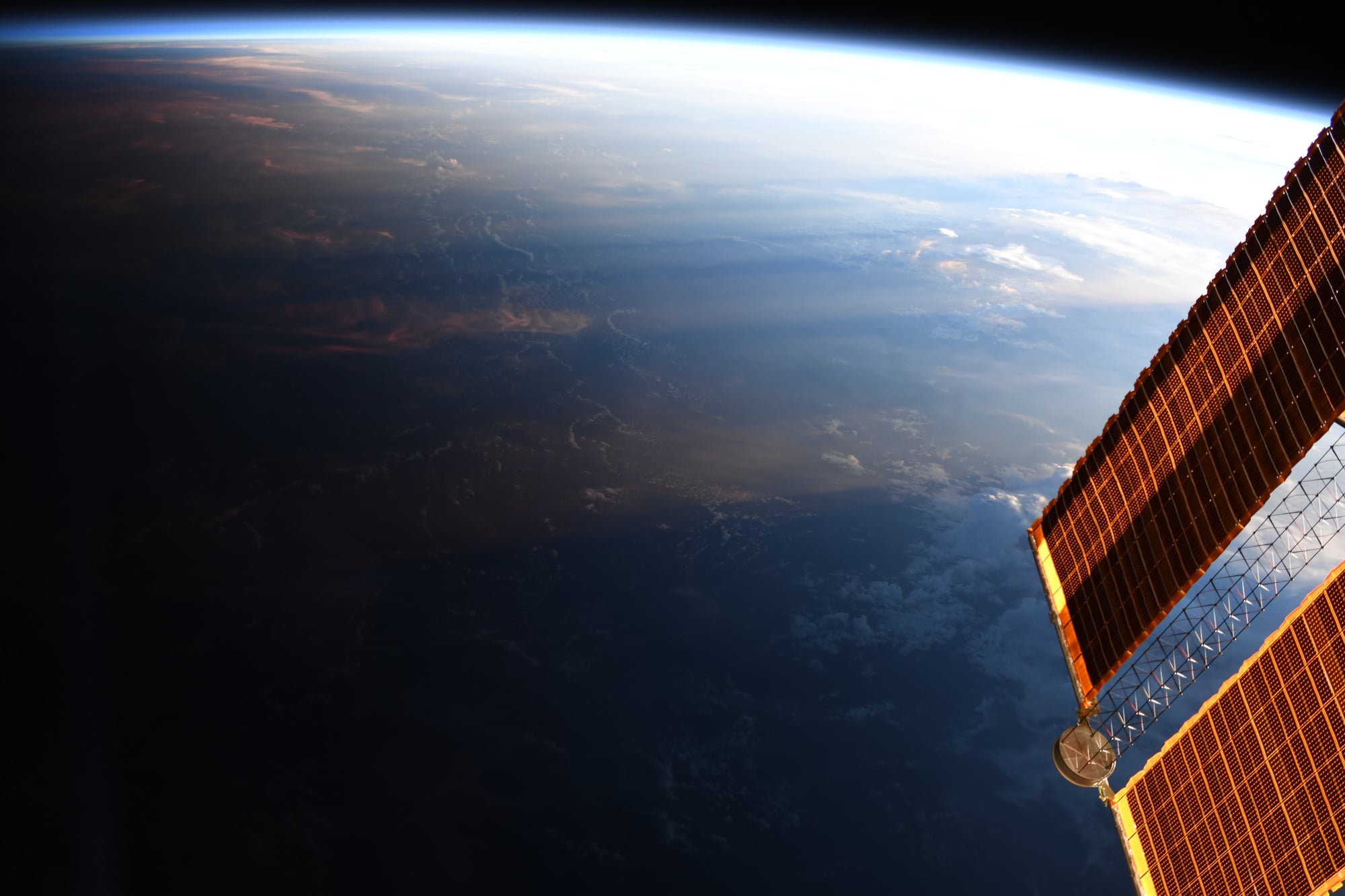
Credit: کریستیانا هاموک ناسا · Public domain
Day and night are the two halves of Earth's daily cycle. Day is the time when your part of Earth faces the Sun, so sunlight reaches you. Night is the time when your part of Earth faces away from the Sun, so you are in the planet's own shadow. One full day and night together take about 24 hours.
Day and night happen because Earth spins. Earth turns like a slow top, making one full spin every 24 hours. As Earth spins, different parts of it face the Sun at different times. The Sun is not actually moving across the sky. You are moving. Sunrise is really the moment when your part of Earth rotates into the Sun's light. Sunset is the moment when it rotates back out.
Earth spins from west to east. That is why the Sun appears to rise in the east and set in the west. If you could watch Earth from space, you would see the line between day and night sweep across the planet once every 24 hours. Scientists call this line the terminator.
Not every place gets the same amount of daylight. Earth is tilted by about 23 degrees as it orbits the Sun. This tilt is what causes seasons. In summer, your half of Earth leans toward the Sun, so days are long. In winter, it leans away, so days are short. At the North and South Poles, the tilt is so strong that the Sun does not set at all for weeks in summer, and does not rise for weeks in winter.
Other planets have days too, but their days are very different from ours. A day on Jupiter is only about 10 hours long because Jupiter spins fast. A day on Mars is almost the same length as a day on Earth, about 24 hours and 40 minutes. Mercury takes 59 Earth days to spin around once.
People used day and night to measure time long before clocks existed. Ancient Egyptians built tall stone pillars called obelisks and watched their shadows move. Sundials do the same thing. They turn Earth's spin into a way to tell time. Even today, the hour hand of a clock moves in the direction a shadow moves in the Northern Hemisphere. That is where the word "clockwise" comes from.
Last updated 2026-04-22