
Seasons
Credit: Tauʻolunga · CC0
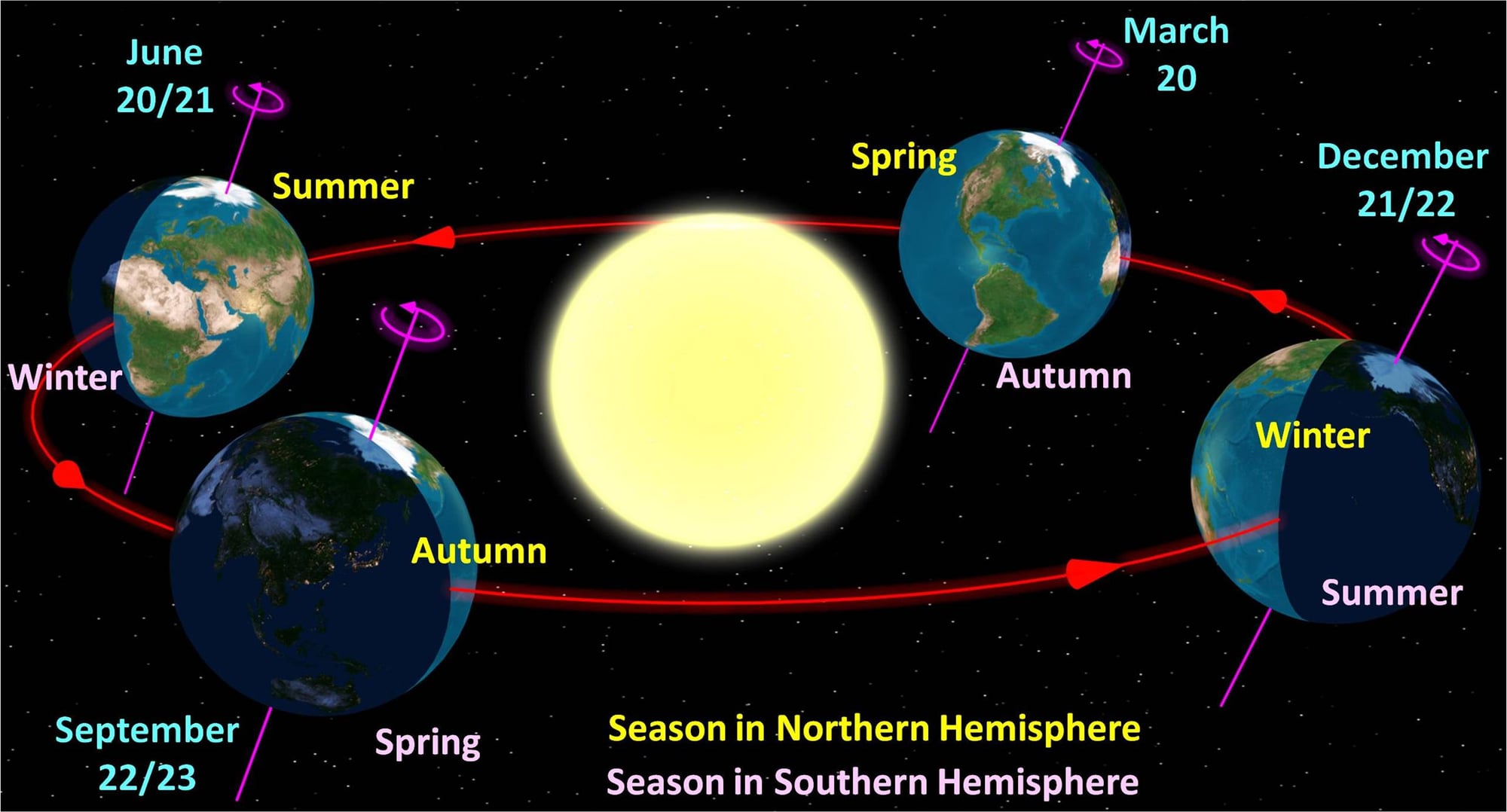
Seasons are the four parts of the year that bring different weather to most places on Earth. The four seasons are spring, summer, fall, and winter. Each one lasts about three months. Seasons are caused by the way Earth tilts as it travels around the Sun.
Earth does not stand straight up. It leans to one side by about 23.5 degrees. As Earth orbits the Sun once a year, this tilt stays pointed in the same direction in space. That means different parts of Earth lean toward the Sun at different times.
When your half of the Earth tilts toward the Sun, you get summer. The Sun climbs higher in the sky. Days are long and warm. Sunlight hits the ground more directly, like a flashlight pointed straight down. Six months later, your half of Earth tilts away from the Sun. That brings winter. Days are short and cold. Sunlight hits at a slanted angle and spreads out, so it warms the ground less.
Spring and fall happen in between. During these seasons, neither half of Earth leans strongly toward or away from the Sun. The weather is milder, and the length of day and night is closer to equal.
A common myth is that summer happens because Earth moves closer to the Sun. That is not true. Earth's distance from the Sun barely changes during the year. In fact, the Northern Hemisphere is actually a little farther from the Sun in July than in January. Tilt, not distance, is what makes the seasons.
The two halves of Earth have opposite seasons. When it is July and hot in New York, it is July and cold in Sydney, Australia. When American kids are home for summer break, Australian kids are bundled up for winter.
Not every place on Earth has four clear seasons. Near the equator, the Sun stays high in the sky all year. These places are warm all the time. Many tropical regions have just two seasons: a wet season and a dry season. Near the North and South Poles, the tilt is so extreme that the Sun does not set at all for weeks in summer, and does not rise for weeks in winter.
Plants and animals depend on the seasons. Trees drop their leaves before winter. Bears fatten up and hibernate. Birds fly thousands of miles to follow warmer weather. Even your school year is shaped by the seasons, with summer break landing in the warmest months.
Related
Last updated 2026-04-25