
Eclipse
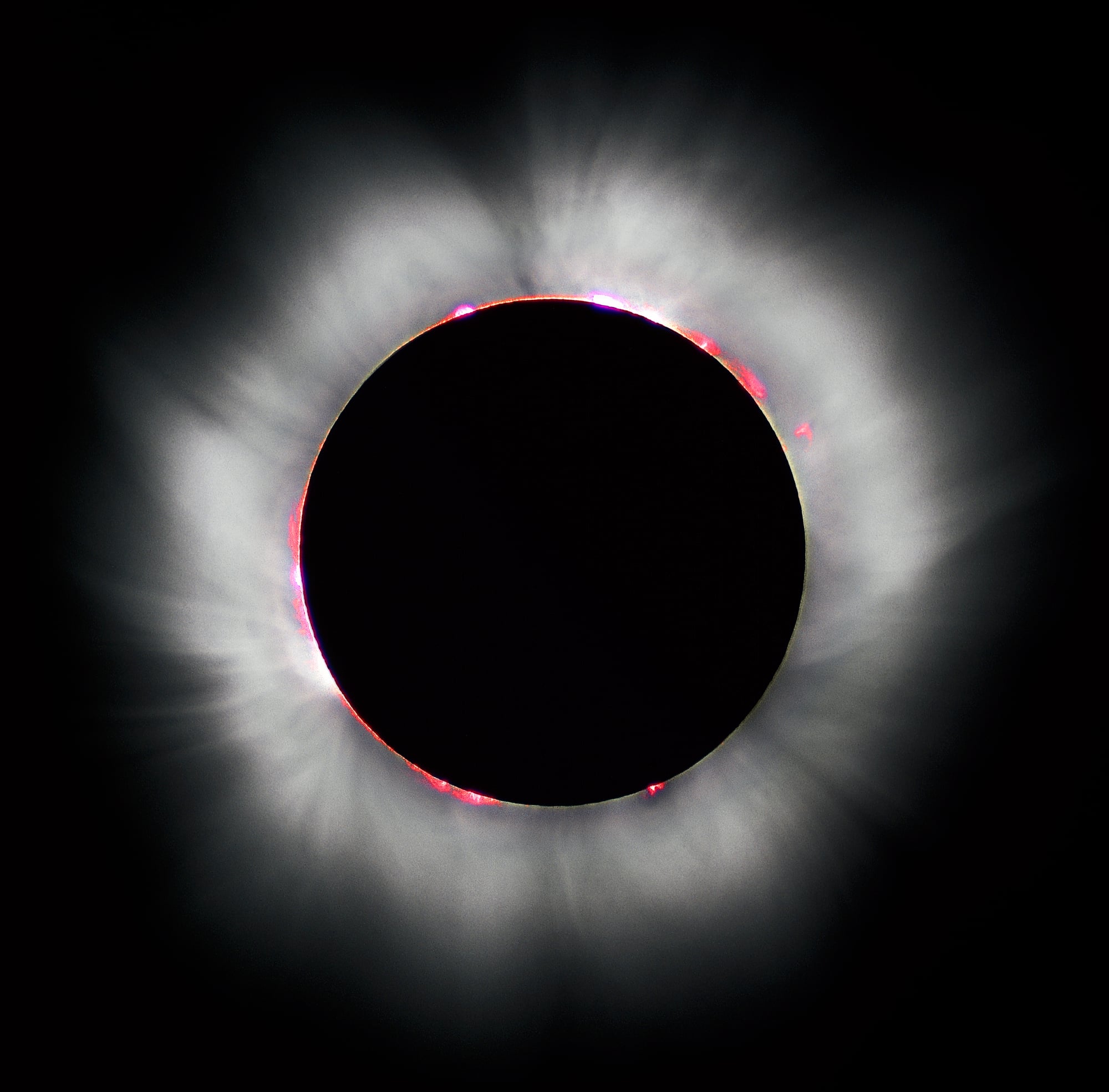
Credit: Luc Viatour · CC BY-SA 3.0
An eclipse is an event in space where one object blocks the light of another. On Earth, the word usually means one of two things. A solar eclipse happens when the Moon passes between the Sun and Earth, hiding the Sun. A lunar eclipse happens when Earth passes between the Sun and the Moon, and Earth's shadow falls on the Moon.
Eclipses happen because of how the Sun, Earth, and Moon line up. The Moon orbits Earth about once a month. Earth orbits the Sun once a year. Most months the three line up almost straight, but not quite. The Moon's orbit is tilted by about five degrees. So usually the Moon passes a little above or below the Sun in our sky. When the lineup is nearly perfect, we get an eclipse.
During a total solar eclipse, the Moon covers the Sun completely. The sky gets dark in the middle of the day. Stars become visible. The air grows cooler. Birds often go quiet, as if night has come. You can see the Sun's outer atmosphere, called the corona, glowing around the black circle of the Moon. Totality only lasts a few minutes before the Moon moves on.
A total solar eclipse is only total for people standing in a narrow path across Earth, usually about 100 miles wide. Outside that path, people see a partial eclipse, where the Moon covers only part of the Sun. You should never look straight at a solar eclipse without special eclipse glasses. The Sun's light can damage your eyes even when most of it is blocked.
Lunar eclipses are different. Earth's shadow is much bigger than the Moon, so a lunar eclipse can be seen from anywhere on the night side of Earth. During a total lunar eclipse, the Moon often turns a deep red color. People call this a "blood moon." The red color comes from sunlight bending through Earth's atmosphere, the same way sunsets look red.
Ancient people did not always know what caused eclipses. Some thought a dragon was eating the Sun. Some saw eclipses as warnings from the gods. In 585 BCE, a Greek thinker named Thales is said to have predicted a solar eclipse, which stunned two armies in the middle of a battle and helped end their war. Today, scientists can predict eclipses thousands of years into the future, down to the minute.
Last updated 2026-04-22