
Fern
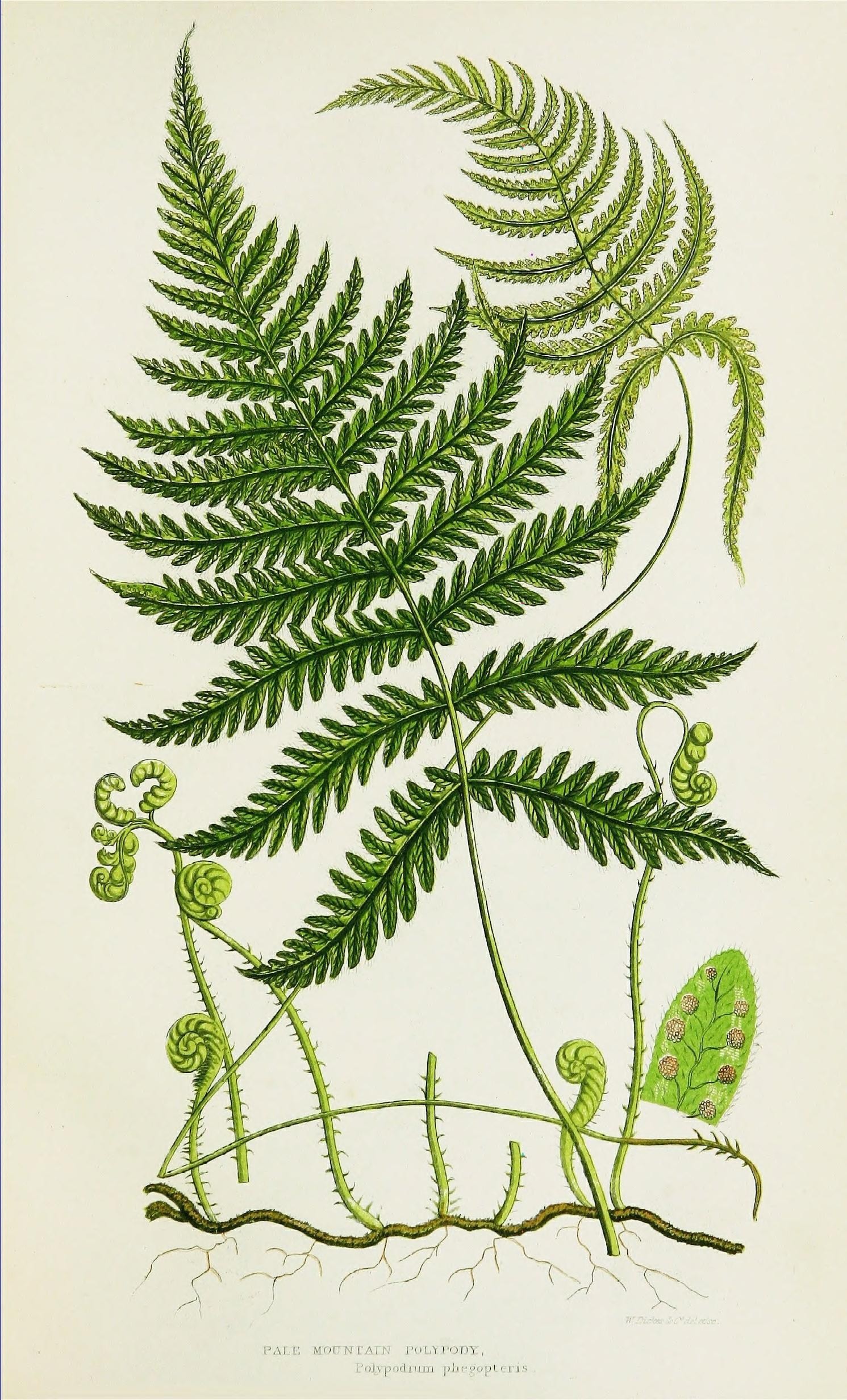
Credit: Pratt, Anne; Pratt, Anne; Society for Promoting Christian Knowledge (Great Britain) · Public domain
A fern is a kind of plant that has roots, stems, and leaves but does not make flowers or seeds. Instead, ferns make tiny cells called spores, which can grow into new ferns. Most ferns live in shady, damp places like forest floors, stream banks, and the cracks of wet rocks. There are about 10,500 different fern species alive today.
The leaf of a fern is called a frond. A frond often looks lacy because it is split into many small leaflets along a central stem. When a new frond first pushes up from the ground, it is rolled up in a tight spiral. People call this curled shape a fiddlehead, because it looks like the curly top of a violin. As the frond grows, it slowly unrolls into its full shape.
If you turn over a fern frond in summer, you may see rows of small brown or black dots on the underside. These dots are called sori. Each sorus is a cluster of tiny cases packed with spores. When the cases dry out, they can snap open and fling spores into the air. A single fern can release millions of spores in one season. Wind and water carry the spores to new spots, where some of them grow into new plants.
Ferns do not need pollen or insects to reproduce. That is one reason they have lasted so long. Ferns first appeared about 360 million years ago, more than 100 million years before the first dinosaurs. Huge fern forests once covered swampy parts of the Earth. When those ancient ferns died and got buried, they slowly turned into much of the coal that people dig up and burn today. So when a power plant burns coal, it is often burning ferns from a world before dinosaurs.
Ferns come in many sizes. The smallest water ferns float on ponds and are no bigger than a fingernail. The biggest are tree ferns, which grow in places like New Zealand and Hawaii. Tree ferns can stand more than 60 feet tall, taller than a six-story building, with fronds 10 feet long.
People grow ferns as houseplants, eat young fiddleheads as a vegetable in some countries, and study them to learn how plants first spread across the land. The next time you walk through a damp forest, look down. The lacy green plants near your feet are some of the oldest kinds of life still growing on Earth.
Last updated 2026-04-25