
Himalayas
Credit: NASA · Public domain
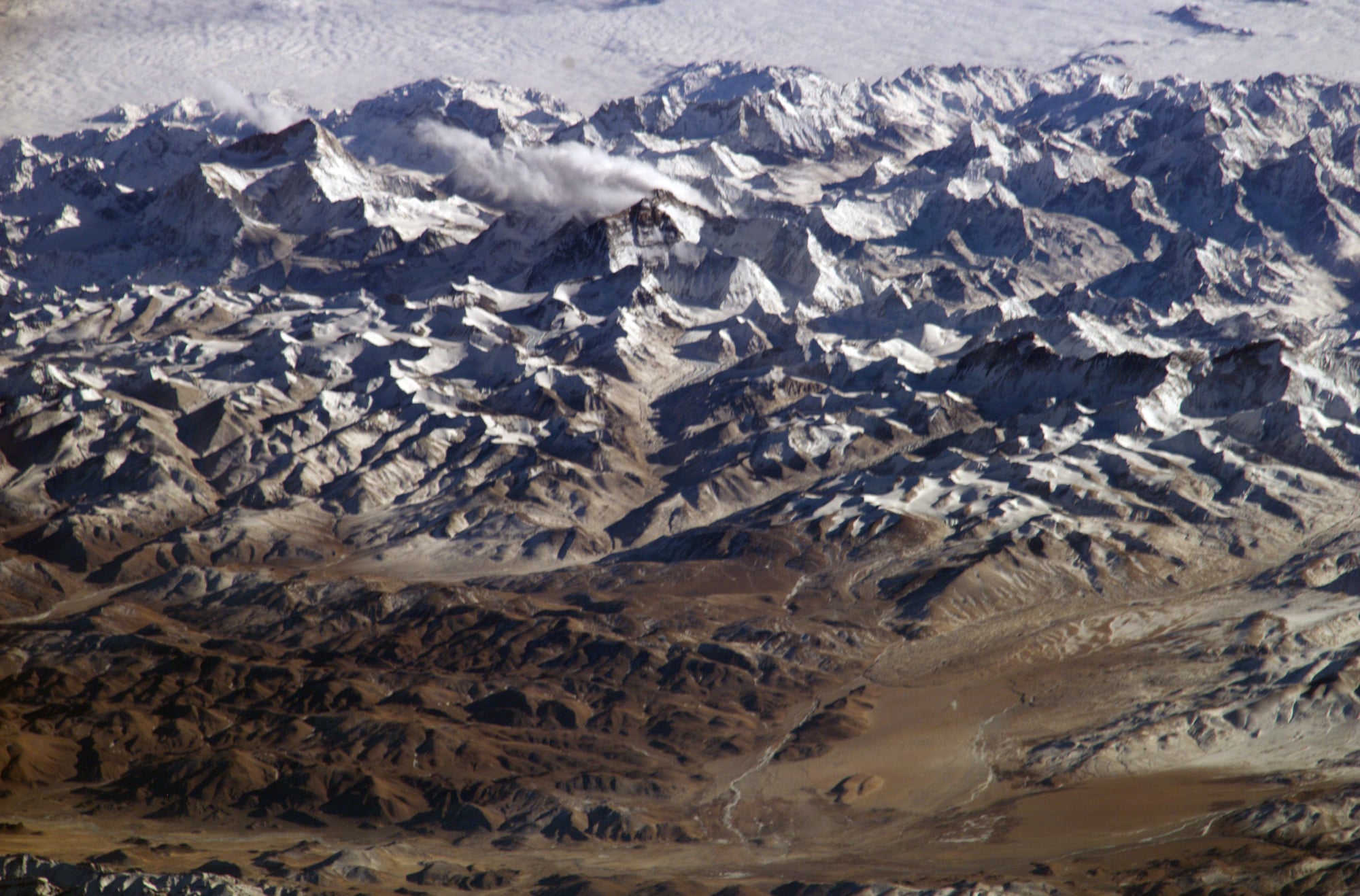
The Himalayas are a huge mountain range in South Asia. The range stretches about 1,500 miles across five countries: India, Nepal, Bhutan, China, and Pakistan. The Himalayas hold the tallest mountains on Earth. More than 50 of them rise above 23,000 feet. The tallest of all is Mount Everest, at 29,032 feet above sea level.
The name "Himalaya" comes from two words in Sanskrit, an ancient language of India. "Hima" means snow, and "alaya" means home. So Himalaya means "home of snow." The name fits. The tops of these mountains are covered in snow and ice all year long.
The Himalayas were born from a slow crash between two giant pieces of Earth's crust. About 50 million years ago, the piece of crust carrying India slammed into the piece carrying Asia. Instead of one sliding under the other, the rock crumpled upward. That crumpling is still happening today. India keeps pushing north about two inches every year. Because of this, the Himalayas are still slowly rising.
The range is so tall that it changes the weather for half of Asia. In summer, warm wet air from the Indian Ocean blows north and hits the mountains. The mountains force the air up, where it cools and drops heavy rain. These rains are called the monsoon. They water the farms of India and Bangladesh and feed some of the biggest rivers in the world. The Ganges, the Indus, and the Brahmaputra all start as melting snow and ice high in the Himalayas.
About 53 million people live in the Himalayas. Many belong to groups like the Sherpa, Tibetan, Bhutia, and Gurkha peoples. The Sherpa are famous for climbing. They live at high altitudes where the air holds less oxygen, and their bodies have adapted to breathe it well. Most climbers who reach the top of Everest are guided by Sherpa teams.
The Himalayas are sacred in both Hinduism and Buddhism. Hindus believe the god Shiva lives on Mount Kailash, a peak in Tibet. Buddhists believe the same mountain is the center of the world. Pilgrims have walked around Kailash for more than a thousand years, and no one is allowed to climb it.
The mountains are changing. Glaciers high in the Himalayas are melting faster than before because the planet is warming. Scientists worry about what this will mean for the nearly two billion people who depend on rivers that start in these peaks.
Related
Last updated 2026-04-23