
Amazon Rainforest
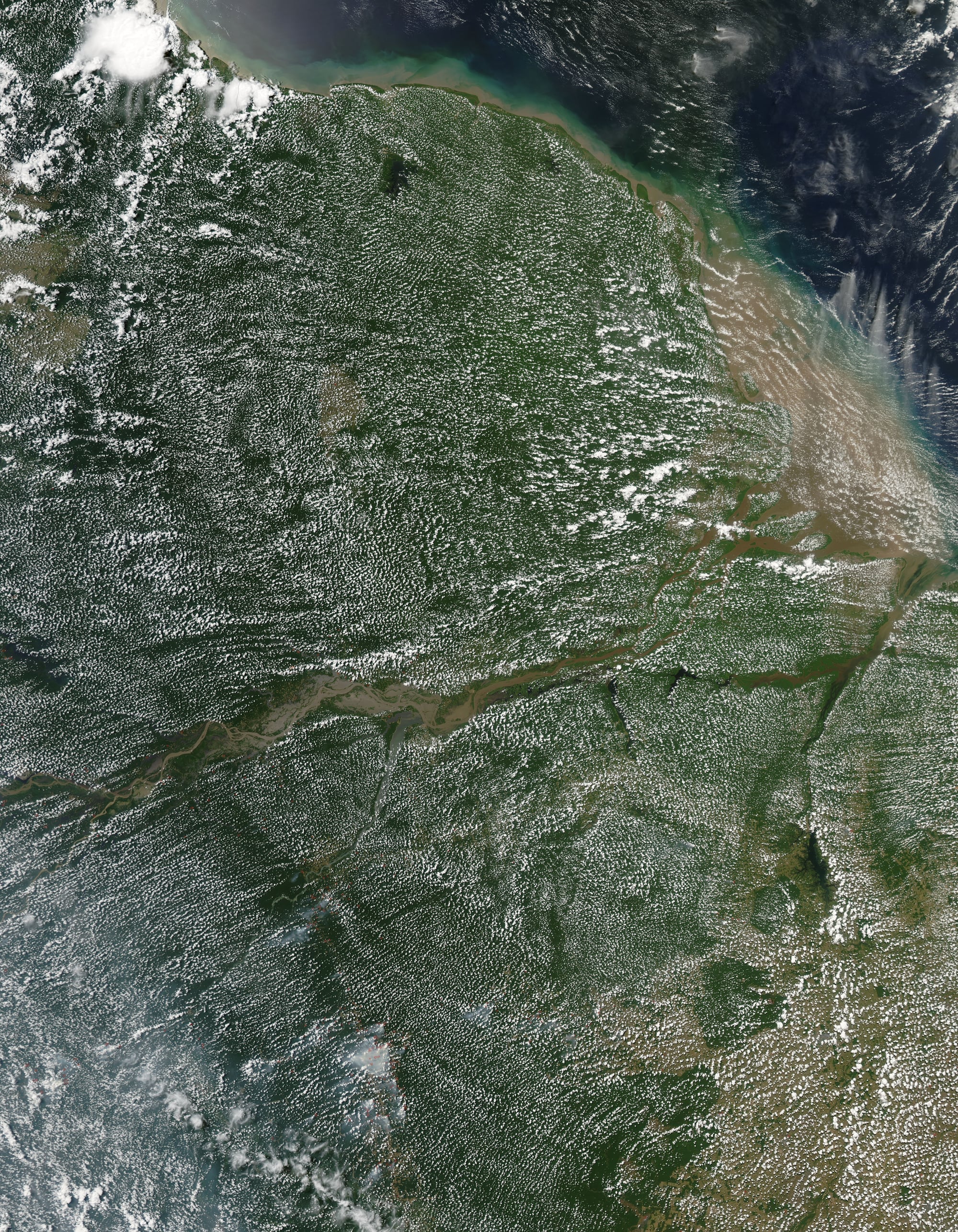
Credit: NASA image courtesy Jeff Schmaltz, MODIS Rapid Response at NASA GSFC. · Public domain
The Amazon Rainforest is a huge tropical forest in South America. It covers about 2.6 million square miles, spread across nine countries. Most of it sits in Brazil, but parts stretch into Peru, Colombia, Venezuela, Ecuador, Bolivia, Guyana, Suriname, and French Guiana. The forest is so big that it could hold the lower 48 United States inside it with room to spare.
The Amazon grows along the Amazon River and the many smaller rivers that feed into it. The region is hot and wet almost all year. Some parts get more than 120 inches of rain each year, which is ten feet of water falling from the sky. All that rain keeps the forest green and growing.
A rainforest has layers, almost like floors in a building. The top layer is called the emergent layer, where the tallest trees poke above the rest. Below that is the canopy, a thick green roof of leaves where most animals live. Under the canopy is the understory, which is darker and full of vines and smaller trees. The forest floor is the bottom layer, where very little sunlight reaches.
The Amazon holds more kinds of living things than any other place on Earth. Scientists have counted more than 40,000 plant species, around 1,300 bird species, 430 mammal species, and over 2.5 million insect species. A single tree can be home to more ant species than live in all of the United Kingdom. New species are still being found every year. Jaguars, sloths, howler monkeys, poison dart frogs, pink river dolphins, and giant otters all live here.
People have lived in the Amazon for at least 12,000 years. About 1.5 million Indigenous people from hundreds of different groups still call the forest home today. Some groups have chosen to live without contact with the outside world. For a long time, outsiders thought the rainforest had always been wild. New archaeology has changed that idea. Researchers have found signs of ancient roads, farms, and even cities hidden beneath the trees, built by people hundreds of years ago.
The Amazon is in trouble. People have cut down large sections for cattle ranches, soybean farms, logging, and mining. Scientists estimate that about 17 percent of the original forest is already gone. When too many trees are cut, the forest dries out and burns more easily. Researchers worry that if too much is lost, the Amazon could flip from a rainforest into a drier grassland. That would release huge amounts of stored carbon into the air and change weather patterns around the world.
Related
Last updated 2026-04-23