
Isaac Newton
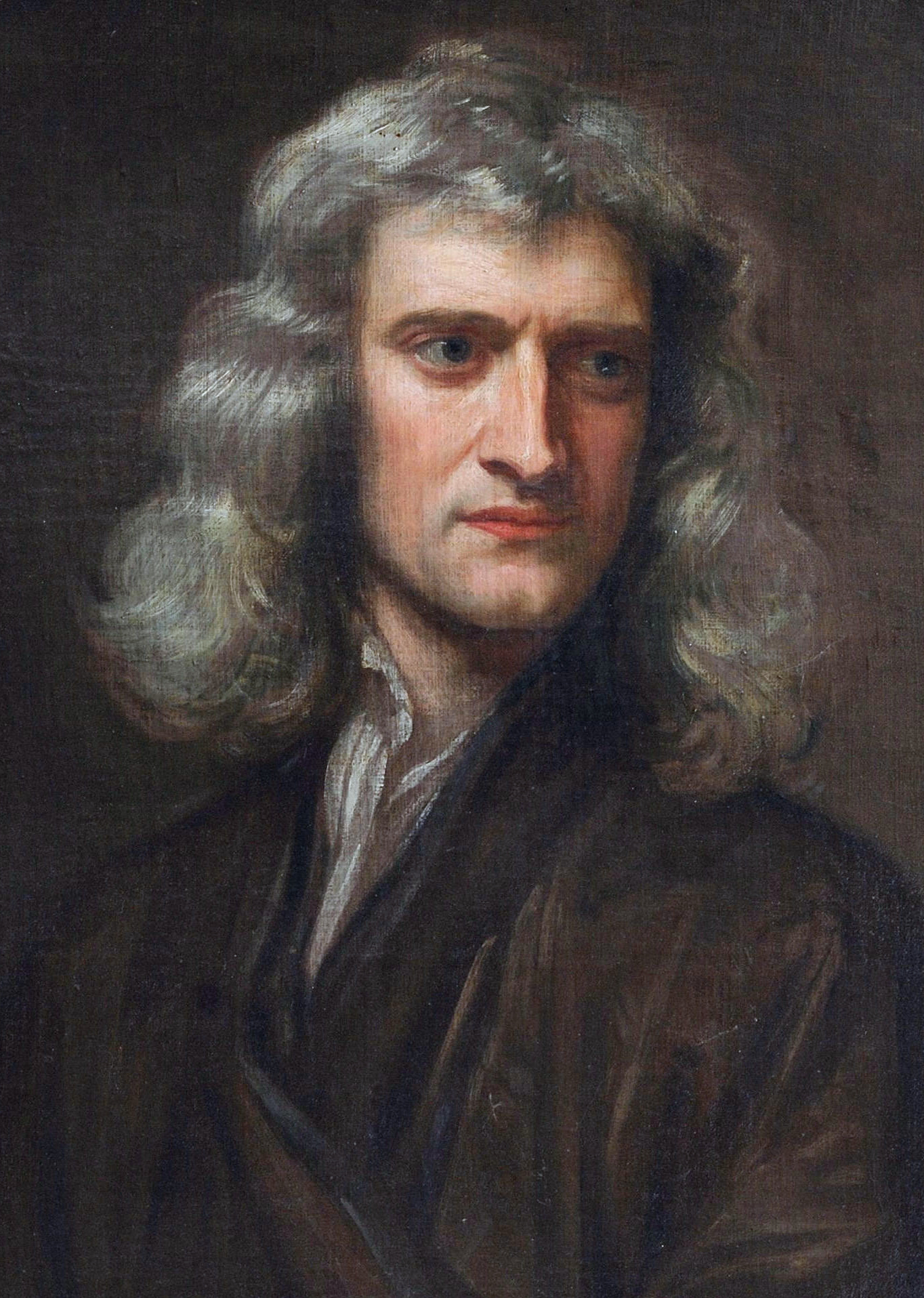
Credit: James Thronill after Sir Godfrey Kneller · Public domain
Isaac Newton was an English scientist and mathematician who lived from 1642 to 1727. He is one of the most important scientists in history. Newton figured out the rules that explain how objects move and how gravity pulls things together. His ideas shaped how people understood the universe for the next 200 years.
Newton was born on a farm in England on Christmas Day in 1642. He was so small at birth that his mother said he could fit inside a quart mug. His father had died before he was born. As a boy, Newton was not the top student. He liked building tiny windmills, water clocks, and kites more than studying. But once he got to Cambridge University, his mind took off.
In 1665, a deadly disease called the plague spread through England. Cambridge closed, and Newton went home to the family farm. He was 23 years old. Over the next two years, alone in the countryside, he did some of the greatest thinking in the history of science. He studied light. He invented new math. He worked out his first ideas about gravity. He later called this time his "year of wonders."
Newton's biggest idea was that the same force pulls an apple to the ground and keeps the Moon in its orbit. There is a famous story that he thought of this while watching an apple fall in his mother's garden. The story is probably true, though the apple did not actually hit his head. Newton called this force gravity, and he wrote a math equation that describes how it works between any two objects in the universe.
In 1687, Newton published a book in Latin called the Principia. In it, he laid out three laws of motion. The first law says an object stays still, or keeps moving in a straight line, unless a force pushes on it. The second law explains how force, mass, and acceleration are linked. The third law says every action has an equal and opposite reaction. These three laws still guide engineers today when they design cars, bridges, and rockets.
Newton was a strange and difficult man. He almost never married, kept few friends, and got into bitter fights with other scientists. He also spent years trying to turn metal into gold, which never worked. But his science changed the world. When Albert Einstein, more than 200 years later, came up with new ideas about gravity, he said he was only standing on Newton's shoulders.
Related
Last updated 2026-04-26