Galileo Galilei
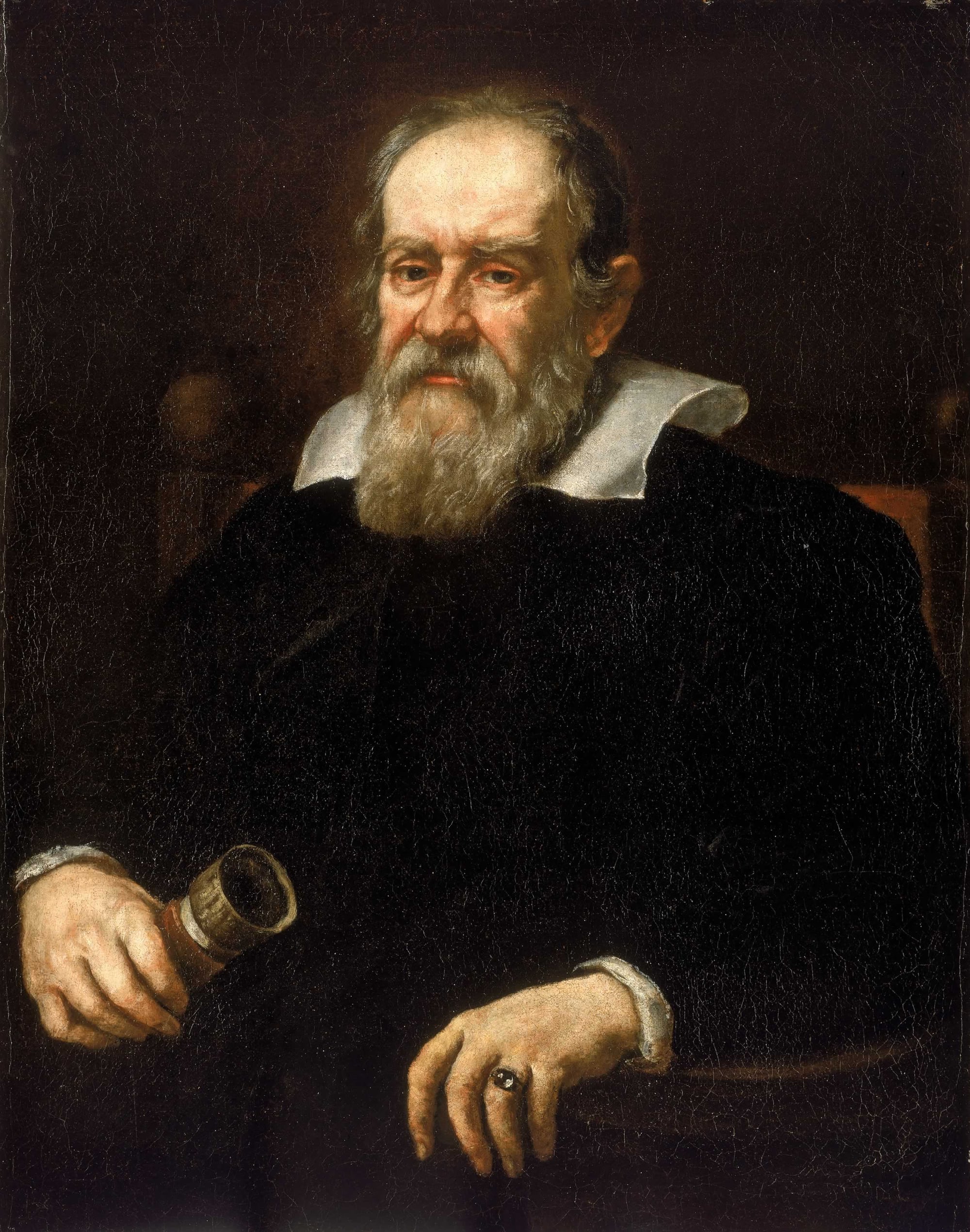
Credit: Justus Sustermans · Public domain
Galileo Galilei was an Italian scientist who lived from 1564 to 1642. He studied the stars, the planets, and how objects move. Many people call him the father of modern science. He was one of the first people to use a telescope to study the sky, and what he saw changed how humans understood the universe.
Galileo was born in the city of Pisa, in Italy. As a young man, he studied medicine, but he soon switched to math. He became a professor when he was just 25 years old. He loved to test ideas by doing experiments, not just by reading old books. That was a new way of doing science at the time.
One of his most famous experiments was about falling objects. People had believed for almost 2,000 years that heavy things fall faster than light things. According to a popular story, Galileo dropped two balls of different weights from the top of the Leaning Tower of Pisa. They hit the ground at the same time. Historians are not sure if this drop really happened, but Galileo did prove the idea using ramps and rolling balls.
In 1609, Galileo heard about a new invention from the Netherlands called the telescope. He built his own and made it much better. Then he pointed it at the night sky. He saw mountains and craters on the Moon. He saw four small dots circling the planet Jupiter, which were moons. He saw that Venus had phases like our Moon. He saw that the Milky Way was made of countless stars.
These discoveries supported a shocking idea. Most people at the time believed Earth sat still at the center of the universe. A Polish astronomer named Copernicus had argued that Earth and the other planets actually orbit the Sun. Galileo's observations gave strong proof that Copernicus was right.
The Catholic Church did not accept this new idea. In 1633, church leaders put Galileo on trial. They forced him to take back his support for the Sun-centered model. He spent the rest of his life under house arrest in his home near Florence. Even so, he kept writing books about science until he went blind.
Galileo died in 1642, the same year Isaac Newton was born. It took the Church 350 years to officially admit that Galileo had been right. His telescope, his experiments, and his courage helped start the way scientists work today: test the world, then trust what you see.
Related
Last updated 2026-04-26