
Plesiosaurus
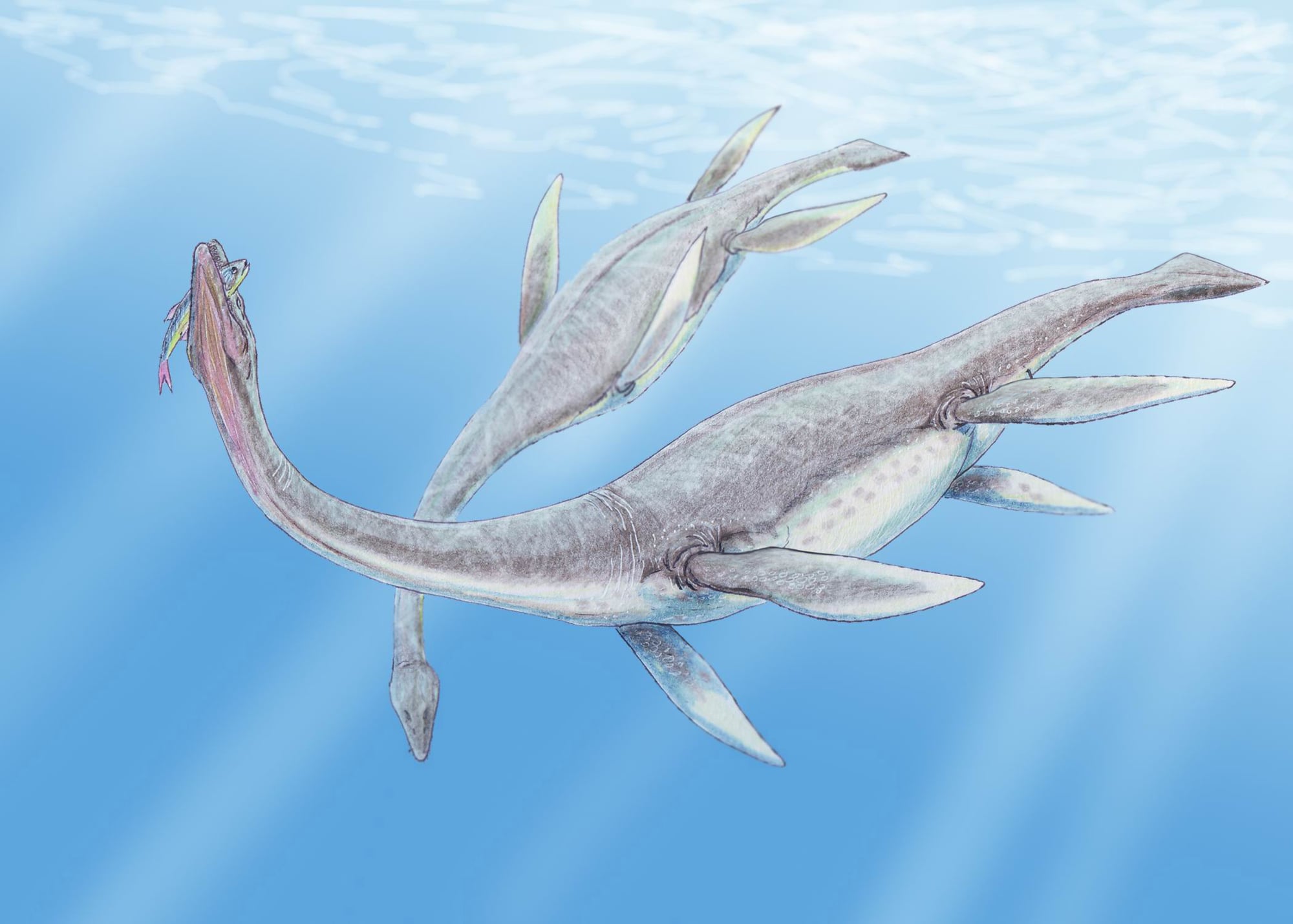
Credit: Creator:Dmitry Bogdanov · CC BY 3.0
Plesiosaurus was a large reptile that swam in the oceans about 200 million years ago, during the age of dinosaurs. It had a small head, a very long neck, a round body, and four wide flippers shaped like paddles. A full-grown Plesiosaurus was about 11 feet long, a little longer than a small car. It lived in shallow seas that once covered what is now Europe.
Even though Plesiosaurus lived at the same time as dinosaurs, scientists do not call it a dinosaur. True dinosaurs lived on land. Plesiosaurus belonged to a different group of ancient reptiles called plesiosaurs. These reptiles spent their whole lives in the water. They still had to come to the surface to breathe air, just like whales and sea turtles do today.
The long neck of Plesiosaurus held more than 30 bones. That is more neck bones than a giraffe, which has only seven. Scientists think Plesiosaurus used its long neck to sneak up on fish and squid. It could hold its body still and dart its small head forward fast. Its sharp, pointed teeth locked together perfectly to grip slippery prey.
Plesiosaurus swam in a strange way. Instead of pushing itself through the water with its tail, it flapped its four flippers up and down, almost like a penguin flying underwater. No living animal swims exactly this way today. Scientists have used computer models and robots to study how the four flippers worked together without getting in each other's way.
The first good Plesiosaurus fossil was found in England in 1823 by a young fossil hunter named Mary Anning. She was only 24 years old. Her discovery was so strange that many scientists at first refused to believe it was real. The neck looked too long, and the flippers looked wrong. But more fossils were soon found, and Anning became one of the most respected fossil hunters in the world.
Plesiosaurus and its cousins ruled the seas for more than 100 million years. Then, 66 million years ago, a huge asteroid hit the Earth. The same disaster that killed the dinosaurs also wiped out the plesiosaurs. None of them survived.
Some people think a creature like Plesiosaurus still lives in Scotland's Loch Ness. Scientists say this is not possible. Loch Ness formed only about 10,000 years ago, long after plesiosaurs were gone. Still, the old stories keep the shape of Plesiosaurus alive in our imagination.
Related
Last updated 2026-04-22