
Lemur
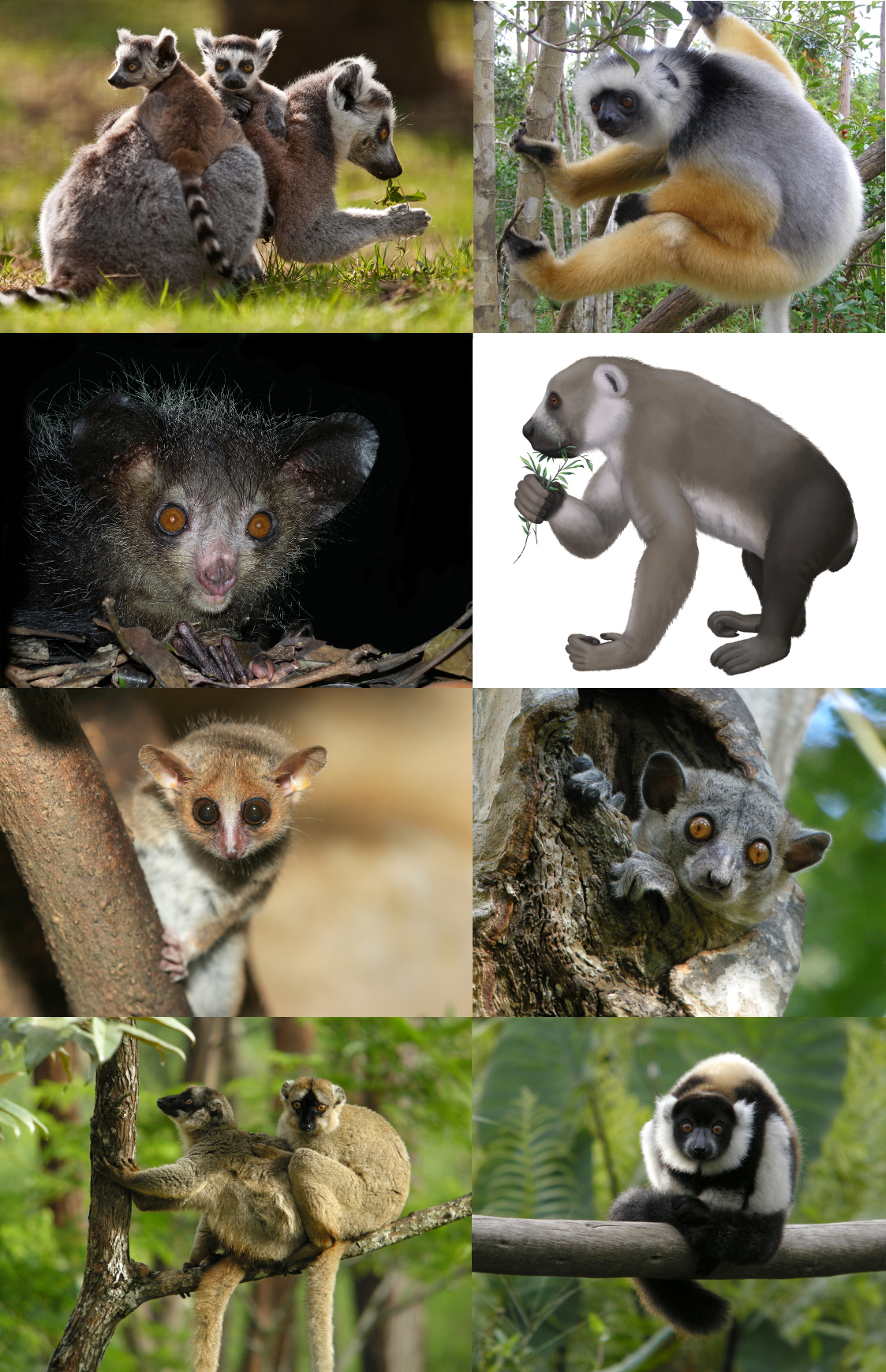
Credit: Katta család.jpg: Veszprémi Állatkert Aye-aye at night in the wild in Madagascar.jpg: Frank Vassen Red-tailed Sportive Lemur, Kirindy, Madagascar.jpg: Frank Vassen Diademed ready to push off.jpg: C. Michael Hogan Archaeoindris fontoynonti.jpg: Smokeybjb Microcebus murinus -Artis Zoo, Amsterdam, Netherlands-8a.jpg: Arjan Haverkamp Juvenile Black-and-White Ruffed Lemur, Mantadia, Madagascar.jpg: Frank Vassen Two Brown Lemur, Mantadia, Madagascar.jpg: Frank Vassen derivative work: Maky · CC BY-SA 3.0
The lemur is a small, furry primate that lives only on the island of Madagascar, off the coast of Africa. Primates are the group of mammals that also includes monkeys, apes, and humans. There are more than 100 kinds of lemurs. The smallest, the pygmy mouse lemur, is tiny enough to sit in your palm. The largest, the indri, is about the size of a toddler.
Most lemurs have big, round eyes, long tails, and soft fur. Their eyes are so big because most kinds are active at night. Those big eyes catch as much light as possible in the dark forest.
Lemurs are found nowhere else in the wild. Madagascar is the fourth-largest island in the world. It broke away from Africa about 160 million years ago, and it drifted into its own spot in the Indian Ocean. Long ago, the ancestors of lemurs floated there from Africa on mats of fallen trees and plants. Once they arrived, they were cut off from the rest of the world. They changed over millions of years into the many different lemurs alive today.
Lemurs eat fruit, leaves, flowers, bark, and sometimes insects. Most kinds live in family groups. Unlike almost all other primates, lemur groups are usually led by females. A female lemur gets first pick of food and the best resting spots.
Ring-tailed lemurs are probably the most famous kind. They have black and white striped tails that stand up tall when they walk. They live in troops of up to 30 animals. In the morning, they sit in the sun with their bellies facing up, arms stretched wide, soaking in heat.
Lemurs are in serious trouble. Scientists say they are the most endangered group of mammals on Earth. Almost all lemur species are at risk of dying out. People have cut down much of the forest where they live to make room for farms and to burn for charcoal. Hunters also kill lemurs for food. Of the roughly 100 known lemur species, more than 90 are listed as threatened.
People in Madagascar are working to save them. Biologists track wild lemurs, plant new trees, and help local villages earn money by protecting the forest instead of clearing it. Zoos around the world also breed lemurs in case wild ones need help to recover. The future of these big-eyed, sun-loving primates depends on choices people make in the next few years.
Last updated 2026-04-22