
Jellyfish
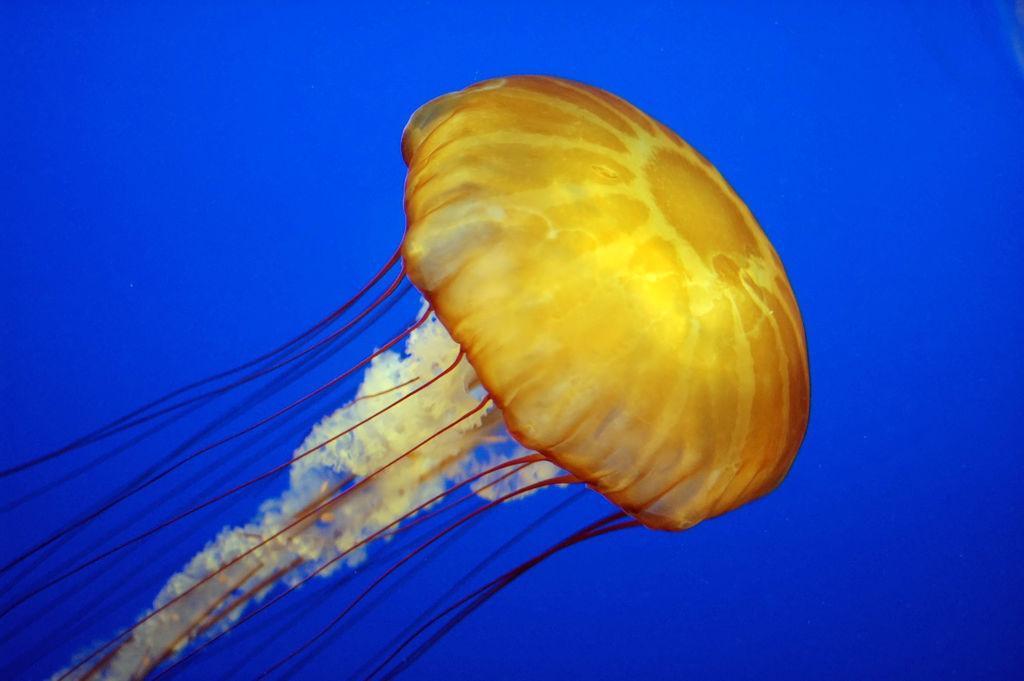
Credit: Dan90266 · CC BY-SA 2.0
A jellyfish is a soft, squishy sea animal with a bell-shaped body and long tentacles. Jellyfish live in every ocean in the world, from warm tropical seas to the freezing waters near the poles. Some live near the surface. Others drift in the deep sea, miles below the light. Jellyfish are not fish at all. They belong to a group of animals called cnidarians, which also includes coral and sea anemones.
Jellyfish have been around for a very long time. Fossils show that they were swimming in the oceans more than 500 million years ago. That is long before the first dinosaurs, and even before the first fish with bones. Jellyfish are some of the oldest animals still alive on Earth today.
A jellyfish has no brain, no heart, and no bones. It does not have blood or lungs either. Its body is about 95 percent water. The top part, shaped like an umbrella, is called the bell. To swim, the jellyfish squeezes its bell and pushes water out behind it. Long tentacles trail below. These tentacles are covered in tiny stinging cells. When a small fish bumps into them, the cells shoot out like little harpoons and inject venom. The jellyfish then pulls its meal up to its mouth, which sits on the underside of the bell.
Most jellyfish stings feel like a bad bee sting to a human. A few kinds are much more dangerous. The box jellyfish, found near Australia and Southeast Asia, has venom strong enough to kill a person in minutes. It is often called the most venomous animal in the sea.
Jellyfish come in wild sizes. The tiny Irukandji is about the size of your fingernail. The lion's mane jellyfish is a giant. Its bell can grow over seven feet wide, and its tentacles can stretch more than 100 feet behind it, longer than a blue whale.
One kind of jellyfish may be the strangest animal on Earth. It is called Turritopsis dohrnii, and scientists nicknamed it the "immortal jellyfish." When it gets old or hurt, it can turn its cells back into a young form and start its life over. In theory, it could do this forever. Scientists are still studying how the trick works and what it might teach us about aging.
Jellyfish populations are growing in many parts of the ocean. Warmer water and fewer predators seem to help them. Huge groups, called blooms, sometimes clog fishing nets and even shut down power plants by getting sucked into cooling pipes. For an animal with no brain, the jellyfish is surprisingly hard to ignore.
Related
Last updated 2026-04-22