
Gecko
Credit: Unknown · CC BY-SA 3.0
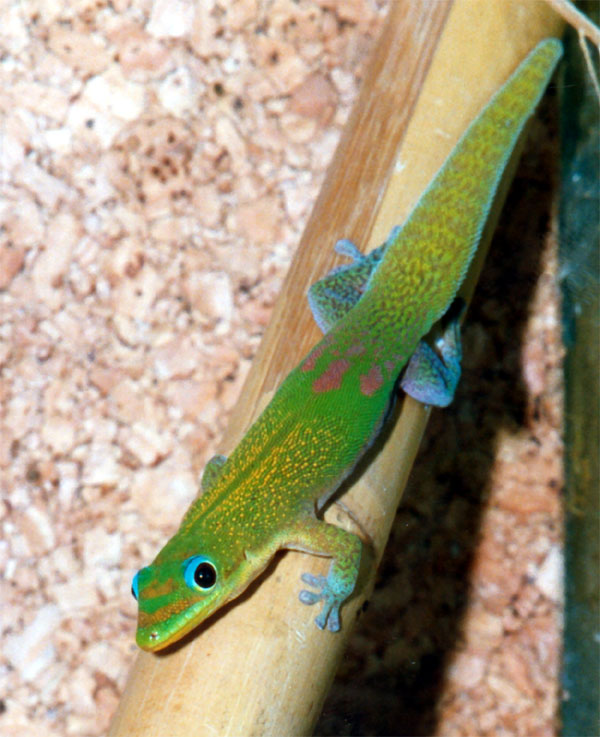
The gecko is a small lizard found in warm parts of almost every continent except Antarctica. There are more than 1,500 different kinds of geckos. Most live in tropical forests, deserts, or grasslands, though some have moved into houses and hunt bugs on people's walls at night. Geckos range in size from tiny ones less than an inch long to the tokay gecko, which can grow over a foot.
Geckos are most famous for their feet. A gecko can run straight up a window or hang upside down from a ceiling without falling. For a long time, scientists could not figure out how. Then they took a close look under a microscope. Each gecko toe is covered in millions of tiny hairs called setae. These hairs are so small and so many that they use a weak pulling force between molecules to grip almost any surface. The gecko is not sticky, not slimy, and not using suction. It is using physics.
Most geckos hunt at night. Their eyes are huge for their heads, and they see colors in the dark about 350 times better than humans can. Because their eyes are so large, geckos cannot blink. Instead, a gecko licks its own eyeball to keep it clean and wet. Watching a gecko wipe its eye with its tongue is one of the stranger sights in the animal world.
Geckos eat mostly insects. Crickets, moths, and spiders are all on the menu. A few larger kinds also eat fruit, flowers, and even small lizards. If a predator grabs a gecko by the tail, the tail snaps off and keeps wiggling on the ground. The predator is distracted, and the gecko runs away. A new tail grows back over the next few weeks, though it is usually shorter and a different shape.
Geckos are also unusual among lizards because most of them can make sounds. They chirp, click, squeak, and bark at each other. The tokay gecko got its name from the loud "to-kay!" call that males shout at night. This ability to talk out loud is rare in the reptile world, where most animals are silent.
Scientists have studied gecko feet to invent new kinds of tape and climbing gloves. Engineers have even tested gecko-inspired grips for robots that could one day climb the outside of spacecraft. A small lizard that licks its eyeballs has turned out to be one of nature's best teachers.
Last updated 2026-04-22