
Snake
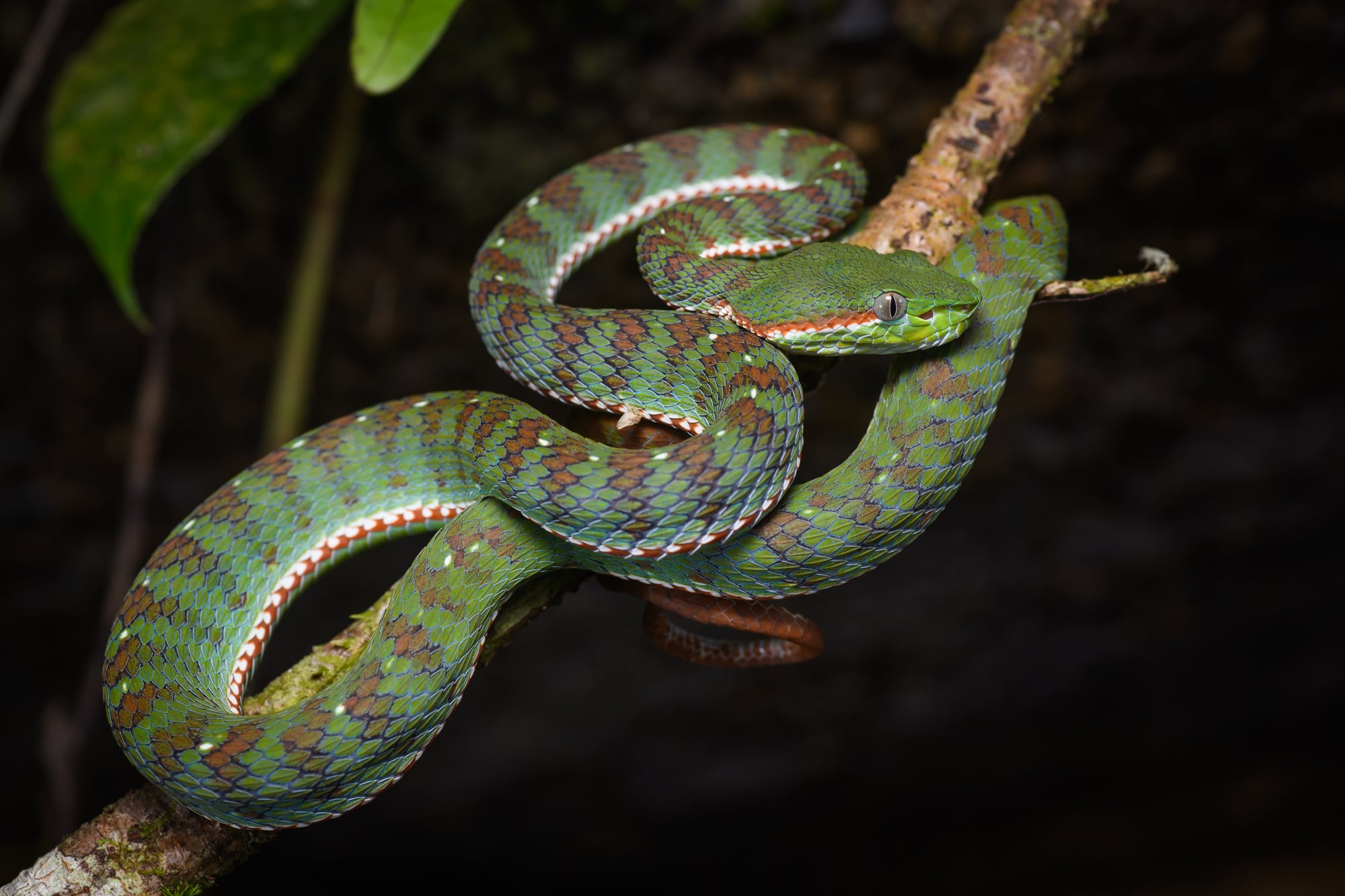
Credit: Rushenb · CC BY-SA 2.0
The snake is a long, legless reptile found on every continent except Antarctica. There are about 4,000 different kinds of snakes. They live in forests, deserts, grasslands, rivers, and oceans. The smallest snake, the Barbados threadsnake, is about as long as a pencil. The largest, the reticulated python, can grow over 20 feet long, longer than a school bus is wide.
Snakes are covered in dry, overlapping scales. Their skin does not grow with them, so they shed it a few times a year. A snake crawls out of its old skin in one piece, often leaving behind a perfect see-through copy of itself.
Snakes do not have legs, but they move well without them. Most snakes slither by pushing their muscles in waves against the ground. Sidewinders throw their bodies sideways across hot sand. Sea snakes swim by pressing their flat tails against the water. A few kinds of tree snakes can even glide through the air by flattening their bodies.
All snakes are meat eaters. They swallow their food whole. A snake's jaw is not locked shut at the front like ours. The two sides can stretch far apart, which lets a snake eat animals much wider than its own head. After a big meal, a python may not need to eat again for weeks or even months.
About one in five snakes is venomous. Venomous snakes have sharp fangs that inject poison into their prey. Cobras, rattlesnakes, and vipers are famous examples. Most snakes, though, are not dangerous to people. Boas and pythons kill by squeezing their prey until it stops breathing. Many small snakes just grab worms, frogs, or mice with their teeth.
Snakes are cold-blooded. Their body temperature matches the air around them. In cold weather, they slow down and hide. In deserts, they often come out only at night. Snakes have no eyelids, so their eyes are always open, even when they sleep.
Humans have told stories about snakes for thousands of years. In ancient Egypt, the cobra was a symbol of royalty and appeared on the pharaoh's crown. In Greek myths, the healer Asclepius carried a staff with a snake coiled around it, and doctors still use that symbol today. The snake is also a sign of evil in some religious stories, like the serpent in the Garden of Eden. Many people are afraid of snakes. Scientists think this fear may be built into human brains from long ago, when snakes were a real danger to our ancestors.
Today, snakes face threats from habitat loss and from people who kill them out of fear. But snakes help keep rodent populations under control, which protects crops and homes.
Last updated 2026-04-22