
Flamingo
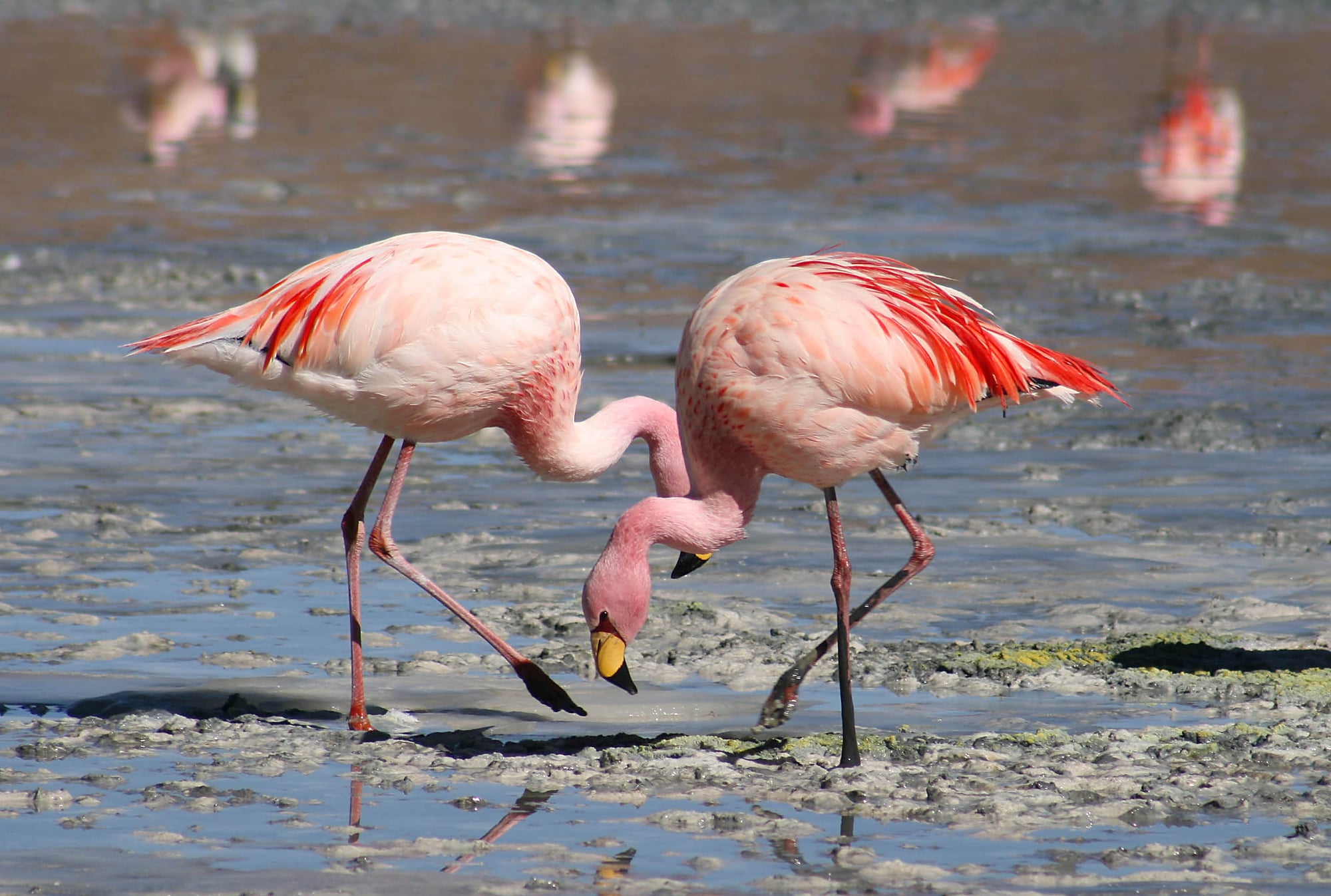
Credit: Valdiney Pimenta · CC BY 2.0
The flamingo is a tall wading bird known for its bright pink feathers, long legs, and curved beak. There are six different species of flamingo. They live in warm parts of the world, including Africa, southern Europe, southern Asia, the Caribbean, and Central and South America. Flamingos almost always live near shallow lakes, lagoons, or mudflats where they can wade in the water and find food.
A grown flamingo stands between three and five feet tall. The greater flamingo is the biggest species. It can be as tall as some fifth graders. Flamingos weigh only about five to eight pounds, because their bones are hollow, like the bones of most other birds. Their long legs let them walk through deep water without getting their feathers wet.
Flamingos are not born pink. Chicks hatch with gray or white feathers. The pink color comes from their food. Flamingos eat tiny shrimp, algae, and other small water creatures that contain a natural color called beta-carotene. The same chemical is what makes carrots orange. As a flamingo eats these foods for months, its feathers slowly turn pink. A flamingo kept on a poor diet in a zoo would fade back to white.
A flamingo eats with its head upside down. It lowers its curved beak into the water so the top points at the mud. Tiny comblike parts inside the beak, called lamellae, work like a strainer. The flamingo sucks in water, then pushes the water back out. The food stays trapped inside.
Flamingos are famous for standing on one leg. Scientists have studied this pose for years and still argue about exactly why they do it. The best explanation is that standing on one leg saves body heat. The leg tucked into the belly feathers stays warm while the other does the work. Strangely, flamingos can balance this way even while they are asleep.
Flamingos live in large groups called flocks or colonies. Some colonies in East Africa have more than a million birds. Living in such a huge group helps protect each flamingo from predators like eagles, wild cats, and hyenas. Flamingos are noisy, too, honking and grunting almost constantly.
Most kinds of flamingo are not in danger right now, but some are. The Andean flamingo, which lives high in the mountains of South America, is listed as vulnerable. Lakes where flamingos feed are shrinking in many places as humans use more water and the climate warms.
Last updated 2026-04-22